Traditional SEO vs AI SEO represents the biggest shift in how businesses approach online visibility, search rankings, and digital growth. While traditional SEO focuses on improving website rankings through proven optimization methods, AI SEO introduces new strategies designed for artificial intelligence, generative search, and evolving user behavior.
Search engines are becoming smarter every year. Google and AI-powered platforms now understand context, user intent, entities, and relationships between information. Therefore, businesses need to understand the difference between traditional SEO and AI SEO to create future-ready search strategies.
In today’s competitive digital environment, businesses can no longer depend only on traditional ranking techniques. They need to create meaningful content, strengthen brand authority, improve user experience, and optimize information in a way that both search engines and AI systems can understand. AI-driven search is changing how users discover brands, products, and services, making it essential for businesses to adapt their SEO strategies according to new search behaviors.
This guide by Taslima Akter explains how traditional SEO and AI SEO work, their key differences, benefits, limitations, and how businesses can combine both approaches to achieve sustainable digital growth. It also explores how future-ready SEO strategies can help businesses improve visibility across Google search, AI-powered platforms, and emerging digital ecosystems.
Introduction to Traditional SEO vs AI SEO: Understanding the Evolution of Search
The digital search landscape has changed significantly over the years. Earlier, businesses mainly focused on keyword rankings, backlinks, and technical optimization to improve their position in search results. However, modern search engines now use artificial intelligence to understand meaning, context, and user needs.
The comparison between Traditional SEO vs AI SEO helps businesses understand how search optimization is moving from keyword-focused strategies toward intelligent, user-centered approaches.
How Search Optimization Has Changed From Traditional Search to AI-Powered Search
Traditional search optimization was mainly focused on helping websites rank for specific keywords. Businesses optimized pages, created backlinks, and improved technical elements to increase visibility on search engine result pages.
However, AI-powered search focuses more on understanding complete questions, user intent, relationships between topics, and providing direct answers. As a result, businesses now need content strategies that go beyond traditional ranking methods.
- Traditional SEO focuses on ranking web pages
- AI SEO focuses on improving information understanding
- Traditional SEO targets search results
- AI SEO targets visibility across intelligent search experiences
Why Businesses Need to Understand Traditional SEO vs AI SEO
Understanding both SEO approaches helps businesses prepare for the future of digital marketing. Companies that adapt early can improve their visibility across Google search, AI platforms, and emerging search technologies.
- Improve search visibility
- Build stronger digital authority
- Create future-ready content strategies
- Reach customers through changing search platforms
The Role of SEO in Modern Digital Growth
SEO remains one of the most powerful digital growth strategies because it helps businesses connect with users who are actively searching for information, products, and services.
- Increasing organic website visibility
- Attracting targeted audiences
- Building long-term brand credibility
- Supporting sustainable business growth
What Is Traditional SEO? A Complete Overview of Classic Search Optimization
Traditional SEO refers to the established process of optimizing websites to improve rankings on search engines like Google. It focuses on technical improvements, keyword optimization, content quality, and authority-building methods.
For many years, traditional SEO has helped businesses increase organic traffic by making websites easier for search engines to crawl, understand, and rank.
Understanding the Fundamentals of Traditional SEO
Traditional SEO works by improving different website elements that influence search performance. These improvements help search engines identify the relevance and quality of web pages.
- Keyword research and optimization
- Content creation and improvement
- Technical website optimization
- Internal linking strategies
- Backlink development
How Traditional SEO Helps Websites Rank Higher on Google
Traditional SEO improves ranking opportunities by making websites more accessible, relevant, and trustworthy. Search engines evaluate different signals to determine which pages provide the best answers for users.
- Better keyword targeting
- Improved website structure
- High-quality content development
- Authority through trusted links
- Enhanced user experience
Key Components of Traditional SEO Strategies
On-Page SEO Optimization
On-page SEO improves individual website pages by optimizing content, structure, and important HTML elements.
- Title tag optimization
- Meta description improvement
- Heading optimization
- Keyword placement
- Internal linking
Technical SEO Improvements
Technical SEO focuses on improving website performance, accessibility, and search engine crawling ability.
- Website speed optimization
- Mobile responsiveness
- Schema implementation
- Indexing improvements
- Website security
Off-Page SEO and Authority Building
Off-page SEO focuses on improving website reputation through external signals such as quality backlinks, brand mentions, and digital authority.
What Is AI SEO? Exploring the Future of Search Optimization
AI SEO is the modern approach to search optimization that focuses on helping artificial intelligence systems understand, interpret, and recommend information. It combines traditional SEO principles with advanced methods such as semantic optimization, entity understanding, and generative search optimization.
As AI-powered search experiences continue growing, businesses need strategies that help their content appear not only in traditional search results but also in AI-generated answers.
Understanding AI-Powered SEO and Search Intelligence
AI SEO focuses on creating content that provides clear, accurate, and meaningful information. Instead of only matching keywords, AI systems analyze context, relationships, and expertise.
- Semantic content optimization
- Entity-based SEO
- User intent understanding
- AI search visibility improvement
How AI SEO Changes the Way Businesses Optimize Content
AI SEO encourages businesses to create deeper, more helpful, and expert-driven content. The focus moves from simply ranking for keywords toward becoming a trusted source of information.
- Answer-focused content creation
- Topic authority development
- Clear information structure
- Expert-led optimization
Traditional SEO vs AI SEO: Key Differences Explained
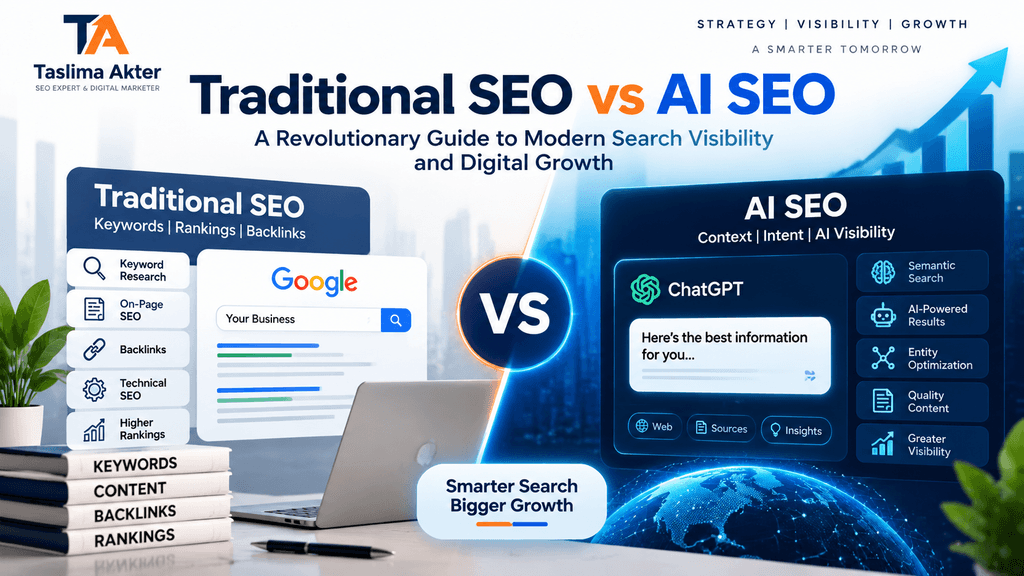
The comparison between Traditional SEO vs AI SEO shows how search optimization is evolving from keyword-focused ranking methods toward intelligent, context-based visibility strategies. Both approaches aim to improve online discovery, but they use different methods to achieve search growth.
Traditional SEO mainly focuses on optimizing websites for search engine ranking factors, while AI SEO focuses on helping artificial intelligence systems understand content, expertise, and relevance.
| Traditional SEO | AI SEO |
|---|---|
| Focuses on keyword rankings | Focuses on meaning and context |
| Optimizes webpages for search engines | Optimizes information for AI understanding |
| Targets Google search results | Targets AI-generated search experiences |
| Uses traditional ranking signals | Uses semantic and entity-based signals |
| Measures rankings and traffic | Measures visibility, mentions, and AI presence |
Difference Between Keyword-Based SEO and Context-Based AI SEO
Traditional SEO historically focused on finding keywords and optimizing pages around those search terms. While keywords are still important, AI SEO expands beyond exact phrases by understanding topics, relationships, and user intent.
- Traditional SEO answers: “Which keywords should this page rank for?”
- AI SEO answers: “How can this content provide the best understanding and solution?”
Traditional Search Results vs AI-Generated Search Answers
Traditional search displays a list of webpages where users select the most relevant result. AI-powered search provides summarized answers by analyzing information from multiple sources.
- Search result rankings
- AI-generated summaries
- Conversational responses
- Personalized information discovery
Ranking on Google vs Appearing in AI Search Responses
Ranking on Google remains important, but businesses now need to consider how their information appears in AI-powered platforms. Strong expertise, clear content structure, and brand authority help improve AI visibility.
Traditional SEO vs AI SEO: Benefits and Limitations
Both traditional SEO and AI SEO provide unique advantages. Understanding their strengths and limitations helps businesses create balanced strategies that support long-term digital growth.
Advantages of Traditional SEO Strategies
- Proven methods for improving search rankings
- Long-term organic traffic opportunities
- Strong website authority development
- Clear performance measurement
- Better understanding of search behavior
Limitations of Traditional SEO Approaches
- May focus too heavily on keywords
- Requires continuous algorithm adaptation
- Competition for rankings can be high
- Traditional metrics may not show complete AI visibility
Benefits of AI SEO Strategies
AI SEO helps businesses prepare for modern search experiences by focusing on information quality, expertise, and contextual understanding.
- Improved AI search visibility
- Better semantic understanding
- Stronger entity recognition
- Future-ready content strategies
- Enhanced user-focused optimization
Limitations and Challenges of AI SEO
- AI search technology continues evolving
- Measurement methods are still developing
- Requires strong content quality
- Human expertise remains necessary
Why Combining Traditional SEO and AI SEO Creates Better Results
The strongest digital strategies combine both approaches. Traditional SEO creates a strong technical and ranking foundation, while AI SEO improves visibility across emerging search experiences.
- Stronger search presence
- Better content understanding
- Improved brand authority
- Sustainable digital growth
Combining Traditional SEO and AI SEO Successfully
Businesses do not need to choose between traditional SEO and AI SEO. Instead, combining both approaches creates a complete optimization strategy that supports current search rankings and future AI visibility.
Building a Hybrid SEO Strategy for Modern Search
A hybrid SEO strategy combines technical optimization, quality content, authority building, semantic SEO, and AI-focused improvements.
- Technical SEO foundation
- Helpful content creation
- Entity optimization
- User intent analysis
- AI search preparation
Creating Content That Works for Google and AI Search
Modern content should satisfy both human readers and intelligent search systems. Businesses should create content that explains topics clearly, demonstrates expertise, and provides valuable solutions.
- Answer real customer questions
- Provide detailed explanations
- Use clear content organization
- Show practical experience
Future-Proof SEO Practices for Businesses
- Continuously update content
- Monitor search changes
- Improve user experience
- Build brand authority
- Use AI tools responsibly
AI SEO and GEO: The Future of Digital Search Visibility
Artificial intelligence is changing how people discover information online. AI SEO and GEO (Generative Engine Optimization) help businesses prepare their content for AI-powered search platforms.
How Generative Engine Optimization Impacts Search Growth
GEO focuses on improving the chances of a brand being recognized and referenced by generative AI systems. It requires accurate information, strong expertise signals, and well-structured content.
- Clear expert information
- Strong brand signals
- Structured content format
- Reliable data presentation
Why Businesses Should Prepare for AI Search Evolution
As users increasingly interact with AI-powered search tools, businesses that optimize early can build stronger visibility and competitive advantages.
Building Authority for Google, ChatGPT, and AI Platforms
Modern search visibility depends on more than traditional rankings. Businesses now need to build strong authority signals that help Google, ChatGPT, and other AI platforms understand their expertise, reliability, and relevance.
In the era of AI-powered search, businesses that clearly communicate their knowledge, experience, and value have stronger opportunities to appear in search results and AI-generated responses.
Creating Strong Entity Signals for Better Search Understanding
Entity optimization helps search engines understand relationships between businesses, people, services, and topics. A strong entity presence improves recognition and credibility across digital platforms.
- Consistent business information
- Clear brand identity
- Relevant topic associations
- Strong author and expertise signals
- Trusted online references
Strengthening E-E-A-T Signals for AI Search Visibility
E-E-A-T (Experience, Expertise, Authoritativeness, and Trustworthiness) plays an important role in creating reliable digital content. AI systems prefer information that demonstrates expertise and provides genuine value to users.
- Show real experience and practical knowledge
- Create expert-led content
- Provide accurate information
- Build trust through transparency
Optimizing Content for ChatGPT and Generative Search Platforms
AI platforms analyze content differently from traditional search engines. They focus on understanding meaning, context, and usefulness. Therefore, businesses should create content that clearly answers questions and explains topics in depth.
- Use clear question-based headings
- Provide direct answers
- Include expert insights
- Organize information logically
Building Digital Trust Through Brand Mentions and Citations
Brand mentions, trusted references, and online discussions help strengthen digital authority. These signals show search systems that a brand is recognized within its industry.
Technical and Content Strategies for AI-Ready SEO Success
AI-ready SEO requires a combination of strong technical foundations and high-quality content strategies. Businesses must ensure their websites are easy for both users and intelligent systems to understand.
A balanced approach combines traditional technical SEO practices with AI-focused optimization methods to improve visibility across multiple search environments.
Improving Website Structure for AI Understanding
A well-organized website helps search engines and AI systems understand relationships between pages, topics, and information. Clear structure improves content discovery and interpretation.
- Create logical website navigation
- Develop clear content hierarchy
- Use descriptive URLs
- Implement structured data
- Improve internal linking
Creating Expert-Level Content for AI Search
AI systems prioritize content that provides accurate, useful, and complete answers. Therefore, businesses should focus on creating resources that demonstrate expertise and solve real user problems.
- Detailed educational content
- Real-world examples
- Expert explanations
- Original insights
- User-focused solutions
Using Semantic SEO to Improve AI Search Understanding
Semantic SEO focuses on topics, relationships, and meaning rather than only individual keywords. This approach helps AI systems understand the complete context of website content.
- Related topic coverage
- Entity optimization
- Natural language usage
- Comprehensive information structure
Optimizing Content Format for Google AI Overviews
Content structure influences how easily search systems can understand and summarize information. Clear formatting improves readability and helps AI identify important answers.
- Use clear headings
- Answer questions directly
- Add helpful lists and tables
- Provide accurate explanations
- Maintain content freshness
Measuring AI SEO Performance and Growth
Measuring AI SEO performance requires looking beyond traditional rankings. Businesses should evaluate visibility, engagement, authority signals, and overall digital presence.
- Organic traffic improvement
- Search visibility growth
- Brand mentions
- User engagement
- Content performance
By combining technical SEO, semantic optimization, and AI-focused strategies, businesses can prepare their websites for the future of search and create stronger digital growth opportunities.
Common SEO Mistakes Businesses Should Avoid in the AI Search Era
As search technology continues evolving, businesses need to update their SEO strategies. Many websites struggle to achieve sustainable growth because they follow outdated practices or ignore important optimization areas.
Understanding common mistakes in Traditional SEO vs AI SEO helps businesses create stronger strategies that improve visibility, authority, and long-term digital performance.
1. Focusing Only on Keywords Without Understanding User Intent
Keywords are still important, but modern SEO requires a deeper understanding of what users actually need. Businesses should focus on creating content that answers questions and solves problems instead of only adding keywords.
2. Creating Low-Quality or Generic Content
Search engines and AI platforms prioritize helpful, accurate, and experience-based information. Generic content without unique insights may struggle to build authority and visibility.
3. Ignoring Technical SEO Foundations
Even excellent content requires a technically healthy website. Slow loading speed, poor structure, and indexing problems can reduce search performance.
- Ignoring website speed
- Not optimizing mobile experience
- Poor internal linking structure
- Crawling and indexing issues
4. Depending Completely on AI-Generated Content
AI tools can support content creation, but businesses should not depend only on automated content. Human expertise, real experience, and originality remain essential for building trust.
5. Ignoring Entity SEO and Brand Authority
Modern search systems understand brands, people, and topics through connected information. Businesses should build strong entity signals through consistent and trustworthy online presence.
6. Measuring Only Rankings Instead of Complete Growth
Rankings are useful, but businesses should also analyze traffic quality, engagement, conversions, and brand visibility to understand complete SEO performance.
7. Not Updating SEO Strategies With Search Evolution
Search behavior continues changing. Businesses that combine traditional SEO foundations with AI-focused strategies can better prepare for future opportunities.
Why Taslima Akter Focuses on Future-Ready SEO Strategies
The future of SEO requires a balance between proven optimization methods and emerging AI technologies. Taslima Akter focuses on creating strategies that help businesses improve current search performance while preparing for future digital changes.
By combining traditional SEO expertise with AI SEO principles, businesses can build stronger visibility across Google search, AI platforms, and evolving digital channels.
Combining Traditional SEO Knowledge With AI Search Optimization
A successful SEO strategy requires both technical understanding and adaptation to new search technologies. Taslima Akter focuses on creating balanced strategies that include:
- Technical SEO improvements
- Content optimization
- Semantic SEO strategies
- Entity-based optimization
- AI search preparation
Helping Businesses Improve Search Visibility Across Multiple Platforms
Modern businesses need visibility beyond traditional search results. Future-ready SEO strategies focus on improving presence across Google, AI-powered platforms, and digital ecosystems.
Creating Sustainable Digital Growth Through Smart SEO
Long-term success comes from continuous optimization, valuable content, strong authority, and adapting to changing search behaviors.
Frequently Asked Questions About Traditional SEO vs AI SEO
1. What Is the Difference Between Traditional SEO and AI SEO?
Traditional SEO focuses on improving website rankings through keywords, technical optimization, and backlinks. AI SEO focuses on helping artificial intelligence systems understand content, context, and expertise.
2. Is Traditional SEO Still Important in the AI Era?
Yes. Traditional SEO remains an important foundation because technical optimization, quality content, and authority signals continue supporting search visibility.
3. How Does AI SEO Improve Search Visibility?
AI SEO improves visibility by focusing on semantic understanding, entity optimization, helpful content, and strategies designed for AI-powered search experiences.
4. Can Businesses Use Traditional SEO and AI SEO Together?
Yes. Combining both approaches creates a complete SEO strategy that supports current rankings and future AI search opportunities.
5. What Is GEO in AI SEO?
GEO (Generative Engine Optimization) focuses on improving content visibility in AI-generated answers by creating authoritative and well-structured information.
6. Does AI SEO Replace Traditional SEO?
No. AI SEO expands traditional SEO by adding new optimization methods for artificial intelligence and generative search platforms.
7. How Can Businesses Optimize Content for AI Search?
Businesses can optimize content by creating expert-driven information, answering user questions clearly, improving structure, and building authority.
8. Which SEO Strategy Is Better for Future Growth?
A combination of traditional SEO and AI SEO provides the strongest approach because it supports both current search engines and future technologies.
9. How Does AI Search Change SEO Strategies?
AI search shifts SEO from simple keyword targeting toward deeper content understanding, authority building, and user-focused optimization.
10. Why Should Businesses Invest in AI-Ready SEO?
AI-ready SEO helps businesses prepare for changing search behavior, improve digital visibility, and create stronger long-term growth opportunities.
Conclusion: Embracing the Future of Search With Traditional SEO and AI SEO
The comparison of Traditional SEO vs AI SEO shows that search optimization is entering a new era. While traditional SEO continues providing a strong foundation, AI SEO introduces new opportunities for businesses to improve visibility across modern search platforms.
The most successful businesses will combine proven SEO practices with AI-focused strategies to create valuable content, build authority, and achieve sustainable digital growth.
The Future Belongs to Businesses That Adapt Their SEO Strategies
Search technology will continue evolving. Businesses that continuously improve their SEO strategies will have stronger opportunities to maintain online visibility and competitiveness.
Build Stronger Search Visibility With Modern SEO Approaches
By combining traditional optimization methods with AI-powered strategies, businesses can create a complete digital growth system.
Final CTA: Upgrade Your SEO Strategy for the AI-Powered Future
Ready to improve your search visibility and prepare your business for the future of SEO? Work with Taslima Akter to create a modern SEO strategy combining traditional optimization and AI-powered search solutions.