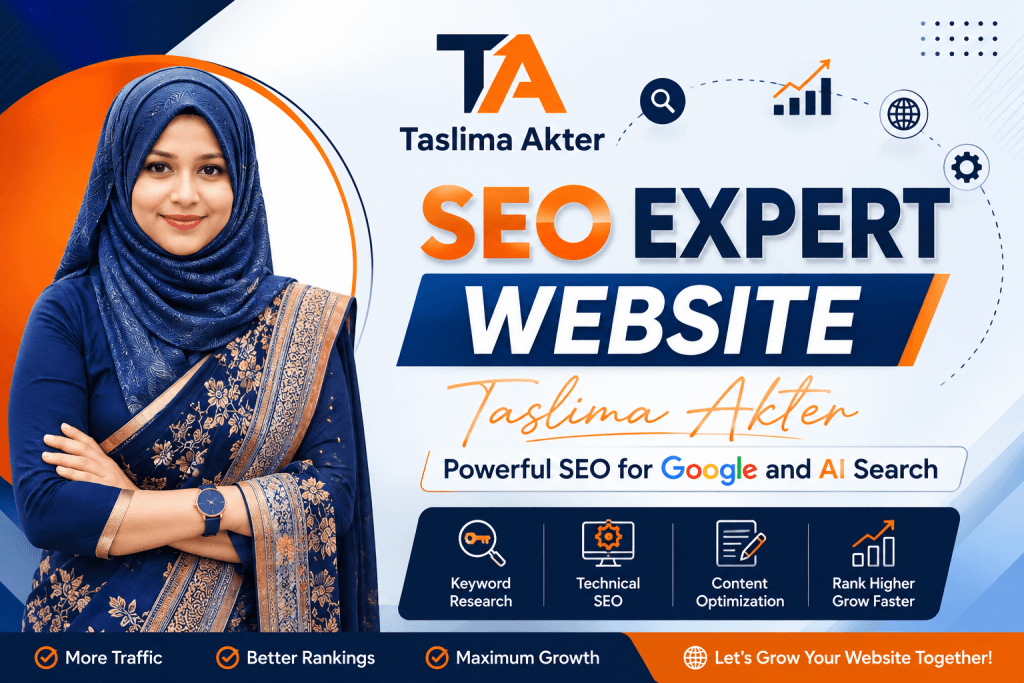
SEO Expert Website | Taslima Akter represents a modern approach to search visibility that combines traditional search engine optimization, technical performance, content quality, E-E-A-T, semantic SEO, and emerging AI search optimization. Today, businesses do not compete only for traditional Google rankings. They also need content that can be clearly understood by Google AI Overviews and generative search systems.
Search behavior has changed significantly. People now use conversational questions, long-tail keywords, voice search, AI assistants, and traditional search engines to research businesses and make decisions. Therefore, an effective SEO expert website should provide useful information, demonstrate genuine expertise, and make its topics, services, and brand entities easy for both users and search engines to understand.
Moreover, successful SEO should not focus only on generating more traffic. Instead, it should attract relevant visitors, improve brand authority, generate qualified leads, and support sustainable business growth
What Makes an Effective SEO Expert Website?
A strong SEO expert website should immediately answer three questions: who the expert is, what SEO services are available, and how those services can help a business.
Therefore, the website itself should demonstrate good SEO practices through:
- Fast-loading pages
- Mobile-friendly design
- Clear navigation
- SEO-friendly URLs
- Logical heading structure
- Helpful internal links
- Optimized images
- Original content
- Clear author information
- Relevant schema markup
- Strong calls to action
Moreover, service pages and informational content should work together. While service pages target commercial intent, blog content should answer informational questions and strengthen topical authority.
Clear Expertise, Trust, and Search Visibility
Simply describing yourself as an SEO expert is not enough. Instead, the website should demonstrate practical knowledge through useful content, transparent processes, accurate explanations, and realistic expectations.
SEO performance can depend on:
- Website authority
- Keyword difficulty
- Search intent
- Technical health
- Content quality
- Backlink quality
- Competition
- Website history
- User experience
Therefore, ethical SEO should focus on measurable improvements rather than unrealistic ranking guarantees.
Strong Personal Branding and E-E-A-T Signals
E-E-A-T stands for Experience, Expertise, Authoritativeness, and Trustworthiness.
For Taslima Akter, these qualities can be strengthened through professional author information, practical SEO insights, relevant project experience, case studies where appropriate, useful educational content, and consistent professional branding.
Experience shows that strategies come from practical knowledge. Expertise demonstrates subject depth. Authority develops through strong content, mentions, links, and recognition. Meanwhile, trust grows through transparent communication and accurate information.
How Taslima Akter Helps Websites Grow
Website growth usually requires multiple SEO activities working together.
A website with excellent content may struggle if Google cannot crawl it properly. Likewise, a technically strong website may receive little organic traffic if its pages target the wrong search intent.
Therefore, an effective SEO strategy should connect technical SEO, on-page SEO, content SEO, semantic optimization, internal linking, user experience, and authority building.
On-Page SEO
On-page SEO improves individual webpages to make their purpose clearer to users and search engines.
Important elements include:
- SEO titles
- Meta descriptions
- H1-H6 headings
- Primary keywords
- Secondary keywords
- Semantic keywords
- Search intent
- Image ALT text
- Internal links
- SEO-friendly URLs
- Content formatting
For example, SEO Expert Website | Taslima Akter can remain the main key phrase while related terms such as SEO expert, SEO services, SEO specialist, SEO consultant, search engine optimization, AI SEO, and GEO strengthen semantic relevance.
However, these keywords should appear naturally rather than being repeated unnecessarily.
Technical SEO
Technical SEO creates the foundation for organic search performance.
A comprehensive technical SEO audit commonly evaluates:
- Crawlability
- Indexing
- XML sitemap
- Robots.txt
- Canonical tags
- Broken links
- Redirects
- HTTPS
- Mobile usability
- Website speed
- Core Web Vitals
- Structured data
- Schema markup
- Duplicate content
- Site architecture
For example, excellent content cannot generate meaningful Google visibility if an indexing problem prevents the page from appearing in search.
Therefore, technical problems should often be addressed before expanding content.
Content and Semantic SEO
Modern search engines understand context, entities, relationships, and user intent much better than older search systems.
Therefore, semantic SEO focuses on covering a topic comprehensively instead of repeatedly targeting exact-match keywords.
Related topics for an SEO website can include:
- Search engine optimization
- SEO services
- Keyword research
- Technical SEO
- On-page SEO
- Content marketing
- WordPress SEO
- Local SEO
- Link building
- Google Search Console
- Organic traffic
- Semantic SEO
- AI SEO
- Generative Engine Optimization
However, topical authority does not mean creating separate articles for every close keyword variation.
For example, SEO expert, professional SEO expert, and SEO specialist may have very similar search intent. Consequently, consolidating overlapping terms into one strong page can reduce keyword cannibalization.
Local SEO and Organic Growth
Local SEO helps businesses appear when potential customers search within a particular geographic market.
A local SEO strategy may involve:
- Google Business Profile optimization
- Local citations
- Customer reviews
- Location pages
- Local keywords
- Service-area content
- Local backlinks
- Consistent business information
Meanwhile, broader organic SEO can target national and international searches.
Therefore, the target market should determine which SEO approach receives the greatest priority.
Building Better Rankings Step by Step
A practical SEO workflow can follow this sequence:
SEO Audit → Keyword Research → Competitor Analysis → Search Intent → Keyword Mapping → Technical Optimization → Content Optimization → Internal Linking → Authority Building → Measurement
This structured approach helps businesses prioritize important issues instead of performing random SEO activities.
SEO for Google Search
Google remains one of the most valuable channels for discovering businesses, products, experts, services, and information.
However, successful Google SEO now requires more than exact-match keyword optimization.
A competitive webpage should combine:
- Search-intent alignment
- Helpful content
- Technical accessibility
- Good user experience
- Clear structure
- Internal links
- Topical depth
- Credibility
- Authority signals
Therefore, ranking improvement should begin with understanding what searchers actually need.
Improve Rankings with Search Intent
Search intent explains why someone performs a search.
The major search intents include:
| Search Type | Example | Suitable Page |
|---|---|---|
| Informational | What is SEO? | Blog post |
| Commercial | Best SEO expert | Service/comparison page |
| Transactional | Hire an SEO expert | Service page |
| Local | SEO expert near me | Local page |
| Navigational | Taslima Akter SEO | Brand/profile page |
Therefore, keyword similarity alone should not determine page creation.
Instead, different pages should be created only when users have genuinely different search reasons.
Strengthen Content Quality and Authority
High-quality SEO content should answer the main question early and then provide relevant supporting information.
Useful content commonly includes:
- Clear answers
- Original explanations
- Practical examples
- Lists
- Tables
- Comparisons
- Expert observations
- Reliable sources
- FAQs
- Updated information
Moreover, content length should follow topic requirements rather than arbitrary word counts.
A 1,500-word page that fully satisfies search intent can be more useful than a 3,000-word article filled with repetitive information.
Optimize Keywords, Structure, and Internal Links
Modern keyword optimization includes several layers:
Primary keywords define the main topic.
Secondary keywords provide closely related relevance.
Semantic keywords establish topic context.
Long-tail keywords target more specific search needs.
Question keywords support conversational and AI-powered searches.
Internal linking should then connect related pages naturally.
Useful internal-link anchors for this website could include SEO Expert, WordPress SEO Expert, AI SEO Expert, White Hat SEO Expert, Technical SEO, SEO Services, and Keyword Research.SEO for AI Search and GEO
Search is expanding beyond traditional search result pages.
Users increasingly interact with AI systems that summarize information, compare alternatives, and provide direct answers. Therefore, businesses should understand Generative Engine Optimization (GEO) alongside traditional SEO.
GEO focuses on making information clear, credible, contextual, and easy for generative systems to interpret.
Key areas include:
- Entity clarity
- Direct answers
- Structured information
- Reliable citations
- Consistent brand details
- Strong E-E-A-T
- Natural language
- Topic depth
- FAQ content
- Original expertise
However, GEO should complement traditional SEO rather than replace it.
Optimize for Google AI Overviews
Content designed for modern Google Search should clearly answer important questions while providing supporting context.
Useful practices include:
- Answering questions early
- Using descriptive headings
- Providing concise definitions
- Adding relevant examples
- Demonstrating first-hand expertise
- Using reliable sources
- Updating outdated information
- Using structured data where appropriate
No legitimate SEO professional can guarantee inclusion in Google AI Overviews. Therefore, the focus should remain on producing information that deserves visibility.
Improve Visibility in Generative Search
Generative search systems benefit from clear relationships between people, brands, services, and topics.
For example:
Taslima Akter → SEO Expert → SEO Services → Technical SEO → Semantic SEO → AI SEO → GEO → Organic Growth
This relationship helps clarify the person, expertise, service area, and desired business outcome.
Therefore, professional information should remain consistent across author pages, professional profiles, websites, and credible third-party mentions.
Use Entities, Clear Answers, and Trusted Sources
Entity optimization helps search systems understand real-world subjects.
Important entities surrounding SEO Expert Website | Taslima Akter may include:
- Taslima Akter
- SEO expert
- SEO services
- Search engine optimization
- Technical SEO
- WordPress SEO
- Semantic SEO
- AI SEO
- Generative Engine Optimization
When factual support is needed, link to trusted resources such as Google Search Central, Google Search Console, Google Analytics, and PageSpeed Insights.
Make Content Easier for AI Systems to Understand
AI-friendly content should remain human-friendly.
Therefore, use:
- Direct definitions
- Short paragraphs
- Clear headings
- Tables when useful
- Relevant bullet points
- FAQs
- Examples
- Consistent terminology
- Strong entity relationships
Clear communication benefits both readers and machine interpretation.
Why Choose SEO Expert Website | Taslima Akter?
Every website has different SEO challenges.
A local service website may need stronger local rankings. An e-commerce business may need better product and category architecture. Meanwhile, a WordPress website may require technical optimization, content restructuring, and plugin configuration.
Therefore, an effective SEO strategy should begin with the actual website rather than a generic checklist.
Data-Driven and Ethical SEO Strategies
SEO decisions should rely on evidence.
Useful tools and data sources include:
- Google Search Console
- Google Analytics
- Keyword research platforms
- Website crawlers
- Competitor research tools
- Rank trackers
- PageSpeed Insights
However, data requires interpretation.
For instance, lower organic clicks might result from declining rankings, seasonality, changing demand, new SERP features, CTR changes, or increasing competition.
Therefore, investigating the cause should come before making major changes.
Focus on Sustainable Organic Growth
SEO performance should be measured through meaningful metrics.
Important KPIs include:
- Organic clicks
- Search impressions
- Keyword visibility
- Organic sessions
- Qualified traffic
- Leads
- Conversions
- Non-branded traffic
- Revenue from organic search
Rankings are useful, but they are not the final business objective.
Therefore, successful SEO should connect visibility with meaningful outcomes.
SEO Solutions for Different Business Needs
Depending on the website, SEO services may include:
- Technical SEO
- On-page SEO
- Content SEO
- Local SEO
- WordPress SEO
- E-commerce SEO
- International SEO
- SEO audits
- Semantic SEO
- AI SEO
- GEO
Consequently, the appropriate strategy should be selected according to business goals and existing website problems.
SEO Process for Better Results
A successful SEO campaign should follow an organized process instead of isolated tasks.
A useful framework is:
Discover → Audit → Research → Plan → Optimize → Publish → Build Authority → Measure → Improve
This sequence helps ensure that resources are invested in the most valuable areas first.
Audit, Research, Optimize, and Measure
First, an SEO audit identifies technical and content weaknesses.
Next, keyword research and competitor analysis reveal search opportunities.
Then, pages should be mapped according to intent before important URLs are optimized.
Finally, Google Search Console and analytics data should be monitored to evaluate performance.
Improve Performance Through Continuous Updates
SEO is an ongoing process because search results constantly change.
Existing content may periodically require:
- New information
- Updated examples
- Improved headings
- Better internal links
- Additional FAQs
- Updated metadata
- Technical fixes
- Removal of outdated information
Therefore, improving valuable existing content can sometimes deliver better results than publishing another similar page.
Benefits of Professional SEO
Professional SEO can provide more than higher rankings.
Better Visibility
SEO helps important pages become discoverable for relevant search queries.
More Organic Traffic
Targeting the correct keywords and search intent can increase qualified unpaid traffic.
Stronger Brand Authority
Consistently publishing accurate and useful information can strengthen recognition and credibility.
Higher-Quality Leads
Commercial and transactional SEO can attract visitors who are already researching a solution or service.
Quick SEO Checklist
Before publishing an important webpage, check whether it includes:
- One clear search intent
- One primary focus keyword
- SEO-friendly title
- Meta description
- Proper heading structure
- Secondary and semantic keywords
- Helpful internal links
- Relevant external sources
- Optimized images and ALT text
- Mobile-friendly design
- Fast loading speed
- Author information
- Updated facts
- FAQ section
- Appropriate structured data
Recommended Internal Linking Words
Useful internal linking anchors include SEO Expert, WordPress SEO Expert, AI SEO Expert, White Hat SEO Expert, Technical SEO, SEO Services, Semantic SEO, Keyword Research, Local SEO, and SEO Audit.
Use each anchor only where it naturally helps the reader.
Recommended External Linking Words
Relevant authority-building external links can be placed on:
- Google Search Central
- Google Search Console
- Google Analytics
- PageSpeed Insights
Whenever possible, link these phrases to the official Google resources.
Frequently Asked Questions
1. What is an SEO expert website?
It is a professional website that demonstrates SEO expertise, services, experience, and useful search optimization knowledge.
2. What is SEO Expert Website | Taslima Akter?
It is Taslima Akter’s SEO-focused presence covering Google SEO, technical SEO, content optimization, AI SEO, and GEO.
3. What does an SEO expert do?
An SEO expert improves technical health, keywords, content, rankings, organic traffic, and website search visibility.
4. Why is SEO important for a website?
SEO helps relevant users discover a website through Google and other search experiences.
5. What is AI SEO?
AI SEO optimizes content and website signals for modern AI-assisted and conversational search environments.
6. What is Generative Engine Optimization?
GEO improves the clarity, authority, and structure of information for generative search systems.
7. Can SEO help with Google AI Overviews?
Strong SEO can improve overall search visibility, but inclusion in AI Overviews cannot be guaranteed.
8. How long does SEO take to work?
Results vary, although competitive SEO usually requires consistent optimization over several months.
9. What are the main SEO services?
Key services include technical SEO, on-page SEO, keyword research, content SEO, local SEO, and SEO audits.
10. Is traditional SEO still important in the AI era?
Yes. Technical SEO, useful content, authority, and E-E-A-T remain fundamental to both Google and AI search.
Conclusion
SEO Expert Website | Taslima Akter – Powerful SEO for Google and AI Search reflects the direction modern search optimization is taking.
Traditional SEO remains essential. However, websites now also need to consider semantic SEO, E-E-A-T, entity optimization, AI SEO, Google AI Overviews, and Generative Engine Optimization.
Therefore, the strongest strategy combines technical performance, search-intent-driven content, topical authority, internal linking, reliable information, and continuous improvement.
By connecting these elements effectively, SEO Expert Website | Taslima Akter can support stronger Google visibility, better AI search readiness, qualified organic traffic, brand authority, and sustainable long-term growth.
For more, please contact@Taslima Akter