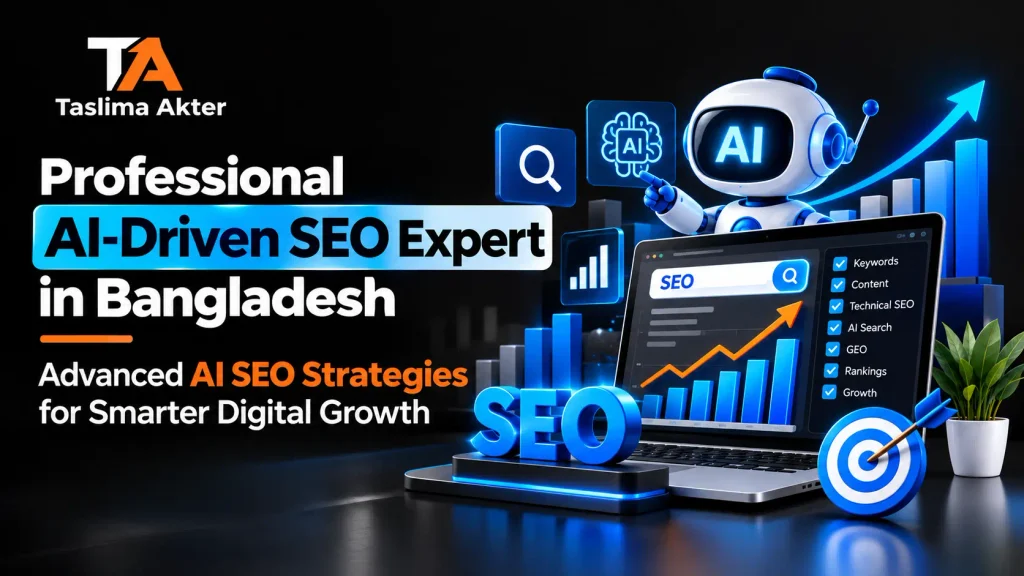
Professional AI-Driven SEO Expert in Bangladesh services are becoming increasingly important as search behavior, artificial intelligence, and digital competition continue to evolve. Businesses today need more than traditional keyword optimization to remain visible. Instead, they need a strategic combination of AI SEO, technical optimization, semantic search, content intelligence, search intent analysis, and human expertise to build sustainable organic visibility.
Search engines are no longer evaluating websites only by matching exact keywords. They increasingly interpret topics, entities, context, relationships, user intent, content usefulness, and overall website quality. At the same time, AI-powered search experiences are changing how people discover information, compare businesses, and make purchasing decisions. Therefore, businesses need an SEO strategy that can adapt to both traditional search results and emerging AI-driven search environments.
A modern AI-driven SEO strategy combines the efficiency of artificial intelligence with the judgment of an experienced SEO professional. AI can help analyze large amounts of data, identify keyword opportunities, detect content gaps, organize information, and accelerate repetitive research. However, human expertise remains essential for strategic decisions, factual accuracy, search intent interpretation, brand positioning, and content quality.
For businesses in Bangladesh, this approach can create opportunities to compete in increasingly crowded local and international markets. Whether the objective is to improve Google visibility, strengthen topical authority, attract qualified organic traffic, generate leads, or prepare for AI search, the strategy should begin with research and continue through measurable optimization.
This guide explains how AI-powered SEO works, how it can support technical and content optimization, how GEO can prepare websites for generative search, and how businesses can combine automation with human expertise. It also explains a practical roadmap for building smarter, data-driven, and sustainable
What Is an AI-Power SEO Expert ?
A Professional AI-Driven SEO Expert in Bangladesh combines established search engine optimization principles with artificial intelligence, advanced data analysis, automation, and modern search strategies. The purpose is not simply to automate SEO tasks. Instead, AI is used as an intelligent support layer while strategic decisions remain guided by SEO knowledge, business objectives, and audience needs.
This approach can be particularly useful for websites with large amounts of content, competitive keywords, multiple service pages, or complex markets. AI-assisted workflows can process information quickly, while an experienced SEO professional determines which insights are meaningful and how they should influence the campaign.
Understanding AI-Driven SEO in the Modern Search Landscape
AI-driven SEO uses artificial intelligence to support research, analysis, content planning, optimization, monitoring, and decision-making. It can help identify patterns that may be difficult to discover manually when a website has thousands of keywords, pages, queries, or competitors.
| SEO Area | AI Support | Human Expertise |
|---|---|---|
| Keyword Research | Pattern and opportunity discovery | Intent and business relevance |
| Content | Research and organization | Originality, accuracy and expertise |
| Technical SEO | Issue detection and analysis | Prioritization and implementation |
| Analytics | Data processing | Strategic interpretation |
| GEO | Content and entity analysis | Authority and brand strategy |
How AI Is Changing Traditional Search Engine Optimization
Traditional SEO remains important, but the workflow is becoming more data-driven. AI can help SEO professionals process search data, identify relationships between topics, analyze competitor content, and discover opportunities more efficiently. Consequently, SEO teams can spend more time on strategic decisions instead of repetitive manual tasks.
Why Businesses in Bangladesh Need AI-Powered SEO
Businesses operating in Bangladesh can target local customers, international buyers, or both. Because competition varies across industries, an adaptable SEO strategy can help identify specific search opportunities rather than relying on generic optimization.
- Local visibility: Improve discovery for Bangladesh-focused searches.
- International reach: Build content and authority for global markets.
- Faster research: Analyze keywords, topics, and competitors efficiently.
- Better optimization: Identify content and technical opportunities systematically.
- Future readiness: Prepare content for evolving AI search experiences.
Combining SEO Expertise With Artificial Intelligence
The strongest workflow does not treat AI as a replacement for SEO expertise. Instead, it uses AI to accelerate research and analysis while a human expert validates the findings and makes strategic decisions.
AI-Powered Research and Data Analysis
AI can process large datasets, identify patterns, organize keywords, compare content themes, and support opportunity analysis. Human review is then used to determine which findings are genuinely relevant.
Automated SEO Insights and Opportunity Detection
Automation can help identify recurring technical issues, underperforming pages, content gaps, keyword clusters, and other signals. However, each recommendation should be evaluated within the context of the website and its business objectives.
Human Strategy With AI-Assisted Execution
Human expertise remains responsible for prioritization, brand positioning, search intent interpretation, quality control, and final strategic decisions. Therefore, AI becomes a powerful assistant rather than an independent SEO decision-maker.
Why AI-Driven SEO Matters for Digital Growth
Modern SEO involves enormous amounts of information. Search queries, competitor pages, content topics, ranking data, technical reports, user behavior, and conversion information can all influence strategy. Therefore, AI can provide valuable support by making large-scale analysis faster and more organized.
However, data alone does not create growth. The important step is turning data into useful decisions. A data-driven SEO strategy therefore combines technology with experience so that businesses can identify meaningful opportunities and prioritize actions.
How AI Helps Businesses Improve Search Visibility
- Analyzing search trends and keyword relationships.
- Identifying content opportunities and topic gaps.
- Supporting competitor research.
- Detecting technical SEO patterns.
- Improving content structure and semantic coverage.
- Supporting ongoing performance analysis.
Using Data to Make Smarter SEO Decisions
SEO decisions become more reliable when they are supported by evidence. Instead of assuming which pages need improvement, businesses can analyze search impressions, clicks, rankings, traffic, engagement, conversions, and content performance.
| Data Signal | What It Can Reveal | Possible SEO Action |
|---|---|---|
| High impressions, low clicks | Potential title or intent mismatch | Review title and snippet relevance |
| Traffic decline | Possible ranking, demand or content issue | Investigate page and SERP changes |
| Weak content engagement | Potential relevance or UX problem | Improve clarity and usefulness |
| Ranking for related terms | Existing topical relevance | Expand supporting coverage |
Connecting AI SEO With Business Growth Objectives
SEO should support business goals rather than operate separately from them. A website may need more qualified leads, stronger product visibility, improved local discovery, or greater brand recognition. Therefore, the SEO strategy should define relevant business outcomes before selecting optimization activities.
From Search Visibility to Qualified Traffic
Higher visibility is useful when it reaches the right audience. Consequently, AI-supported keyword research should consider search intent, relevance, competition, business value, and audience expectations instead of focusing only on search volume.
Identifying High-Value Search Opportunities
AI-assisted analysis can help group keywords according to themes and intent. Human evaluation then determines which opportunities align with the business’s products, services, audience, and market.
Improving Search Intent Alignment
Search intent describes what users are trying to accomplish. Content should therefore satisfy the underlying reason behind a query instead of simply repeating the target keyword.
Advanced AI SEO Strategies for Modern Businesses
Advanced AI SEO strategies connect automation, data analysis, content intelligence, and strategic SEO decision-making. Instead of applying AI randomly, businesses can integrate it into specific stages of the optimization process where it can provide measurable efficiency or insight.
AI-Powered Keyword Research and Search Intent Analysis
Keyword research can become more sophisticated when AI helps organize large keyword datasets into themes, questions, entities, and intent groups. This makes it easier to develop content plans that address genuinely different search needs.
- Keyword clustering
- Search intent classification
- Question discovery
- Semantic relationship analysis
- Competitor keyword comparison
Semantic SEO and Topic Cluster Optimization
Semantic SEO focuses on relationships between topics, concepts, entities, and user needs. AI can help discover related concepts, but the final content architecture should be based on genuine search intent rather than creating unnecessary pages for every variation.
AI-Assisted Content Optimization
AI can support content optimization by analyzing headings, topic coverage, readability, related concepts, and content structure. Nevertheless, the final content should be reviewed by a human to ensure that it provides original, accurate, useful, and contextually appropriate information.
Competitor SEO Analysis With AI
AI can make competitor analysis more efficient by organizing information about competing pages, topics, content formats, keyword coverage, and potential gaps. However, competitor data should inform strategy rather than encourage copying.
Finding Content and Keyword Gaps
A content gap exists when users have a meaningful information need that is not adequately addressed by the current website. AI can help identify patterns, while an SEO expert determines whether the opportunity deserves a new page or should be incorporated into an existing one.
Identifying Untapped Search Opportunities
Potential opportunities can come from unanswered questions, underserved use cases, comparison searches, problem-based queries, or missing topical relationships.
Discovering Competitor Content Weaknesses
Rather than copying competitors, businesses can examine where existing search results provide incomplete explanations, weak evidence, poor organization, or insufficient user value.
AI-Powered Content Strategy and Topical Authority
Content remains one of the most important parts of SEO because search engines need useful information to understand and satisfy user queries. AI can accelerate research and organization, while human expertise ensures that the final content is accurate, useful, original, and relevant.
Building Comprehensive Topic Clusters
A topic cluster connects a broad subject with supporting content that answers distinct search questions. Therefore, businesses should create supporting pages only when they represent genuinely different search intents.
- Define the primary commercial or informational topic.
- Map related search intents.
- Identify supporting questions and use cases.
- Connect related pages through internal links.
- Review the cluster regularly for gaps and overlap.
Creating Search Intent-Focused Content
AI can help classify search queries, but intent still needs contextual interpretation. A query may be informational, commercial, transactional, navigational, or mixed. Understanding this distinction helps determine the appropriate page type and content format.
Using AI to Identify Related Topics and Entities
Related entities and concepts help search engines understand context. AI can assist with discovering these relationships, while human editors can decide which concepts genuinely improve the user’s understanding of the topic.
Strengthening E-E-A-T Through Human Expertise
AI-generated information should not be treated as automatically authoritative. Strong content should demonstrate relevant experience, expertise, accuracy, transparency, and useful evidence where appropriate.
Combining AI Efficiency With Human Experience
The most practical model is often collaborative: AI assists with research and analysis, while people provide judgment, context, original experience, fact-checking, and editorial direction.
Fact-Checking AI-Assisted Content
Every important factual claim should be reviewed before publication. This is especially important when content includes statistics, technical specifications, regulations, medical information, financial information, or changing market data.
Adding Original Insights and Practical Experience
Original observations, examples, case studies, practical recommendations, and firsthand experience can make content more useful and differentiated.
AI-Driven On-Page SEO Optimization
On-page SEO optimization becomes more scalable when AI assists with analysis and pattern detection. However, optimization should always preserve natural language, user value, and clear information architecture.
Optimizing SEO Titles and Meta Descriptions
AI can generate and compare title ideas, but the final title should accurately represent the page, match search intent, and communicate a clear reason for users to click.
Improving Heading Structures and Content Architecture
Well-organized headings help readers scan information and help search systems understand the hierarchy of a page. Therefore, headings should represent meaningful sections rather than exist only for keyword placement.
Strengthening Internal Linking With AI Insights
AI can help identify pages that are contextually related. Human review can then determine whether an internal link genuinely helps users navigate the topic and supports the site’s information architecture.
Optimizing Semantic Relevance and Entity Coverage
Semantic optimization involves naturally covering the concepts users need to understand the subject. It should not become an exercise in inserting large lists of related terms.
Creating More Search-Friendly Website Content
- Use descriptive and accurate headings.
- Answer important questions directly.
- Explain specialized terminology where necessary.
- Connect related concepts naturally.
- Use internal links where they provide genuine value.
Improving Content Readability
Short paragraphs, clear language, descriptive subheadings, useful lists, and logical transitions can make complex SEO content easier to understand.
Expanding Relevant Topic Coverage
Content should answer the questions that naturally arise from the primary topic. Additional sections should be included because they improve usefulness, not simply because they contain related keywords.
Technical SEO With AI-Powered Analysis
Technical SEO creates the foundation that allows search engines to crawl, interpret, index, and serve website content efficiently. AI can accelerate technical analysis by helping identify patterns across large websites, but technical decisions still require experienced evaluation.
AI-Assisted Technical SEO Audits
- Crawl issue identification
- Indexation analysis
- Broken link detection
- Redirect analysis
- Duplicate content pattern detection
- Internal linking analysis
Identifying Crawlability and Indexing Issues
Search engines need access to important pages and resources. Technical analysis should therefore review crawlability, robots directives, sitemaps, canonical signals, redirects, and indexation patterns.
Website Performance and Core Web Vitals Analysis
Website performance affects user experience and can influence how effectively visitors interact with a site. AI-assisted monitoring can help identify recurring performance patterns that deserve further investigation.
Detecting Technical SEO Errors at Scale
Large websites can contain thousands of URLs, making manual inspection difficult. Automated analysis can identify patterns and prioritize areas for human review.
Building a Strong Technical SEO Foundation
| Technical Area | Optimization Focus |
|---|---|
| Crawlability | Ensure important resources can be accessed. |
| Indexation | Monitor which pages are eligible and indexed. |
| Site Architecture | Create logical relationships between pages. |
| Performance | Improve speed and user experience. |
| Canonicalization | Clarify preferred URL versions. |
Crawl and Indexation Monitoring
Regular monitoring helps identify unexpected changes in crawling or indexing behavior before they become larger problems.
Website Structure and URL Optimization
A clear website structure helps users and search systems understand how information is organized. URLs should also be logical, descriptive, and consistent with the site’s architecture.
AI Search, GEO and the Future of SEO
Search is increasingly expanding beyond traditional blue-link results. AI-powered experiences can summarize information, answer questions, compare options, and connect users with relevant entities. Therefore, businesses should consider how their information can be understood in both traditional search and generative search environments.
What Is Generative Engine Optimization?
Generative Engine Optimization (GEO) is a developing approach focused on making information clear, useful, authoritative, and understandable for generative search and AI-powered answer experiences. It complements traditional SEO rather than simply replacing it.
How AI Search Is Changing User Behavior
Users can increasingly ask conversational questions instead of typing short keyword phrases. Consequently, websites should provide direct answers, contextual explanations, comparisons, definitions, and supporting details that address complete information needs.
Optimizing Content for AI Overviews and Answer Engines
- Answer important questions clearly.
- Use descriptive headings.
- Explain concepts with sufficient context.
- Maintain factual consistency.
- Strengthen relevant entity relationships.
- Demonstrate expertise through useful information.
Building AI-Friendly Brand and Entity Signals
Consistent information about a business, person, product, service, or organization can help create a clearer digital identity. Therefore, brands should maintain accurate information across relevant digital properties.
Preparing Websites for Generative Search
Creating Clear and Direct Answers
Important questions should be answered directly before expanding into supporting explanations. This structure helps users find essential information quickly.
Strengthening Entity-Based Content
Content should clearly explain the relationships between relevant people, organizations, products, services, locations, concepts, and topics when those relationships matter to the user.
Maintaining Consistent Brand Information
Consistent names, descriptions, services, contact information, and other important brand details help create a more coherent digital presence.
AI-Search SEO for Local Businesses in Bangladesh
For Bangladesh-based businesses, SEO can support both local discovery and broader market expansion. AI can help analyze local search patterns, location-related queries, competitor visibility, and content opportunities. However, local relevance still depends on accurate business information and genuine connections with the target market.
Local SEO Strategies Powered by AI
- Analyze location-based search queries.
- Identify local content opportunities.
- Review competitor local visibility.
- Organize location-related keyword themes.
- Monitor local search performance.
Improving Visibility for Bangladesh-Based Businesses
Businesses can create location-relevant pages and resources when those pages genuinely serve distinct audiences or search intents. Content should provide useful local information instead of simply adding location names repeatedly.
Optimizing Location-Based Search Intent
Local searches often include specific needs, locations, services, or business types. Understanding the intent behind these searches helps determine whether a location page, service page, guide, or other content format is appropriate.
Building Local Brand Authority
Local authority develops through accurate business information, useful local content, customer experiences, relevant mentions, and consistent digital visibility. AI can support analysis, but genuine local relevance remains essential.
Bangladesh-Specific SEO Opportunities
Understanding Local Search Behavior
Businesses should examine how customers search within their specific market rather than assuming that global search behavior is identical to Bangladesh-based search behavior.
Optimizing Business Information and Local Content
Accurate business details, useful location information, service descriptions, and relevant local resources can help customers understand and discover a business more effectively.
Data-Driven SEO Analytics and Performance Tracking
A modern SEO campaign needs continuous measurement. AI can help organize and interpret large datasets, but the purpose of analytics is not simply to produce reports. Instead, analytics should explain what changed, what may have caused the change, and which action should follow.
Measuring Organic Search Visibility
Organic visibility can be evaluated through impressions, clicks, ranking distributions, indexed pages, organic traffic, and other relevant indicators. Each metric should be interpreted according to the website’s objectives.
Tracking Keyword and Ranking Performance
Keyword rankings can help identify changes in search visibility, but rankings should not be considered in isolation. Search demand, intent, traffic quality, and conversions can provide additional context.
Analyzing Organic Traffic and User Engagement
Traffic analysis can show which pages attract visitors and which topics generate interest. Engagement information can then help identify whether those visitors are finding the content useful.
Measuring SEO Leads and Conversions
For commercial websites, the ultimate value of SEO may extend beyond traffic. Qualified leads, enquiries, purchases, registrations, or other business actions can provide a clearer picture of performance.
Turning SEO Data Into Actionable Insights
| Performance Question | Data to Review | Potential Next Step |
|---|---|---|
| Which pages are losing visibility? | Clicks, impressions, rankings | Audit affected pages |
| Which topics are growing? | Query and page trends | Expand relevant coverage |
| Which pages generate leads? | Organic conversions | Improve and support those pages |
| Where are technical issues? | Crawl and index data | Prioritize technical fixes |
Identifying Underperforming Pages
Pages with declining impressions, weak engagement, poor intent alignment, or limited organic visibility may deserve a content, technical, or structural review.
Finding New Growth Opportunities
Performance data can reveal related queries, emerging topics, pages with untapped potential, and opportunities for stronger internal linking or content expansion.
AI SEO Automation Without Losing Human Expertise
Automation can make SEO workflows faster, but not every SEO decision should be automated. The most effective approach separates repetitive processes from decisions that require experience, context, judgment, and accountability.
What Should Be Automated in SEO?
- Data collection and organization
- Keyword clustering
- Large-scale content pattern analysis
- Technical issue detection
- Routine reporting
- Content structure analysis
What Should Remain Human-Led?
- Business strategy
- Search intent interpretation
- Brand positioning
- Fact-checking
- Editorial judgment
- Final content approval
- Ethical and strategic decisions
Creating an AI + Human SEO Workflow
A balanced workflow starts with AI-assisted research, moves into human validation, continues through strategic implementation, and ends with data-based review. This structure helps businesses benefit from automation without sacrificing quality.
Balancing Automation, Accuracy and Creativity
AI can increase efficiency, but quality still depends on how the technology is used. Human experts should verify important information, refine recommendations, and ensure that content reflects the brand’s actual expertise.
AI for Research and Repetitive Tasks
AI is particularly useful for processing large datasets, organizing information, summarizing patterns, and supporting repetitive analytical tasks.
Human Experts for Strategy and Quality Control
Human professionals should guide strategic priorities, review factual claims, protect brand quality, and decide which recommendations are appropriate for the business.
Common AI-Driven SEO Mistakes Businesses Should Avoid
AI can make SEO workflows more efficient, but using it without a strategy can create new problems. Businesses should therefore focus on responsible implementation rather than simply increasing the amount of automated content or analysis.
Publishing Unedited AI-Generated Content
Unreviewed AI content can contain factual errors, generic explanations, repetitive wording, or unsupported claims. Human editing and validation are therefore important before publication.
Relying Too Heavily on Automation
Automation should improve efficiency rather than remove strategic thinking. SEO decisions require context that automated systems may not fully understand.
Ignoring Search Intent
A keyword alone does not explain what a searcher needs. Content should satisfy the actual purpose behind the query.
Overusing Keywords in AI Content
Repeating a keyword excessively can make content unnatural and reduce readability. Semantic variations should be used naturally while keeping the primary topic clear.
Neglecting Technical SEO
AI-generated content cannot compensate for serious technical problems. Crawlability, indexation, website architecture, performance, and mobile usability remain important parts of SEO.
Failing to Add Human Expertise
AI can assist with information processing, but meaningful expertise comes from accurate knowledge, experience, analysis, and responsible editorial decisions.
How to Build a Safer and More Effective AI SEO Strategy
- Review: Check important AI-generated information.
- Validate: Confirm facts and business-specific details.
- Refine: Add original insights and relevant context.
- Optimize: Align the content with search intent.
- Measure: Evaluate performance after publication.
Why Choose a Professional AI- SEO Expert in Bangladesh?
Choosing an experienced Professional AI-Driven SEO Expert in Bangladesh can help businesses connect modern AI capabilities with proven SEO fundamentals. The objective is not to use AI simply because it is available. Instead, the objective is to determine where AI can improve research, efficiency, analysis, and decision-making while maintaining human strategic control.
Combining Advanced SEO Knowledge With AI Technology
A comprehensive approach can connect technical SEO, content strategy, semantic optimization, keyword research, analytics, AI search, and GEO. This creates a broader framework instead of treating each SEO activity as an isolated task.
Creating Customized SEO Strategies for Each Business
Different industries have different audiences, competition, search behavior, conversion paths, and content requirements. Therefore, SEO strategies should be customized rather than copied from another website.
Using Data to Guide SEO Decisions
Data can help identify priorities, evaluate progress, and reveal new opportunities. A structured measurement process makes SEO more transparent and easier to improve over time.
Focusing on Sustainable Search Visibility
Sustainable SEO focuses on creating useful resources, improving technical foundations, understanding user intent, strengthening authority, and continuously refining the website based on evidence.
The Taslima Akter Approach to AI-Driven SEO
Research-First SEO Strategy
The process begins with research into the website, audience, search landscape, competitors, content opportunities, and business objectives.
Human-Led Strategic Decision Making
AI can provide insights, but strategic decisions remain connected to business context, search intent, brand positioning, and user value.
AI-Assisted Optimization and Analysis
AI tools can support keyword analysis, content research, technical pattern detection, competitor analysis, and performance interpretation as part of a broader SEO workflow.
Step-by-Step AI-Driven SEO Growth Roadmap
A structured roadmap makes AI-powered SEO easier to manage because each stage has a specific purpose. The following framework can be adapted according to the website, industry, market, competition, and business objectives.
Step 1: Website and SEO Performance Audit
Begin by reviewing technical health, existing content, organic visibility, keyword targeting, internal linking, website architecture, and current performance.
Step 2: AI-Powered Keyword and Competitor Research
Use AI-assisted analysis to organize keyword opportunities, identify competitor patterns, discover related topics, and understand the search landscape.
Step 3: Search Intent and Topic Mapping
Map keywords to genuine search intents and determine which topics belong on existing pages and which represent distinct content opportunities.
Step 4: Technical and On-Page SEO Optimization
Resolve technical barriers and optimize titles, headings, content structure, internal links, metadata, images, and other relevant on-page elements.
Step 5: AI-Assisted Content and Topical Authority Development
Develop useful content around clearly defined topics and search intents. Use AI to support research and organization while maintaining human editorial control.
Step 6: GEO and AI Search Optimization
Improve content clarity, entity relationships, direct answers, factual consistency, and brand information so the website is better prepared for modern generative search environments.
Step 7: Performance Tracking and Continuous Optimization
Monitor organic visibility, rankings, traffic, engagement, leads, and conversions. Then use those insights to refine the strategy and prioritize the next optimization cycle.
Turning SEO Insights Into Sustainable Growth
| Stage | Primary Objective | Key Output |
|---|---|---|
| Measure | Understand current performance | Baseline SEO data |
| Analyze | Identify problems and opportunities | SEO insights |
| Optimize | Implement strategic improvements | Improved website and content |
| Scale | Expand successful strategies | Sustainable growth framework |
Measure
Establish a reliable baseline before making major changes so that future performance can be compared against the original condition.
Analyze
Use SEO data, competitor information, content performance, and technical findings to understand the most important opportunities.
Optimize
Implement prioritized technical, content, on-page, semantic, and authority improvements based on the analysis.
Scale
When a strategy demonstrates useful performance signals, expand it carefully while continuing to monitor quality, relevance, and search intent.
Frequently Asked Questions About AI-Driven SEO
1. What Does an AI-Driven SEO Expert Do?
An AI-driven SEO expert combines traditional SEO knowledge with AI-assisted research, data analysis, content optimization, technical auditing, competitor analysis, and modern search strategies.
2. How Does AI Improve SEO?
AI can improve SEO workflows by processing large amounts of data, identifying patterns, organizing keywords, supporting content research, detecting technical issues, and accelerating repetitive analytical tasks.
3. Can AI Replace Human SEO Experts?
AI can automate and support many SEO tasks, but human expertise remains important for strategy, search intent interpretation, fact-checking, brand positioning, originality, quality control, and business decision-making.
4. Is AI-Generated Content Good for SEO?
AI-assisted content can be useful when it provides accurate, helpful, original, and relevant information. Human review is important to verify facts, improve quality, add expertise, and ensure the content satisfies the intended search.
5. What Is AI SEO?
AI SEO refers to using artificial intelligence to support SEO research, analysis, content optimization, technical auditing, automation, and strategic decision-making.
6. What Is GEO in SEO?
Generative Engine Optimization, or GEO, focuses on making information clear, useful, context-rich, and understandable for AI-powered search and generative answer experiences.
7. How Can AI Improve Keyword Research?
AI can organize large keyword datasets, identify semantic relationships, group queries by themes, discover questions, and support competitor analysis. Human review is still needed to validate intent and business relevance.
8. Can AI Help With Technical SEO?
Yes. AI-assisted tools can help identify patterns involving crawlability, indexing, redirects, internal links, duplicate content, performance, and other technical areas. Experts should review and prioritize the findings.
9. Why Should Bangladesh Businesses Invest in AI-Driven SEO?
AI-driven SEO can help Bangladesh businesses analyze competitive search environments, improve content strategies, identify relevant opportunities, strengthen organic visibility, and prepare for evolving AI-powered search experiences.
10. How Can Businesses Start an AI-Powered SEO Strategy?
Businesses can begin with a complete SEO audit, followed by keyword and competitor research, search intent mapping, technical optimization, content development, GEO preparation, and continuous performance measurement.
Conclusion: Building Smarter SEO Growth With AI and Human Expertise
A modern SEO strategy requires more than simply adding keywords to web pages. Search engines are becoming increasingly capable of understanding topics, entities, context, intent, and content quality. At the same time, AI-powered search is creating new ways for users to discover information. Therefore, businesses need an adaptable approach that connects traditional SEO fundamentals with emerging technologies.
A Professional AI-Driven SEO Expert in Bangladesh can use AI to accelerate research, analyze complex datasets, discover opportunities, support technical audits, organize content strategies, and monitor performance. However, the most important decisions still require human judgment, experience, accuracy, creativity, and strategic understanding.
By combining AI SEO, semantic SEO, technical SEO, content optimization, GEO, and data-driven analysis, businesses can build a more comprehensive search strategy. More importantly, the strategy can evolve as user behavior, technology, and search experiences continue to change.
The goal is not simply to use more AI. Instead, the goal is to use the right technology in the right place while keeping strategy, quality, expertise, and user value at the center of SEO. This balanced approach can create a stronger foundation for sustainable organic visibility and long-term digital growth.
Final CTA: Build Smarter Digital Growth With Taslima Akter
Ready to make your SEO strategy more intelligent, structured, and future-ready? Taslima Akter can help businesses develop a customized SEO framework that combines AI-assisted research, advanced optimization, content strategy, technical SEO, semantic search, and modern GEO approaches.
Instead of relying on one-size-fits-all tactics, build an SEO strategy around your website, audience, industry, market, and business objectives. With the right combination of AI-powered insights and human SEO expertise, your digital presence can be prepared for both today’s search environment and the evolving future of AI search.