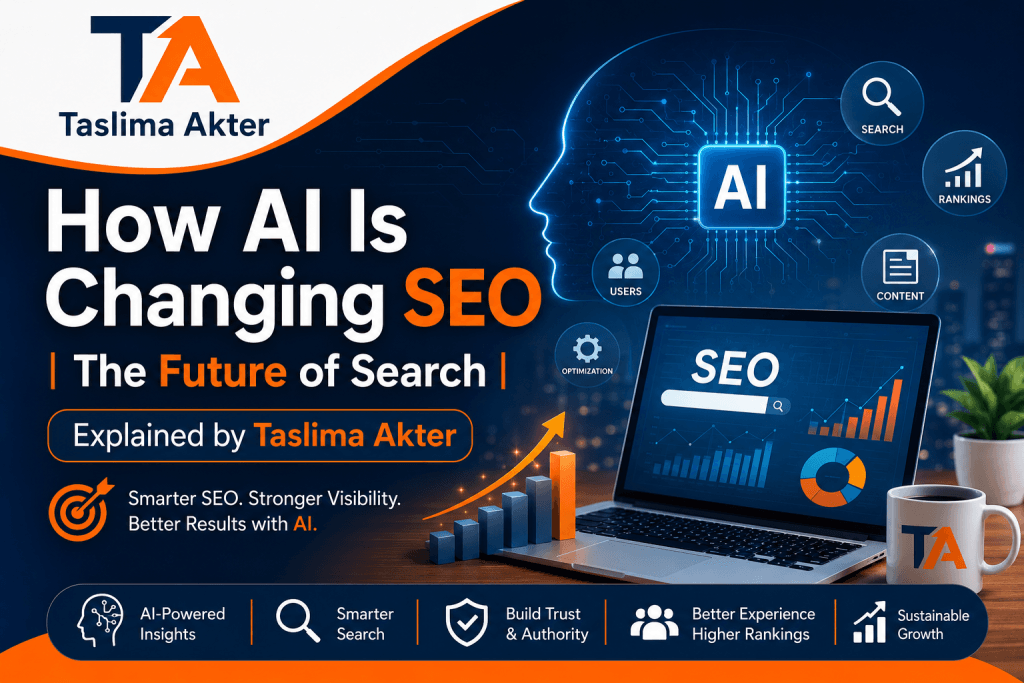
How AI is changing SEO is now one of the most important questions for businesses, marketers, content creators, and SEO professionals. Search is no longer limited to ten blue links on Google. Instead, users increasingly receive summaries, recommendations, comparisons, and direct answers through Google AI Overviews, AI-powered search, conversational search, ChatGPT, Gemini, Perplexity, and other generative platforms.
Therefore, modern SEO must evolve. Traditional ranking factors such as technical SEO, keyword research, backlinks, content quality, internal linking, and search intent still matter. However, they now work alongside Generative Engine Optimization (GEO), semantic SEO, entity optimization, E-E-A-T, answer-focused content, and AI search visibility.
The future of SEO is not about choosing between humans and artificial intelligence. Instead, it is about using AI efficiently while maintaining experience, expertise, accuracy, originality, and strategic thinking. In this guide, Taslima Akter explains how AI is reshaping SEO and what businesses should do to remain visible in the new search environment.
How AI Is Changing SEO and Why It Matters
AI is changing both sides of search.
First, search engines use artificial intelligence to understand queries, context, entities, and intent more accurately. Meanwhile, users are changing how they search because conversational AI allows them to ask longer and more specific questions.
Previously, someone might search:
Now, the same person may ask:
“Who is an SEO expert in Bangladesh who understands Google SEO and AI search optimization?”
Therefore, SEO strategies must target not only keywords but also questions, context, topics, and user intent.
Search Is Moving Beyond Traditional Blue Links
Traditional search results still matter. However, search pages increasingly include:
- AI-generated summaries
- Featured snippets
- People Also Ask
- Local packs
- Videos
- Shopping results
- Knowledge panels
- Direct answers
As a result, ranking number one is no longer the only visibility opportunity.
AI Is Changing How Users Search for Information
Users now expect faster, more complete answers.
Therefore, content should provide:
- Direct answers
- Clear explanations
- Useful examples
- Supporting evidence
- Relevant follow-up information
- Strong topic coverage
Conversational Queries Are Becoming More Important
Long-tail and question-based searches are becoming increasingly valuable.
Examples include:
- How does AI affect SEO?
- Will AI replace SEO experts?
- What is AI SEO?
- How do I optimize for Google AI Overviews?
- What is GEO in SEO?
SEO Must Now Optimize for Questions, Context and Intent
Keywords still matter. However, understanding why the user is searching matters even more.
How Artificial Intelligence Is Transforming Search Engines
Artificial intelligence helps search engines understand meaning rather than simply matching words.
Google Uses AI to Understand Search Intent Better
Modern search systems can interpret:
- Synonyms
- Entities
- Relationships
- Search context
- Query meaning
- User intent
Therefore, writing separate pages for every keyword variation is often unnecessary.
AI Overviews Are Changing the Search Experience
Google AI Overviews can provide synthesized answers directly in search results.
Consequently, websites need content that is easy to interpret and trustworthy.
Useful content should be:
- Accurate
- Structured
- Helpful
- Updated
- Relevant
- Supported by expertise
Zero-Click and Answer-Based Searches Are Growing
Some users may receive enough information directly from search results without visiting a website.
Therefore, businesses should focus on both visibility and brand authority, not traffic alone.
Search Engines Understand Entities and Context More Deeply
Entity SEO helps search engines understand real-world subjects such as:
Taslima Akter → SEO Expert → SEO Services → AI SEO → GEO → Search Visibility
These relationships help search systems understand who or what a page represents.
Traditional SEO vs AI-Driven SEO
Traditional SEO and AI SEO are not competitors. Instead, they complement each other.
| Traditional SEO | AI-Driven SEO |
|---|---|
| Focuses heavily on rankings | Focuses on search + AI visibility |
| Keyword targeting | Intent and entity targeting |
| Search engine results | Generative search experiences |
| Standard content optimization | Semantic and conversational content |
| Traditional backlinks | Links, mentions, citations and authority |
| Basic FAQs | Answer-focused structured information |
| SEO metrics | SEO + AI visibility signals |
Therefore, strong websites should preserve traditional SEO foundations while adapting to AI-driven search.
Keywords Still Matter, but Search Intent Matters More
A keyword tells you what users type. Search intent tells you what they actually want.
Consequently, SEO content should match the intent behind each query.
Content Quality Is Replacing Keyword-First Strategies
Keyword stuffing no longer creates sustainable SEO performance.
Instead, search engines reward content that answers the user’s question comprehensively.
Semantic SEO Connects Topics, Entities and Relationships
Semantic SEO strengthens topical relevance by covering connected concepts naturally.
Authority and Trust Are Becoming Stronger Search Signals
As AI-generated content becomes easier to create, reliable authorship and real expertise become even more valuable.
How AI Is Changing Keyword Research
Keyword research is becoming more intent-focused.
Move From Exact Keywords to Search Intent and Topic Clusters
Instead of creating one page per keyword, businesses should organize keywords into meaningful topic clusters.
For example:
Main Topic: AI SEO
Supporting topics might include:
- How AI is changing SEO
- AI SEO tools
- Google AI Overviews SEO
- Generative Engine Optimization
- Semantic SEO
- Entity SEO
- AI search optimization
Use Long-Tail and Conversational Keywords More Strategically
Conversational queries can reveal stronger user intent.
Identify Questions Users Ask AI and Search Engines
Question-based content can support Google search, featured snippets, People Also Ask, and generative search.
Build Keyword Strategies Around the Customer Journey
Keyword research should cover:
- Awareness
- Research
- Comparison
- Decision
- Conversion
Therefore, SEO becomes more closely connected to business growth.
How AI Is Changing SEO Content Creation
AI can speed up research, outlining, editing, and idea generation.
However, speed should never replace quality.
Create People-First Content Instead of Mass AI Content
Publishing hundreds of generic AI-generated articles is not a sustainable content strategy.
Instead, content should offer:
- Original insights
- Practical expertise
- Clear examples
- Accurate information
- Helpful recommendations
- Strong editorial review
Answer the Main Search Question Quickly and Clearly
Readers should not need to scroll through several paragraphs to find the answer.
Therefore, provide the core response early and then expand with supporting information.
Add Original Experience, Expertise and Practical Insights
Unique expertise gives content something that generic AI output cannot easily replicate.
Strengthen Content With E-E-A-T
Modern SEO content should demonstrate:
- Experience
- Expertise
- Authoritativeness
- Trustworthiness
Use Reliable Sources, Evidence and Clear Authorship
Whenever factual claims require support, reference credible sources and keep author information transparent.
How AI Is Changing On-Page SEO
AI has also changed how webpages should be structured.
Optimize Headings Around Topics and User Questions
Headings should guide the reader naturally and reflect real search intent.
Strengthen Internal Linking and Semantic Relationships
Internal links should connect closely related topics.
For example:
- AI SEO Expert
- Semantic SEO
- Technical SEO
- SEO Services
- Google SEO
- Generative Engine Optimization
Improve Content Structure for Humans and AI Systems
Logical structure helps both users and machines.
Use Lists, Tables, Definitions and Concise Answers Naturally
Different formats improve readability while making information easier to extract.
How Technical SEO Supports AI Search Visibility
Strong AI-search visibility still depends on strong technical foundations.
Keep Important Content Crawlable and Indexable
Search systems cannot use content they cannot access.
Therefore, regularly check:
- Indexing
- Canonicalization
- XML sitemap
- Robots.txt
- Broken links
- Redirects
- Internal linking
Improve Page Speed, Mobile Experience and Core Web Vitals
Performance affects both user experience and overall website quality.
Use Structured Data Where It Accurately Describes Content
Schema markup can help search engines better interpret page elements.
Help Search Engines Understand Pages and Entities Clearly
Technical clarity supports semantic clarity.
The Rise of Generative Engine Optimization (GEO)
What Is Generative Engine Optimization?
Generative Engine Optimization (GEO) is the process of making content easier for generative search systems to understand, evaluate, and potentially surface in AI-generated responses.
How GEO Differs From Traditional SEO
Traditional SEO focuses strongly on search rankings, while GEO expands optimization toward generative answers and AI search experiences.
SEO Targets Search Visibility While GEO Expands AI Search Readiness
Both approaches share important foundations such as:
- Quality content
- Authority
- Technical accessibility
- Entity clarity
- Trusted sources
- E-E-A-T
Why SEO and GEO Should Work Together
The strongest strategy is not SEO vs GEO.
Instead, it is:
SEO + GEO + Semantic SEO + E-E-A-T + Technical SEO
SEO vs GEO vs AEO in the AI Search Era
| Strategy | Main Goal |
| SEO | Improve organic search visibility |
| GEO | Improve generative search readiness |
| AEO | Optimize content for direct answers |
| Semantic SEO | Strengthen topical relationships |
| Entity SEO | Clarify people, brands and concepts |
Therefore, these strategies should support one another rather than operate separately.
How Google AI Overviews Are Changing SEODirect Answers Are Reshaping the Traditional Search Journey
Users may receive summarized information before visiting websites.
Therefore, brands should aim to become trusted information sources.
Clear and Trustworthy Content Has Greater Strategic Value
Accurate and well-structured content is increasingly important.
Structure Content Around Primary and Follow-Up Questions
For example:
Primary question: How is AI changing SEO?
Follow-up questions:
- Will AI replace SEO?
- What is GEO?
- Does AI content rank?
- How does AI affect keyword research?
Avoid Treating AI Overview Inclusion as a Guaranteed Ranking
No legitimate strategy can guarantee inclusion in AI-generated search experiences.
How AI Search Changes E-E-A-T and Brand Authority
Demonstrate Genuine Experience and Subject Expertise
AI can generate information quickly. However, first-hand experience remains a differentiator.
Build Clear Author and Brand Entity Signals
The same professional identity should remain consistent across:
- Website
- Author bio
- Social profiles
- Professional profiles
- Relevant publications
Strengthen Trust With Transparent and Verifiable Information
Avoid unsupported claims and exaggerated promises.
Connect Authors, Brands, Services and Topics Consistently
For example:
Taslima Akter → SEO Expert → AI SEO → Semantic SEO → GEO → Google Search
This strengthens entity clarity.
How AI Is Changing Local SEO
AI is also changing local search behavior.
Conversational Local Searches Are Becoming More Specific
Users increasingly search with phrases such as:
- “Best SEO expert near me”
- “Who can improve my Google Maps visibility?”
- “Local SEO expert in Bangladesh”
Strengthen Google Business Profile and Local Entity Signals
Accurate business information remains essential.
Create Helpful Location-Relevant Content
Local content should answer genuine geographic intent.
Keep Business Information Accurate and Consistent
Consistency builds trust across local search ecosystems.
How AI Is Changing Link Building and Digital Authority
Backlinks still matter. However, brand mentions and digital authority are becoming increasingly important.
Prioritize Relevant Backlinks Over Link Quantity
One strong, relevant link can be more useful than many low-quality links.
Earn Mentions Through Original and Useful Content
Useful research, guides, and practical insights can naturally attract citations.
Build Digital Authority Beyond Traditional Backlinks
Authority may also come from:
- Brand mentions
- Expert quotes
- Digital PR
- Industry citations
- Author profiles
- Partnerships
Can AI-Generated Content Rank on Google?
Yes, AI-assisted content can perform if it is genuinely useful, accurate, relevant, and high quality.
However, generic automation alone is risky.
Focus on Content Quality Rather Than How It Was Produced
The final content should satisfy user intent.
Avoid Publishing Generic AI Content at Scale
Mass-produced content often lacks originality and expertise.
Add Human Expertise, Examples and Original Value
Expert review can transform basic AI-assisted drafts into valuable content.
Review AI-Assisted Content for Accuracy Before Publishing
AI can make factual mistakes. Therefore, human verification remains essential.
Benefits of Using AI in Modern SEO
AI can improve efficiency when used responsibly.
Key benefits include:
- Faster keyword clustering
- Quicker competitor analysis
- Content-gap discovery
- Better data organization
- Faster content outlining
- Improved workflow automation
- Large-scale data analysis
Analyze Large SEO Data Sets More Efficiently
AI can help identify patterns within large datasets.
Discover Keywords, Topics and Content Gaps Faster
This saves time during research.
Improve SEO Workflows Without Replacing Human Strategy
AI should support SEO professionals, not replace strategic judgment.
Combine AI Efficiency With Expert Decision-Making
This creates a stronger balance between speed and quality.
Risks and Challenges of AI-Powered SEO
AI also introduces several risks.
Avoid Inaccurate or Unverified AI-Generated Information
Incorrect information can damage trust.
Prevent Generic Content and Search-Intent Misalignment
Automated content may sound polished while failing to answer the actual search question.
Protect Brand Voice, Trust and Content Quality
Every brand should maintain a recognizable and consistent style.
Never Replace SEO Judgment With Automation Alone
AI tools cannot fully understand business context without human direction.
AI SEO Strategy for Future Search Growth
A future-ready SEO strategy should combine traditional SEO with AI-search optimization.
Start With Search Intent and Audience Needs
Understand the user before selecting keywords.
Build Strong Topic Clusters and Semantic Connections
Organize content around meaningful themes.
Optimize for Google Search and Generative Search Together
Use strong SEO fundamentals while improving GEO readiness.
Measure Rankings, Visibility, Traffic and Conversions
Important KPIs include:
- Organic clicks
- Search impressions
- Keyword visibility
- Leads
- Conversions
- Brand searches
- AI-search mentions where measurable
Continuously Update the Strategy as Search Evolves
AI search will continue to change. Therefore, SEO strategies must remain flexible.
AI SEO Checklist for 2026 and Beyond
Before considering your SEO strategy future-ready, check whether you:
- Maintain strong technical SEO
- Understand search intent
- Build topical authority
- Use semantic keywords naturally
- Create useful long-form and short-form content
- Demonstrate E-E-A-T
- Strengthen author entities
- Use reliable external sources
- Add relevant internal links
- Optimize for conversational search
- Review AI-assisted content manually
- Track Google and AI-search changes
Key Takeaways on How AI Is Changing SEO
The most important changes are clear:
- AI is changing search behavior
- SEO is becoming more intent-focused
- Generative search is creating new visibility opportunities
- E-E-A-T is increasingly important
- Entity SEO matters more
- Content quality matters more than content volume
- Human expertise remains essential
- SEO and GEO should work together
Therefore, SEO is evolving rather than disappearing.
Frequently Asked Questions
1. How is AI changing SEO?
AI is making SEO more focused on intent, entities, semantic relevance, and conversational search.
2. Will AI replace traditional SEO?
No. Traditional SEO remains essential, although strategies are evolving.
3. What is AI SEO?
AI SEO combines traditional optimization with AI-assisted research, analysis, and search visibility strategies.
4. What is GEO?
GEO means optimizing information for generative and AI-powered search experiences.
5. How are Google AI Overviews affecting SEO?
They provide direct answers, so brands must focus more on authority and useful content.
6. Can AI-generated content rank on Google?
Yes, if it is accurate, useful, original, and aligned with search intent.
7. Is keyword research still important?
Yes. However, keyword research now focuses more heavily on intent and topic relationships.
8. How can businesses optimize for AI search?
Use clear answers, strong E-E-A-T, semantic content, entities, and reliable sources.
9. Why is E-E-A-T important in AI SEO?
It helps demonstrate experience, expertise, authority, and trust.
10. What should SEO professionals focus on now?
Focus on technical SEO, helpful content, search intent, entities, GEO, and continuous learning.
Conclusion
How AI is changing SEO is ultimately a story of evolution, not replacement. Artificial intelligence is changing how users search, how search engines interpret content, and how brands compete for digital visibility. However, the foundations of strong SEO remain familiar: technically accessible websites, relevant content, credible information, strong authority, and excellent user experience.
Therefore, businesses should not abandon traditional search engine optimization. Instead, they should expand it through AI SEO, Generative Engine Optimization, semantic SEO, entity optimization, E-E-A-T, conversational search, and Google AI Overview readiness.
As explained by Taslima Akter, the most successful SEO strategies will combine AI efficiency with human expertise. Businesses that understand search intent, publish genuinely useful content, strengthen authority, and adapt continuously will be better positioned for both Google Search and the growing AI-search ecosystem.