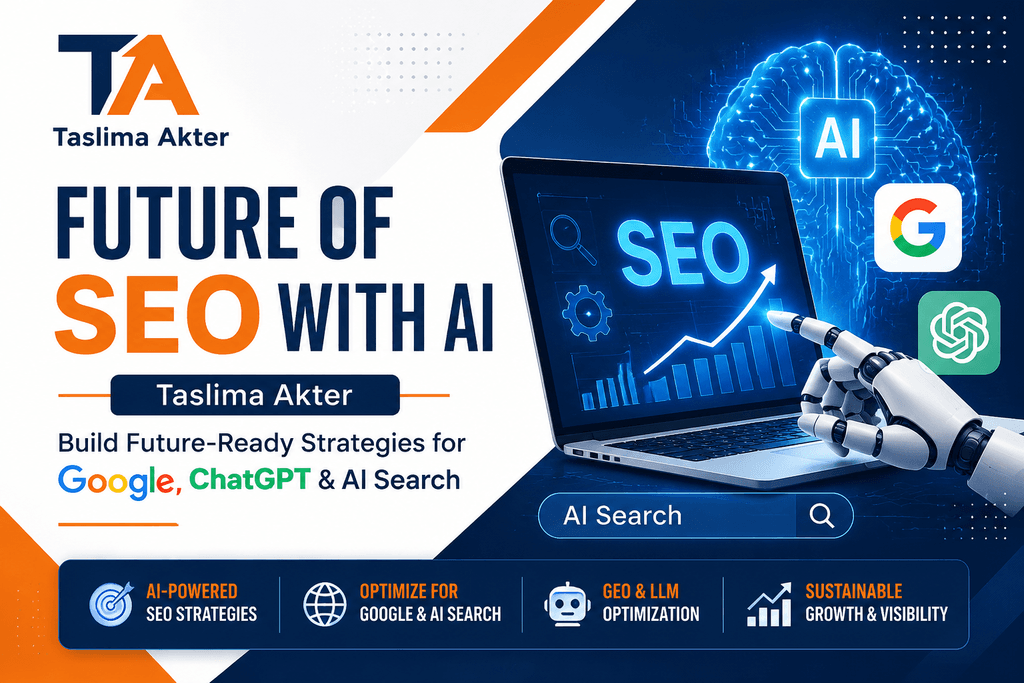
Future of SEO with AI is transforming the way businesses improve online visibility, reach customers, and build digital authority. Search engines are no longer focused only on matching keywords; instead, they now understand user intent, context, relationships, and content quality through advanced artificial intelligence technologies.
As AI-powered platforms such as Google AI Search, ChatGPT Search, and Generative AI assistants continue to grow, businesses need smarter SEO strategies that combine AI SEO, Technical SEO, Semantic SEO, GEO (Generative Engine Optimization), and E-E-A-T principles.
Taslima Akter helps businesses prepare for the future of search by developing future-ready SEO strategies that improve visibility across Google and AI-driven search platforms. The goal is not only to rank higher but also to create trusted digital experiences that search engines and users value.
Introduction – How Artificial Intelligence Is Transforming the Future of SEO
The digital search landscape is experiencing one of the biggest transformations in history. Previously, SEO mainly focused on keywords, backlinks, and technical improvements. However, modern search has shifted toward understanding users, answering questions, and delivering personalized experiences.
Artificial Intelligence is changing SEO by helping search engines understand human language more accurately. Through technologies like Machine Learning, Natural Language Processing (NLP), and Large Language Models (LLMs), search engines can now analyze the meaning behind searches instead of simply matching words.
Therefore, the future of SEO requires businesses to move beyond traditional optimization methods and focus on creating valuable, trustworthy, and AI-friendly digital experiences.
| Traditional SEO Approach | AI-Powered SEO Approach |
|---|---|
| Keyword matching | Understanding search intent |
| Ranking-focused strategy | User satisfaction-focused strategy |
| Single keyword targeting | Topic and entity optimization |
| Search engine-only focus | Google + AI search optimization |
Moreover, AI does not replace SEO professionals. Instead, it provides powerful opportunities for experts to analyze data, understand audiences, and create more effective strategies.
What Is the Future of SEO with AI?
The Future of SEO with AI represents the transition from traditional search optimization to intelligent search optimization. AI-powered systems now evaluate content based on relevance, expertise, context, and usefulness.
Modern SEO combines multiple advanced approaches, including:
- AI SEO for smarter optimization and analysis
- Semantic SEO for better topic understanding
- GEO for AI-generated search visibility
- LLM SEO for large language model understanding
- Technical SEO for stronger website performance
As a result, businesses that adopt AI-focused SEO strategies can create stronger connections between their content, customers, and search platforms.
Moving From Traditional SEO to Intelligent Search Optimization
Search engines have become more intelligent. Instead of evaluating pages only through keywords, AI systems analyze the complete meaning of content.
- User search intent
- Content depth and usefulness
- Entity relationships
- Website authority
- Experience and trust signals
Therefore, businesses should create content that answers customer needs rather than simply adding keywords repeatedly.
How AI Understands Search Intent, Context, and User Behavior
AI systems use advanced algorithms to understand what users actually want when they search. This process helps search engines deliver more accurate and meaningful results.
| AI Technology | SEO Impact |
|---|---|
| Natural Language Processing | Understands human language and meaning |
| Machine Learning | Improves search predictions |
| Large Language Models | Generates and understands complex answers |
For example, when someone searches for “best SEO consultant for business growth,” AI understands that the user may need expertise, trust, results, and service information rather than only a definition.
The Growing Importance of AI Search Optimization
AI Search Optimization focuses on preparing websites for AI-powered search experiences. As users increasingly depend on AI assistants, businesses must ensure their information is clear, structured, and trustworthy.
- Optimize content for direct answers
- Build strong brand authority
- Improve structured data
- Create expert-driven information
- Strengthen website credibility
Consequently, businesses that adapt early can gain stronger visibility opportunities in the evolving search ecosystem.
How AI Is Changing Modern SEO Strategies
AI has introduced smarter methods for keyword research, content planning, competitor analysis, and website optimization. However, successful SEO still depends on combining AI technology with professional strategy.
AI-Powered Keyword Research and Content Planning
AI tools help SEO professionals identify valuable opportunities by analyzing search behavior, related topics, and user questions.
- Discover keyword clusters
- Analyze search intent
- Identify content gaps
- Understand competitor strategies
- Find user-focused topics
Instead of creating many separate pages for similar keywords, modern SEO focuses on building complete topic coverage and strong topical authority.
AI Content Optimization for Better Search Visibility
AI can support content creation and optimization, but human expertise remains essential. High-quality content should combine AI assistance with real experience and professional knowledge.
- Helpful information
- Original insights
- Clear explanations
- Practical examples
- Expert opinions
Generative Engine Optimization (GEO): The Future of AI Search Visibility
Generative Engine Optimization (GEO) is becoming an important part of modern SEO because users are increasingly relying on AI-generated answers instead of traditional search results. GEO focuses on optimizing content so that AI platforms can better understand, reference, and recommend information.
Unlike traditional SEO, which mainly focuses on improving rankings on search engine result pages, GEO SEO focuses on improving visibility inside AI-generated responses from platforms such as ChatGPT, Google AI Search, and other large language model-based systems.
| Traditional SEO | Generative Engine Optimization (GEO) |
|---|---|
| Targets search rankings | Targets AI-generated recommendations |
| Focuses on keywords | Focuses on meaning and context |
| Optimizes web pages | Optimizes information understanding |
| Search engine visibility | AI answer visibility |
Therefore, businesses that want to succeed in the future of search should combine traditional SEO practices with GEO strategies to create stronger digital visibility.
How GEO Helps Websites Appear in AI-Generated Answers
AI systems select information based on relevance, trust, clarity, and authority. Therefore, websites need to provide well-structured and reliable information that AI models can easily understand.
- Create clear and informative content
- Answer specific user questions
- Build strong author and brand signals
- Use structured data properly
- Maintain consistent business information
Additionally, GEO requires businesses to focus on becoming a trusted source of information rather than only targeting individual keywords.
Optimizing Content for ChatGPT, Google AI Search, and LLM Platforms
Large Language Models (LLMs) understand information through patterns, relationships, and context. Therefore, content should be organized in a way that clearly explains topics and answers user needs.
- Use descriptive headings
- Provide direct answers
- Explain concepts clearly
- Include expert insights
- Connect related topics naturally
For example, content about AI SEO should not only define artificial intelligence. It should also explain how AI impacts keyword research, content optimization, technical SEO, search intent, and future marketing strategies.
Future-Ready SEO Strategies for Google, ChatGPT & AI Search
Future SEO strategies require businesses to create websites that are understandable for humans as well as artificial intelligence systems. The combination of technical excellence, content authority, and entity optimization creates a stronger foundation for long-term search success.
Building Strong Entity-Based SEO Signals
Entity SEO helps search engines and AI systems understand the relationship between people, businesses, services, and topics. Instead of viewing content as separate keywords, modern search systems analyze entities and their connections.
| Entity | Relationship |
|---|---|
| Taslima Akter | SEO Consultant and SEO Expert |
| SEO Consultant | Digital marketing service expertise |
| Technical SEO | Website performance optimization |
| AI SEO | Future search optimization |
Strong entity signals help AI systems understand who provides the information and why that source should be trusted.
Establishing Digital Authority Through E-E-A-T
E-E-A-T plays a major role in future SEO because search engines and AI systems prioritize trustworthy information. Businesses and professionals should demonstrate real experience and expertise through valuable content.
| E-E-A-T Factor | How It Builds Trust |
|---|---|
| Experience | Shows practical knowledge and real-world involvement |
| Expertise | Demonstrates professional skills |
| Authority | Builds industry recognition |
| Trust | Creates confidence among users |
Creating Consistent Brand Information Across Platforms
AI systems collect information from different online sources. Therefore, businesses should maintain consistent information across websites, social profiles, professional platforms, and business directories.
- Consistent brand name
- Clear professional identity
- Accurate service information
- Updated business profiles
- Connected online presence
Optimizing Content for Large Language Models (LLM SEO)
LLM SEO focuses on making content easier for large language models to understand and retrieve. Since AI systems analyze huge amounts of information, businesses must create content with clear structure and meaningful context.
- Use natural language writing
- Create detailed explanations
- Answer common questions
- Support claims with expertise
- Organize information logically
Creating AI-Friendly Content Structures
AI-friendly content structures improve understanding by organizing information clearly. Therefore, businesses should use:
- Question-based headings
- Short paragraphs
- Helpful tables
- Bullet points
- FAQ sections
Improving Content Retrieval for AI Systems
When content is well-structured and informative, AI systems can identify important information more effectively. Therefore, businesses should focus on clarity, relevance, and authority.
The Role of Technical SEO in AI-Powered Search
Technical SEO remains one of the most important foundations for AI search visibility. Even high-quality content cannot perform effectively if search engines cannot access, understand, or index the website properly.
A technically optimized website allows Google and AI systems to discover information more efficiently and provide better search experiences.
Strengthening Website Performance for Search Engines and AI Systems
Website performance directly affects user experience and search accessibility. Therefore, technical SEO should focus on creating a fast, secure, and reliable website environment.
- Improve page speed
- Optimize Core Web Vitals
- Enhance mobile usability
- Improve website security
- Create clean website architecture
Using Structured Data to Help AI Understand Websites
Structured data provides additional information about website content. It helps search engines understand businesses, services, authors, and other important entities.
| Schema Type | Purpose |
|---|---|
| Person Schema | Defines author expertise |
| Organization Schema | Explains business identity |
| Service Schema | Describes offered services |
| FAQ Schema | Highlights question answers |
Improving Website Crawling and Indexing for Better Visibility
Search engines must properly crawl and index pages before they can appear in search results. Therefore, technical SEO focuses on removing barriers and improving accessibility.
- Optimize XML sitemap
- Manage robots.txt correctly
- Fix indexing errors
- Improve internal linking
- Use proper canonical tags
By strengthening technical foundations, businesses can create websites that are ready for Google Search, ChatGPT, and future AI-powered search experiences.
AI SEO vs Traditional SEO: Understanding the Difference
The evolution of search technology has completely changed how businesses approach optimization. Traditional SEO focused mainly on keywords, backlinks, and ranking improvements. However, the Future of SEO with AI requires a more advanced approach that combines artificial intelligence, user intent, data analysis, and human expertise.
AI SEO does not replace traditional SEO. Instead, it enhances the SEO process by helping professionals understand user behavior, analyze large amounts of data, and create more effective optimization strategies.
| Traditional SEO | AI SEO |
|---|---|
| Focuses mainly on keywords | Focuses on intent, context, and meaning |
| Optimizes for search rankings | Optimizes for visibility across search and AI platforms |
| Uses manual analysis | Uses AI-assisted insights and automation |
| Targets individual keywords | Builds complete topic authority |
| Search engine focused | Google, ChatGPT, and AI search focused |
Therefore, successful businesses should combine traditional SEO foundations with modern AI Search Optimization strategies to remain competitive in the changing digital environment.
How AI SEO Creates More Intelligent Optimization
Artificial intelligence helps SEO professionals discover deeper insights and create smarter strategies. Instead of depending only on assumptions, AI allows marketers to analyze real search behavior and identify valuable opportunities.
- Analyze search intent more accurately
- Discover keyword relationships
- Identify content gaps
- Improve competitor research
- Predict search trends
- Optimize content structure
Moreover, AI helps businesses understand what users actually need. As a result, SEO strategies become more focused on solving problems rather than simply achieving rankings.
Why Human Expertise Still Matters in AI SEO
Although AI technology has transformed SEO, human expertise remains essential. Artificial intelligence can analyze information quickly, but it cannot fully understand business goals, customer emotions, industry challenges, or unique brand positioning.
A successful SEO strategy requires the combination of advanced technology and professional experience.
| Human Expertise | Why It Matters |
|---|---|
| SEO Strategy | Creates a clear direction for growth |
| Industry Knowledge | Understands customer needs and challenges |
| Experience | Provides practical optimization decisions |
| Creativity | Creates unique and valuable content |
| Decision Making | Selects the right SEO actions |
For example, AI can suggest keywords related to Technical SEO Consultant Bangladesh, but an experienced SEO professional understands which keywords bring business value, which pages should target them, and how to create content that builds trust.
Combining Human Expertise With AI Technology
The future of SEO is not about choosing between humans and AI. Instead, the strongest results come from combining AI capabilities with expert strategy.
- AI provides data insights
- SEO experts create strategies
- AI improves efficiency
- Experts maintain quality
- Technology supports decision-making
Consequently, businesses can achieve better results by using AI as a powerful assistant while maintaining human creativity, expertise, and strategic thinking.
How Taslima Akter Helps Businesses Prepare for AI SEO
As an SEO Consultant | Taslima Akter, the focus is on helping businesses adapt to the changing search environment through advanced SEO strategies. Modern search requires more than keyword optimization; it requires a complete approach that combines technology, expertise, and user-focused strategies.
The goal is to help businesses improve their visibility across Google, ChatGPT, and AI-powered search platforms by creating strong technical foundations, authoritative content, and future-ready optimization strategies.
Developing Advanced AI SEO Strategies for Business Growth
A successful AI SEO strategy requires understanding the relationship between users, search engines, and business objectives. Therefore, each strategy should be customized according to industry, audience, and competition.
| SEO Strategy Area | Business Benefit |
|---|---|
| AI SEO | Improves visibility in modern search environments |
| Technical SEO | Creates a stronger website foundation |
| Semantic SEO | Builds deeper topic authority |
| Content Optimization | Improves user engagement |
| GEO Optimization | Prepares content for AI answers |
Optimizing Websites for Google and AI Search Platforms
Google and AI search systems require websites to provide clear, reliable, and structured information. Therefore, businesses need optimization strategies that improve both search engine understanding and user experience.
- Improve technical website performance
- Create expert-driven content
- Strengthen entity signals
- Implement structured data
- Improve search intent matching
Creating Long-Term Search Success Through Future-Proof SEO
Search algorithms continue changing, but strong SEO foundations remain valuable. Therefore, future-proof SEO focuses on creating websites that are technically healthy, trustworthy, and useful.
- Build sustainable organic visibility
- Increase brand authority
- Create better user experiences
- Prepare for future search updates
Benefits of Future-Ready AI SEO Strategies
Future-ready SEO strategies help businesses prepare for the next generation of search. By combining AI SEO, GEO, Technical SEO, Semantic SEO, and E-E-A-T, businesses can create stronger digital visibility.
Improve Visibility Across Google and AI Search Platforms
AI-powered search is changing how users discover information. Businesses that optimize for both traditional search engines and AI platforms can increase their opportunities to be discovered.
- Better search visibility
- Stronger online presence
- Improved brand recognition
- More qualified visitors
Attract More Relevant Customers Through Search Intent
Modern SEO focuses on understanding customer needs. By matching content with search intent, businesses can attract users who are more likely to engage and convert.
Build Strong Digital Authority and Brand Trust
AI systems prefer reliable and authoritative sources. Therefore, businesses should continuously improve their expertise, content quality, and online reputation.
- Expert content
- Author credibility
- Consistent branding
- Reliable information
Increase Sustainable Organic Growth
Future-ready SEO creates long-term value by improving visibility, trust, and customer relationships. Instead of depending on temporary ranking tactics, businesses can build a strong digital foundation.
Future SEO Trends Driven by Artificial Intelligence
The future of search is continuously evolving because artificial intelligence is changing how people discover, evaluate, and consume information. Therefore, businesses must understand upcoming SEO trends 2026 and prepare strategies that support Google Search, AI platforms, and changing user behaviors.
The next generation of SEO will focus less on traditional ranking methods and more on creating meaningful digital experiences. Businesses that combine AI SEO, GEO, LLM SEO, Technical SEO, and E-E-A-T will have stronger opportunities to build long-term visibility.
Growth of Generative Search Experiences
Generative search is changing how users interact with search engines. Instead of browsing multiple websites, users can now receive direct AI-generated answers based on different information sources.
Therefore, businesses need to optimize content that AI systems can understand, trust, and reference.
- Create clear and comprehensive content
- Answer user questions directly
- Build strong authority signals
- Improve content structure
- Maintain accurate information
Increasing Importance of GEO and LLM Optimization
Generative Engine Optimization (GEO) and LLM SEO are becoming important because AI platforms rely on structured, trustworthy, and context-rich information.
| Future SEO Area | Importance |
|---|---|
| GEO Optimization | Improves visibility in AI-generated answers |
| LLM SEO | Helps AI systems understand content |
| Entity SEO | Builds stronger brand recognition |
| Semantic SEO | Improves topic understanding |
Voice Search and Conversational SEO Growth
Voice search continues to influence how users interact with technology. People often use natural conversations instead of short keywords when asking questions.
Therefore, businesses should create content that answers conversational queries such as:
- What is the best SEO strategy for businesses?
- How can AI improve website rankings?
- Who is a trusted SEO consultant?
- How does technical SEO improve visibility?
Personalized Search Experiences Through AI
AI enables search platforms to provide more personalized results based on user behavior, interests, location, and previous interactions.
- Better audience targeting
- More relevant search results
- Improved customer experiences
- Stronger content personalization
AI-Assisted SEO Automation and Data Analysis
AI will continue supporting SEO professionals by improving efficiency. However, successful optimization still requires human strategy and expertise.
| AI Support Area | SEO Benefit |
|---|---|
| Data Analysis | Finds valuable insights faster |
| Keyword Research | Identifies opportunities |
| Content Analysis | Improves optimization |
| Reporting | Saves time and improves decisions |
Common Mistakes Businesses Make in AI SEO
Although AI provides powerful opportunities, businesses often make mistakes when adopting AI SEO strategies. Avoiding these mistakes helps create stronger and more sustainable search performance.
Depending Only on AI-Generated Content
AI-generated content can support SEO, but depending only on automation may reduce originality and expertise. Search engines and users value content that provides real experience and unique insights.
- Add expert opinions
- Include real examples
- Improve accuracy
- Maintain brand personality
Ignoring Human Experience and Expertise
AI can process information, but it cannot replace professional experience. Businesses should demonstrate real knowledge through expert authorship, case studies, and valuable insights.
Creating Content Without Search Intent
One of the biggest SEO mistakes is creating content without understanding what users actually need.
- Analyze user questions
- Understand search purpose
- Match content with customer needs
- Provide complete solutions
Neglecting Technical SEO Foundations
Even excellent AI-optimized content cannot perform well if a website has technical problems. Therefore, businesses should maintain strong technical SEO foundations.
- Website speed optimization
- Mobile responsiveness
- Proper indexing
- Structured data implementation
Failing to Optimize for AI Search Platforms
Many businesses still focus only on traditional Google rankings. However, future visibility requires preparation for AI-driven search experiences.
Frequently Asked Questions About Future of SEO with AI
1. What is the Future of SEO with AI?
The future of SEO with AI focuses on combining artificial intelligence, user intent optimization, GEO, technical SEO, and expert-driven strategies to improve search visibility.
2. How is AI changing SEO strategies?
AI is changing SEO by improving keyword research, content optimization, search understanding, data analysis, and personalization.
3. Will AI replace SEO experts?
No. AI supports SEO professionals, but human strategy, creativity, experience, and decision-making remain essential.
4. What is GEO in SEO?
GEO (Generative Engine Optimization) focuses on improving visibility within AI-generated answers and generative search platforms.
5. How can businesses optimize for ChatGPT search?
Businesses can optimize for ChatGPT search by creating trustworthy content, improving technical SEO, building authority, and using clear information structures.
6. Is AI-generated content good for SEO?
AI-generated content can support SEO when it is reviewed, improved, and combined with human expertise and original insights.
7. Why is E-E-A-T important for AI search?
E-E-A-T helps demonstrate experience, expertise, authority, and trust, which are important for reliable search results.
8. What is LLM SEO?
LLM SEO focuses on optimizing content so large language models can better understand, process, and reference information.
9. How does technical SEO support AI search visibility?
Technical SEO improves website accessibility, crawling, indexing, performance, and structured understanding for search engines and AI systems.
10. How can Taslima Akter help businesses with AI SEO?
Taslima Akter helps businesses build future-ready SEO strategies using AI SEO, technical optimization, GEO, content strategy, and authority-building methods.
Conclusion – Building a Future-Proof SEO Strategy With AI
The Future of SEO with AI is not about replacing traditional SEO methods. Instead, it represents a smarter evolution where businesses combine artificial intelligence, human expertise, technical excellence, and valuable content strategies.
As search continues evolving through Google AI Search, ChatGPT, and generative search platforms, businesses must create websites that are trustworthy, understandable, and technically strong.
- Build strong SEO foundations
- Create expert-driven content
- Optimize for AI search
- Improve technical performance
- Strengthen brand authority
By combining AI SEO, GEO, LLM SEO, technical SEO, Semantic SEO, and E-E-A-T, businesses can prepare for the next generation of search and achieve sustainable digital growth.
Taslima Akter helps businesses navigate this changing SEO landscape by developing future-ready strategies designed for Google, ChatGPT, and AI-powered search experiences.