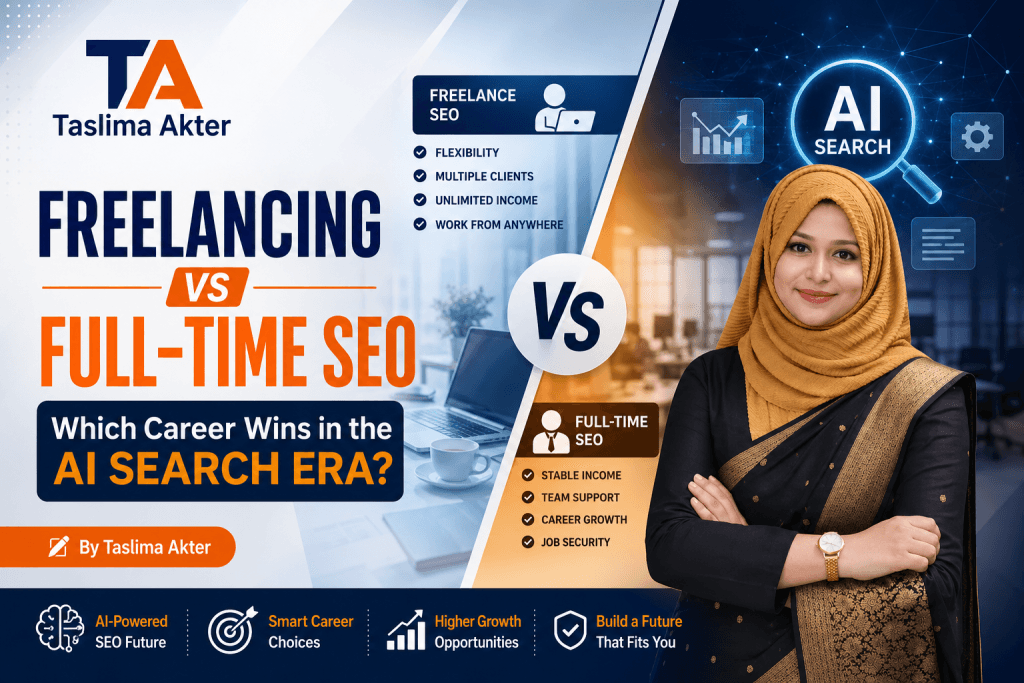
Freelancing vs Full-Time SEO: Which Career Wins in the AI Search Era? A few years ago, choosing an SEO career seemed simple. You either joined a company as an SEO specialist or worked independently as a freelancer. Today, however, artificial intelligence, Google AI Overviews, conversational search, and Generative Engine Optimization have changed the decision.
Businesses no longer need SEO professionals who only place keywords, build backlinks, and track rankings. Instead, they need specialists who understand search intent, technical SEO, semantic content, user experience, E-E-A-T, AI search visibility, and measurable business growth.
Therefore, the debate around Freelancing vs Full-Time SEO is no longer only about freedom versus job security. It is also about learning opportunities, income potential, access to technology, professional responsibility, and the ability to adapt to the AI search era.
Both career paths can offer excellent opportunities. Nevertheless, the right choice depends on your skills, financial situation, personality, experience, and long-term goals.
This guide compares freelance SEO and full-time SEO so you can confidently choose the career path that suits you best.
What Is Freelance SEO?
Freelance SEO means providing search engine optimization services independently to different clients. Instead of working permanently for one employer, a freelance SEO specialist manages projects for businesses, agencies, entrepreneurs, e-commerce stores, or local companies.
A freelance SEO professional may offer services such as:
- Keyword research
- SEO audits
- On-page SEO
- Technical SEO
- Local SEO
- Content optimization
- Link-building strategy
- WordPress SEO
- E-commerce SEO
- Google Search Console analysis
- AI SEO and GEO
- SEO reporting and consultation
Freelancers may charge clients per project, per hour, through a monthly retainer, or according to specific deliverables.
How Freelance SEO Work Operates
First, an SEO freelancer finds clients through personal branding, referrals, LinkedIn, networking, social media, freelance marketplaces, or a professional website. Next, the freelancer identifies the client’s problems, prepares an SEO proposal, agrees on the scope of work, and begins the campaign.
However, completing SEO tasks is only one part of freelancing. A freelancer must also communicate with clients, manage deadlines, send invoices, prepare reports, market services, and handle several projects simultaneously.
Clients, Projects, Income, and Flexibility
Freelance SEO provides significant flexibility because professionals can often choose:
- Which clients they accept
- Which services they provide
- Where they work
- When they work
- How much they charge
- How many projects they manage
Moreover, experienced freelancers can increase their rates as they build authority, case studies, and specialised knowledge.
On the other hand, freelance income may not always be predictable. Some months may bring several projects, while others may be quieter. Therefore, successful SEO freelancing requires financial planning, client retention, and consistent marketing.
What Is Full-Time SEO?
Full-time SEO means working as a permanent or contracted employee for one organisation. The role may be available within an SEO agency, digital marketing company, software business, e-commerce brand, media organisation, or corporate marketing department.
A full-time SEO professional usually receives a fixed monthly salary and works according to the employer’s schedule, policies, objectives, and reporting structure.
How In-House and Agency SEO Roles Work
Full-time SEO positions generally fall into two main categories.
An in-house SEO specialist focuses primarily on one company’s website, products, audience, and long-term organic growth.
An agency SEO specialist, in contrast, often manages several client websites from different industries. Therefore, agency work may provide greater variety and faster exposure to different SEO challenges.
Salary, Team Support, and Career Stability
A full-time SEO job often provides:
- Predictable monthly income
- Defined working hours
- Paid holidays
- Team collaboration
- Access to premium SEO tools
- Professional training
- Structured career progression
- Support from content writers, developers, and designers
Additionally, full-time employees usually spend less time searching for clients or negotiating payments.
However, they may have less control over projects, working hours, strategies, and income growth. Their professional development may also depend on the organisation’s leadership, resources, and willingness to test new SEO methods.
Freelancing vs Full-Time SEO: Key Differences
Understanding the major differences between Freelancing vs Full-Time SEO will help you choose more carefully.
Income and Earning Potential
Freelancers may have a higher earning ceiling because they can set their rates, work with international clients, sell specialised services, and manage several retainers.
For example, a freelance SEO consultant may charge separately for:
- A technical SEO audit
- Keyword research
- Content strategy
- Monthly SEO management
- Local SEO
- SEO consultation
Therefore, skilled freelancers can build multiple income sources.
Nevertheless, higher income is not guaranteed. Freelancers must continuously attract clients, demonstrate results, and manage business expenses.
Full-time SEO professionals receive more predictable income. Although their salary may grow slowly, they usually face less monthly financial uncertainty.
Consequently, freelance SEO may offer greater earning potential, while full-time SEO generally offers greater income stability.
Flexibility and Work-Life Balance
Freelancers can often work remotely, choose their schedules, and organise their workloads. This flexibility can be especially valuable for people managing families, studies, travel, or other responsibilities.
However, flexibility does not automatically create work-life balance. Freelancers may work late at night, answer urgent client messages, or manage deadlines during weekends.
Full-time employees usually have fixed working hours. While this limits freedom, it can also make it easier to separate work from personal life.
Therefore, the better option depends on whether you prefer schedule control or clear workplace boundaries.
Job Security and Financial Stability
A permanent SEO role usually offers better short-term financial stability. Employees know when they will receive their salary and can plan expenses more easily.
Freelancers, however, depend on client retention and project availability. A client may pause a campaign, reduce a budget, or end a contract unexpectedly.
Still, full-time employment is not completely secure. Companies can restructure departments, reduce marketing budgets, or change business priorities.
Freelancers may reduce risk by maintaining several clients, building emergency savings, and creating recurring revenue through monthly SEO retainers.
Skill Development and Career Growth
Agency and in-house roles can provide structured training, team feedback, and access to senior professionals. As a result, beginners may learn faster in a full-time environment.
For instance, an SEO executive may collaborate with:
- Web developers
- Copywriters
- Paid advertising specialists
- UX designers
- Data analysts
- Digital PR professionals
This collaboration builds broader digital marketing knowledge.
Freelancers, meanwhile, often learn through real-world challenges. They must understand strategy, communication, sales, reporting, and project management. Consequently, freelancing can develop both SEO expertise and entrepreneurial skills.
Client Pressure and Workload
Freelancers communicate directly with clients and are personally responsible for expectations, deadlines, reports, and results. Therefore, client management can become stressful.
A freelancer may also face scope creep, delayed payments, frequent revisions, or unrealistic ranking expectations.
Full-time employees usually report to a manager, team leader, or department head. Although they may still face performance pressure, the organisation often shares responsibility across a team.
Therefore, people who enjoy independence may prefer freelance SEO, while those who value shared responsibility may prefer full-time employment.
Access to SEO Tools and Resources
Premium SEO tools can be expensive for independent professionals. Freelancers may need to invest in keyword research tools, rank trackers, crawling software, reporting platforms, and content optimization systems.
Companies and agencies usually provide access to these tools. Moreover, full-time professionals may receive support from developers, designers, and content teams.
However, freelancers can begin with affordable or free resources, including:
- Google Search Console
- Google Analytics
- Google Keyword Planner
- PageSpeed Insights
- Google Trends
- Bing Webmaster Tools
How AI Search Is Changing Both Career Paths
AI-powered search is transforming how people discover information. Users increasingly ask complete questions instead of entering short keyword phrases. Search platforms may then generate direct summaries, recommendations, or conversational answers.
Therefore, modern SEO professionals must optimize content for both traditional search results and AI-generated experiences.
The Growing Importance of GEO and AI SEO
Generative Engine Optimization, commonly known as GEO, focuses on improving a brand’s chances of being understood, trusted, cited, or recommended by AI-powered search systems.
Although traditional SEO remains essential, professionals must now pay greater attention to:
- Clear answers
- Search intent
- Topic depth
- Entity relationships
- Structured content
- Original expertise
- Accurate information
- Author credibility
- Brand mentions
- Schema markup
- Content freshness
- Natural language questions
Freelancers who quickly learn GEO can introduce valuable new services. Similarly, full-time SEO teams can integrate AI search optimization into broader content and brand strategies.
Google AI Overviews and Generative Search
AI-generated search experiences often combine information from multiple sources. Therefore, vague, repetitive, or poorly structured content may struggle to gain visibility.
To compete, SEO professionals should create content that is easy to interpret and extract. For example, they should use descriptive headings, concise explanations, useful comparisons, expert insights, and relevant supporting details.
Skills SEO Professionals Need to Stay Competitive
In the AI search era, both freelance and full-time SEO professionals should develop skills in:
- Technical SEO
- Semantic SEO
- Content strategy
- Search intent analysis
- E-E-A-T optimization
- Data interpretation
- Conversion optimization
- AI-assisted research
- Prompt evaluation
- Structured data
- Digital PR
- Brand authority building
Moreover, professionals must verify AI-generated information instead of publishing it without review. Human expertise, original experience, and editorial judgement remain essential.
Pros and Cons of Freelance SEO
Freelance SEO can be highly rewarding, especially for professionals who value independence and business ownership.
Greater Freedom but Higher Responsibility
The main advantages include:
- Flexible working hours
- Remote work opportunities
- Control over clients and projects
- Higher earning potential
- International market access
- Personal brand development
- Freedom to specialise
However, the disadvantages include:
- Unstable income
- Client acquisition pressure
- Administrative responsibilities
- Delayed payments
- Limited employee benefits
- Greater personal accountability
- Possible isolation
Therefore, freelance SEO is not simply an easy work-from-home career. It is a business that requires discipline, communication, financial planning, and continuous learning.
Pros and Cons of Full-Time SEO
Full-time SEO is often suitable for people who want structured learning, teamwork, and predictable income.
More Stability but Less Independence
The main advantages include:
- Reliable salary
- Clear job responsibilities
- Access to professional tools
- Team support
- Mentorship opportunities
- Employee benefits
- Defined career progression
However, possible disadvantages include:
- Fixed working hours
- Less control over strategy
- Limited project choice
- Slower income growth
- Office politics
- Repetitive responsibilities
- Dependence on company decisions
Consequently, a full-time role may be ideal for building a strong foundation. Later, the professional may choose to move into consulting, freelancing, leadership, or specialised SEO work.
Freelancing vs Full-Time SEO: Which Career Is Better for You?
There is no universal winner in the Freelancing vs Full-Time SEO comparison. Instead, the right career depends on your personal circumstances.
Choose Freelancing If You Value Independence
Freelance SEO may suit you if you:
- Enjoy managing your own schedule
- Communicate confidently with clients
- Can tolerate income fluctuations
- Want to build a personal brand
- Prefer working independently
- Understand sales and negotiation
- Have enough experience to deliver results
Furthermore, freelancing may be attractive if you want to specialize in WordPress SEO, local SEO, e-commerce SEO, technical SEO, or AI search optimization.
Choose Full-Time SEO If You Prefer Stability
A full-time SEO career may be better if you:
- Prefer predictable income
- Want guidance from senior professionals
- Learn effectively within a team
- Need access to premium tools
- Value employee benefits
- Want a clear promotion path
- Are beginning your SEO career
In particular, beginners may benefit from spending time in an agency or in-house team before moving into freelance work.
Can You Combine Freelancing with a Full-Time SEO Job?
Yes, some SEO professionals develop a hybrid career. They keep a full-time job while handling a limited number of freelance projects outside working hours.
This approach can provide stable income while allowing the person to build a portfolio, attract clients, and test freelance business systems.
Building a Hybrid SEO Career Safely
Before accepting freelance projects, check your employment agreement. Some companies restrict outside work, client relationships, or the use of company resources.
Additionally, avoid conflicts of interest. Never use confidential company information, paid tools, working hours, or client data for personal projects.
A safe hybrid strategy may include:
- Choosing one specialised freelance service
- Accepting only a manageable number of clients
- Setting clear communication hours
- Using separate tools and accounts
- Avoiding competing businesses
- Creating written agreements
- Protecting your personal time
Over time, you can evaluate whether freelance income and demand are strong enough to support a full transition.
Conclusion
The Freelancing vs Full-Time SEO decision depends on the kind of career and lifestyle you want to build.
Freelance SEO offers greater freedom, unlimited earning potential, personal branding opportunities, and access to global clients. However, it also brings income uncertainty, client pressure, and business responsibilities.
Full-time SEO provides predictable income, structured learning, collaboration, and access to professional resources. Nevertheless, it may offer less flexibility and slower financial growth.
In the AI search era, neither path wins automatically. Instead, professionals who continuously learn, produce trustworthy work, understand user intent, and adapt to SEO, GEO, and AI-powered search will remain competitive.
Therefore, choose the career environment that supports your current needs. Then, continue developing practical skills, measurable experience, and genuine authority. Ultimately, your adaptability will matter more than your job title.
Frequently Asked Questions
1. What is the main difference between freelancing and full-time SEO?
Freelance SEO professionals work independently for different clients, while full-time SEO professionals work permanently for one company or agency. Freelancers have greater flexibility, whereas employees usually receive more stable income.
2. Is freelance SEO a good career?
Yes, freelance SEO can be a strong career for people with practical SEO skills, communication ability, discipline, and client management experience. However, success requires more than technical knowledge because freelancers must also market and manage their businesses.
3. Is full-time SEO better for beginners?
Generally, full-time SEO can be beneficial for beginners because it provides structured training, team support, professional tools, and exposure to real campaigns. However, beginners can also start freelancing with small, clearly defined projects.
4. Which option offers a higher income?
Freelancing may offer a higher earning ceiling because professionals can set their rates and manage multiple clients. Full-time SEO, however, usually offers more predictable monthly income and employment benefits.
5. What skills does a freelance SEO specialist need?
A freelance SEO specialist needs keyword research, on-page SEO, technical SEO, content optimization, analytics, reporting, communication, sales, project management, and client relationship skills.
6. How is AI changing SEO careers?
AI is changing how users search, how content is created, and how search platforms present answers. Consequently, SEO professionals must understand AI search optimization, GEO, semantic SEO, structured content, E-E-A-T, and information accuracy.
7. Can I do freelance SEO while working full-time?
Yes, you can combine both career paths if your employment agreement allows it. However, you should avoid conflicts of interest, protect confidential information, and manage your workload responsibly.
8. Does SEO freelancing require investment?
Some investment may be necessary for a website, professional tools, training, communication software, and business branding. Nevertheless, freelancers can initially use free tools such as Google Search Console, Google Analytics, and PageSpeed Insights.
9. Which SEO career offers better work-life balance?
The answer depends on personal habits and workplace conditions. Freelancers have more schedule control, but they may work irregular hours. Full-time employees have less flexibility, although their working hours may be more clearly defined.
10. Who wins in the Freelancing vs Full-Time SEO comparison?
Neither career path wins for everyone. Freelancing is often better for independence and earning potential, while full-time SEO is generally stronger for stability, teamwork, and structured learning. The best choice depends on your goals, experience, and financial situation.
To Learn More, you may visit@Taslima Akter.