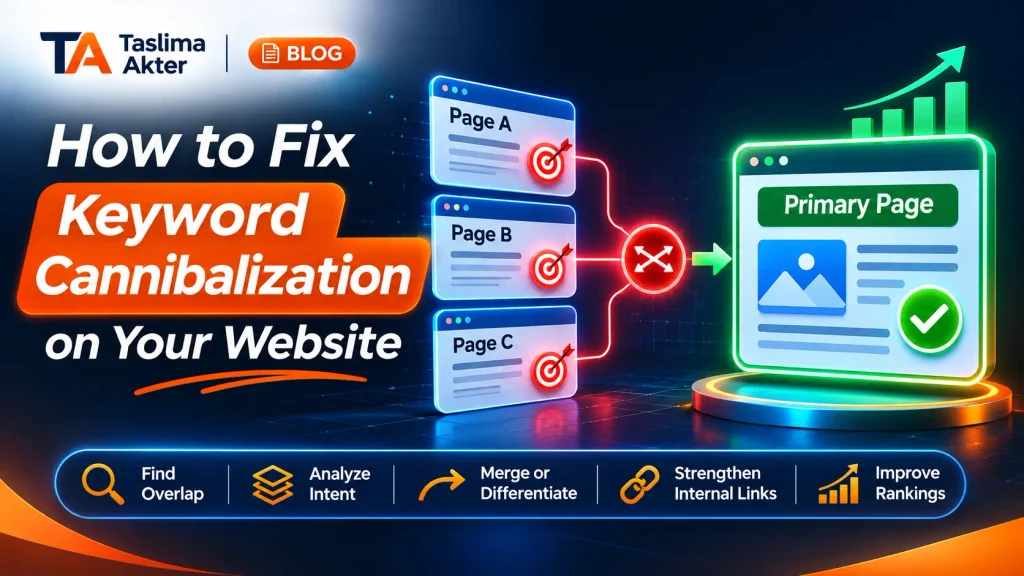
Keyword Cannibalization occurs when multiple pages on a website target substantially overlapping search intent in a way that creates an ineffective content strategy or interferes with the visibility of a preferred page. Although websites often have several URLs ranking for related keywords, genuine cannibalization requires a closer examination of what each page offers and how it performs.
Imagine publishing three blog posts about technical SEO. One explains technical SEO audits, another presents a technical checklist, and the third covers general website optimization. Initially, the articles may appear different. However, if they repeat the same explanations, target identical search questions, and compete for the same audience, your website may lack a clear primary resource. Consequently, visitors and search engines may have difficulty identifying the most useful page for a particular query.
Fortunately, the solution is not always deleting articles or combining every page containing the same keyword. Sometimes, clearer search intent, improved internal linking, differentiated headings, and more useful content are enough. In other cases, merging overlapping articles and implementing appropriate redirects may create a stronger page. Therefore, the correct decision depends on evidence rather than keyword repetition alone.
In this guide, Taslima Akter, Chairman & Co-Founder at Floriva IT and an SEO specialist based in Bangladesh, explains how to identify keyword cannibalization, evaluate competing URLs, and select practical solutions. Furthermore, the article includes examples, a keyword mapping framework, a content decision matrix, and an SEO audit worksheet to help website owners improve their content structure while protecting useful existing pages.
When Does Keyword Overlap Become a Problem?
HEALTHY OVERLAP
Related keywords, different search intent, distinct useful pages.
RISKY OVERLAP
Similar queries, repeated answers, unclear primary destination.
BETTER STRUCTURE
One clear page for each important search intent.
SEO Goal: Preserve Useful Pages, Eliminate Unnecessary Intent Duplication.
What Is Keyword Cannibalization in SEO?
Keyword cannibalization in SEO describes problematic overlap between webpages targeting the same or closely related search intent. The issue is not simply that several pages contain the same keyword. Instead, the pages may compete to serve an almost identical purpose without offering sufficiently distinct value.
For example, a company may publish separate articles titled “SEO Audit Guide,” “Complete SEO Audit Guide,” and “How to Perform an SEO Audit.” If these pages contain nearly identical advice and answer the same search question, consolidation or differentiation may be worth considering.
Keyword Cannibalization vs Normal Keyword Overlap
Normal keyword overlap occurs when different webpages rank for some of the same queries while serving different needs. A commercial SEO service page and an educational technical SEO article may naturally share several keywords.
However, they serve different purposes. The service page helps someone evaluate hiring an SEO provider, while the article explains technical concepts. Therefore, keeping both may be strategically appropriate.
Does Google Penalize Websites for Keyword Cannibalization?
There is no general automatic Google penalty simply because two pages rank for the same keyword. Nevertheless, excessive content overlap can make a website less useful and create uncertainty about its preferred resources.
Consequently, focus on diagnosing actual search performance and content problems rather than treating every overlapping query as a technical error.
Why Keyword Cannibalization Can Affect Organic Search Performance
When several webpages provide almost identical answers, the website may fail to establish a clear content hierarchy. Although Google can rank multiple pages from one domain, an unclear structure may complicate your internal linking, topical organization, and measurement of content performance.
Unclear Primary Landing Pages
Suppose an SEO agency wants visitors searching for professional SEO services to reach its commercial service page. However, a loosely related educational article receives more impressions for that query. This does not automatically prove a problem, but it may suggest that the service page’s relevance or supporting links deserve closer attention.
Overlapping Information and User Confusion
Repeated content can make it difficult for visitors to choose the most relevant page. Furthermore, similar titles and introductions may fail to communicate why each article exists.
Fragmented Internal Linking
When related articles use inconsistent links to several nearly identical resources, the website may lack a clear primary destination. Therefore, a logical pillar and cluster structure can make content relationships easier to understand.
However, ranking fluctuations alone are not definitive evidence of cannibalization. Search results naturally change because of relevance, competition, freshness, location, and other factors. Accordingly, confirm the underlying problem before making changes.
Common Causes of Keyword Cannibalization on Websites
Most keyword overlap problems develop gradually as websites publish more pages. Without an organized keyword map, content teams may unknowingly create several articles for the same search purpose.
Publishing Multiple Articles for Keyword Variations
Searchers may use different phrases to express the same need. For example, “SEO audit process” and “how to audit a website for SEO” can overlap substantially in intent. Publishing a separate page for every wording variation may create repetitive content.
Creating Several Pages for the Same Search Intent
A service page, category page, and blog article may target similar commercial phrases. However, if all three attempt to satisfy the same buying intent, the content strategy may become unnecessarily fragmented.
Poor Internal Linking and Content Hierarchy
Without clear relationships between main pages and supporting articles, visitors may not know which destination provides the complete answer. Meanwhile, vague anchor text may fail to communicate why one page is more relevant to a specific topic.
Outdated Articles and Repeated Content Updates
Sometimes, an older guide remains published after a newer article covers the same information. Instead of updating the existing content, the website creates another competing resource. Consequently, maintaining both may require unnecessary editorial work.
Therefore, review existing URLs before planning new content. A clear understanding of published topics, primary search intents, and content gaps can prevent avoidable overlap.
How to Find Keyword Cannibalization in Google Search Console
Google Search Console is a useful starting point for identifying queries that generate impressions and clicks across multiple URLs. However, seeing several URLs for one query is only a signal to investigate, not conclusive evidence of harmful cannibalization.
Filter Search Performance by Query
Open Search Console and navigate to Performance → Search results. Next, apply a query filter for the relevant search term. Afterward, review the Pages tab to identify which URLs receive impressions or clicks for that query.
Compare Pages Over Time
Review the performance of each URL across a meaningful date range. For example, if one page consistently attracts visitors with a specific intent, while another appears occasionally for the same query, the overlap may be harmless.
Conversely, if important URLs repeatedly compete to satisfy an identical intent and neither offers distinct information, a content audit may be useful.
Compare Search Intent, Not Just Keyword Position
Read both pages and determine what the visitor is trying to accomplish. Consider whether one page serves informational intent while the other serves commercial or transactional intent.
Additionally, examine the search results themselves. If Google displays substantially different page types for different related queries, separate pages may be justified.
Understand the Limitations of Search Console Data
Search Console performance reports do not provide a complete record of every query and URL combination. Filtering, anonymized queries, aggregation, and data availability can affect what appears. Therefore, combine its findings with manual content analysis and other appropriate tools.
How to Perform a Keyword Cannibalization Audit
A keyword cannibalization audit combines keyword research, page-level performance, and search intent analysis. Its purpose is to determine which pages should remain independent and which would benefit from restructuring.
Create a Keyword-to-URL Map
List important website URLs, their primary target keywords, search intent, content type, and current performance. Furthermore, record whether a page is a commercial pillar, product page, service page, or supporting blog article.
This information helps identify pages with identical primary intent and reveals opportunities to clarify each page’s role.
Use a Search Intent Comparison Matrix
The following example demonstrates how related keywords can belong to separate pages without automatically causing cannibalization. All example URLs are illustrative.
| Example Page | Primary Intent | Recommended Role |
|---|---|---|
| /seo-services/ | Find or hire an SEO provider. | Commercial service pillar. |
| /technical-seo-checklist/ | Follow an actionable technical checklist. | Informational support article. |
| /seo-audit-cost/ | Understand audit pricing factors. | Cost-focused guide. |
| /how-to-audit-seo/ | Learn the audit process. | How-to article; compare with checklist intent. |
Identify Genuine Intent Conflicts
Compare page introductions, headings, examples, and target queries. If two articles offer almost the same explanation to the same audience, consider consolidation. However, if the pages answer different questions, improve their differentiation and internal links instead.
Finally, review backlinks and organic traffic before changing important URLs. An established page may contain valuable information and links that should be preserved during restructuring.
How to Fix Keyword Cannibalization Without Losing Valuable Pages
The best solution depends on the cause of the overlap. Some pages need more distinct content, while others should be consolidated. Therefore, avoid applying one universal fix to every group of related URLs.
Merge Articles With the Same Search Intent
When two articles provide substantially the same answer, select a suitable primary page and combine valuable unique information into it. Afterward, redirect an obsolete URL to the relevant replacement when the old page is permanently retired.
Differentiate Pages That Serve Distinct Needs
If both pages offer useful but different information, revise their titles, introductions, headings, and examples to make their purposes clear. For instance, a cost guide should explain pricing factors rather than repeat a complete service page.
Improve Internal Linking
Use descriptive internal links to connect relevant supporting articles to their primary pillar pages. Meanwhile, link between related informational guides where that relationship benefits readers.
Review Canonical Tags Only When Appropriate
Canonical tags are designed for duplicate or substantially similar URLs. Therefore, they should not be the default solution merely because two genuinely distinct pages rank for the same keyword.
Similarly, applying noindex to a valuable article without understanding its existing role may unnecessarily remove it from search. Instead, select a solution based on content similarity, search intent, and technical purpose.
Keyword Cannibalization Fixes: Choose the Right SEO Strategy
Choosing the correct action becomes easier when each URL is evaluated according to search intent, content value, and technical requirements. The following decision matrix summarizes practical options.
| Page Situation | Recommended Action | Reason |
|---|---|---|
| Two articles answer the same question. | Consider merging. | One comprehensive page may serve users better. |
| Related pages have distinct search intent. | Keep and differentiate. | Both pages may provide independent value. |
| A commercial page and article share keywords. | Clarify intent and internal links. | Different page types can legitimately coexist. |
| A page has permanently moved. | Use a relevant permanent redirect. | Connect old URLs to their replacements. |
| URLs contain substantially duplicate content. | Review canonicalization. | Identify a preferred representative URL. |
| A page is useful and performing well. | Retain unless evidence suggests otherwise. | Avoid unnecessary disruption. |
Before and After Content Restructuring
BEFORE
Article A: General SEO audit tips.
Article B: Almost identical SEO audit advice.
Problem: Unclear differentiation and repeated answers.
AFTER
Main Guide: Complete SEO audit process.
Supporting Page: Distinct technical audit checklist.
Result: Clearer search intent and internal linking.
Illustrative example: This comparison demonstrates a possible editorial structure, not a guaranteed ranking or traffic improvement. Some websites may require merging both pages rather than retaining a separate checklist.
How to Prevent Keyword Cannibalization With Content Pillars
Preventing keyword cannibalization begins before publishing. A strong content plan assigns each important search intent to a suitable page and establishes clear relationships among supporting articles.
Create One Primary Page for Each Important Intent
Commercial service pages should generally address hiring or purchasing decisions. Meanwhile, supporting articles can answer specific educational questions such as costs, processes, comparisons, and common problems.
Build Supporting Content Around Distinct Questions
For example, a primary technical SEO service page may connect to separate guides explaining indexing errors, Core Web Vitals, website crawl problems, and technical audit checklists.
Each supporting article should provide information that the main service page does not explain in the same depth. Therefore, publishing several pages simply because keywords have slightly different wording is usually unnecessary.
Map Existing URLs Before Writing New Articles
Review published articles, their primary topics, and search intent before selecting a new focus keyword. If a suitable existing page already answers the question, consider updating it instead of creating another similar article.
Use Contextual Internal Links
Connect supporting pages naturally with descriptive anchor text. For example, an article about Core Web Vitals may link to a relevant technical SEO guide when readers need a broader optimization process.
Ultimately, a well-organized pillar and cluster structure should help readers progress between related questions without forcing them through repetitive pages.
How to Fix Keyword Cannibalization in WordPress
WordPress website owners can investigate keyword overlap using their content inventory, Google Search Console, and available SEO plugin settings. However, no plugin can reliably determine harmful cannibalization based only on repeated focus keywords.
Review Existing Posts and Focus Keywords
Start by identifying articles with similar titles, primary keywords, and content outlines. Next, compare their actual search intent and visitor usefulness.
Improve Page Titles and Content Differentiation
When pages address different questions, revise headings and introductions to communicate that distinction. However, do not change titles solely to insert more keyword variations.
Merge Content and Apply Redirects Carefully
If consolidation is necessary, preserve valuable information from the retired page. Then, implement a relevant permanent redirect through an appropriate website configuration method or supported redirect tool.
Review Canonical and Indexing Settings
Check canonical annotations when pages are duplicate or substantially similar. Nevertheless, a canonical tag is not a general substitute for differentiating pages that serve different search intents.
After implementation, clear relevant caches and verify live URL behavior. Finally, update important internal links and monitor Google Search Console for unexpected changes.
Keyword Cannibalization SEO Audit Checklist
Use this Keyword Cannibalization Audit Worksheet to identify potential conflicts, evaluate affected pages, and decide on corrective actions. The priority levels below represent a practical editorial workflow rather than an official search engine ranking system.
Discovery and Search Intent Review
| Check | Priority | What to Verify |
|---|---|---|
| ☐ Identify overlapping URLs | High | Find pages receiving visibility for related queries. |
| ☐ Compare search intent | High | Determine whether pages answer identical questions. |
| ☐ Review organic performance | High | Compare clicks, impressions, and key search queries. |
| ☐ Check backlinks | High | Identify established external and internal link relationships. |
| ☐ Assess unique information | High | Determine what each page offers independently. |
Optimization and Content Decisions
| Check | Priority | What to Verify |
|---|---|---|
| ☐ Select primary URL | High | Identify the most appropriate page for the intent. |
| ☐ Decide whether to merge | High | Consolidate only when content purpose genuinely overlaps. |
| ☐ Differentiate retained pages | High | Clarify unique topics, headings, and examples. |
| ☐ Update internal links | Medium | Connect supporting pages to the correct destinations. |
| ☐ Verify redirects | High | Check retired URLs lead to relevant replacements. |
Monitoring and Prevention
| Check | Priority | What to Verify |
|---|---|---|
| ☐ Monitor search visibility | High | Review page-level queries, clicks, and impressions. |
| ☐ Check indexing and canonical selection | Medium | Confirm expected URL behavior. |
| ☐ Maintain keyword mapping | High | Record the primary intent and owner URL for each topic. |
| ☐ Review new content plans | Medium | Avoid creating unnecessary duplicate-intent pages. |
| ☐ Document outcomes | Medium | Record decisions and performance changes. |
Practical Tip: Replace ☐ with ☑ when a task is complete. This is an editable text-based worksheet, not an interactive saved checkbox system. Avoid redirecting or deleting valuable pages without reviewing their search intent and existing performance.
How to Monitor SEO Results After Fixing Cannibalization
After restructuring content, monitor organic performance rather than assuming the changes will immediately improve rankings. Google may need time to crawl updated pages, process redirects, and reevaluate their relevance.
Compare Important Queries and Landing Pages
Review which URLs receive clicks and impressions for the queries involved in the audit. Additionally, compare performance across a suitable period before and after implementation.
Watch for Unexpected Losses
If a consolidated page loses visibility for a previously important query, investigate whether useful content was removed or whether the new page addresses a different intent. Furthermore, check redirects, internal links, and indexing eligibility.
Evaluate the Entire Topic Cluster
Monitoring a single URL may provide an incomplete picture. For example, one consolidated article may gain visibility while two retired pages lose it. Therefore, evaluate the relevant topic group as well as the preferred page.
Finally, use the findings to improve your content planning process. A successful audit should not only address current overlap but also help prevent the publication of unnecessary competing pages.
Frequently Asked Questions About Keyword Cannibalization
1. What is keyword cannibalization?
Keyword cannibalization occurs when webpages target overlapping search intent in a way that creates an ineffective content structure or interferes with a preferred page’s performance.
2. Does keyword cannibalization hurt SEO?
It can create unclear page targeting and unnecessary content overlap. However, multiple pages ranking for one keyword is not automatically harmful.
3. How can I check keyword cannibalization?
Use Google Search Console to compare queries and landing pages. Then review content similarity, search intent, and page performance.
4. Can two pages rank for the same keyword?
Yes. Multiple pages can legitimately rank for the same query when they provide distinct, useful information.
5. Should I merge competing blog posts?
Merge pages when they serve substantially identical intent and consolidation would provide a better result. Otherwise, consider differentiation.
6. Can internal linking fix keyword cannibalization?
Clear internal links can improve content relationships, but they may not resolve duplication when the pages themselves serve identical purposes.
7. Should I use canonical tags for cannibalization?
Use canonical tags for duplicate or substantially similar URLs when appropriate, not simply because distinct articles share keywords.
8. Can keyword cannibalization happen in WordPress?
Yes. WordPress sites can publish overlapping posts, pages, and archives, particularly when content planning lacks clear search-intent mapping.
9. How long does it take to fix keyword cannibalization?
Timing varies depending on the changes, crawling, indexing, and search competition. There is no guaranteed recovery period.
10. How can I prevent future keyword cannibalization?
Maintain a keyword-to-URL map, assign distinct search intent to each page, review existing content, and strengthen contextual internal linking.
Final Thoughts on Fixing Keyword Cannibalization
Managing Keyword Cannibalization successfully requires a clear understanding of search intent and website content structure. Although multiple pages may share relevant keywords, genuine problems arise when pages offer unnecessarily repeated answers or create confusion about the best destination.
Therefore, start by reviewing Google Search Console data, existing content, internal links, and the actual purpose of each page. Next, choose whether to retain, differentiate, consolidate, or redirect affected URLs based on their usefulness and existing SEO value.
Most importantly, avoid unnecessary changes to valuable pages. A well-organized content strategy should provide a clear primary page for each important search intent while allowing useful supporting articles to answer distinct questions.
Finally, monitor performance after changes and maintain an updated keyword map. This evidence-based approach can help create a more coherent website structure without making unsupported promises about future Google rankings.
About Taslima Akter: Taslima Akter is Chairman & Co-Founder at Floriva IT and an SEO specialist based in Bangladesh. Her work includes technical SEO, on-page optimization, keyword research, and content strategy. Through practical educational guides, she helps website owners understand search visibility challenges and improve their SEO decision-making.