
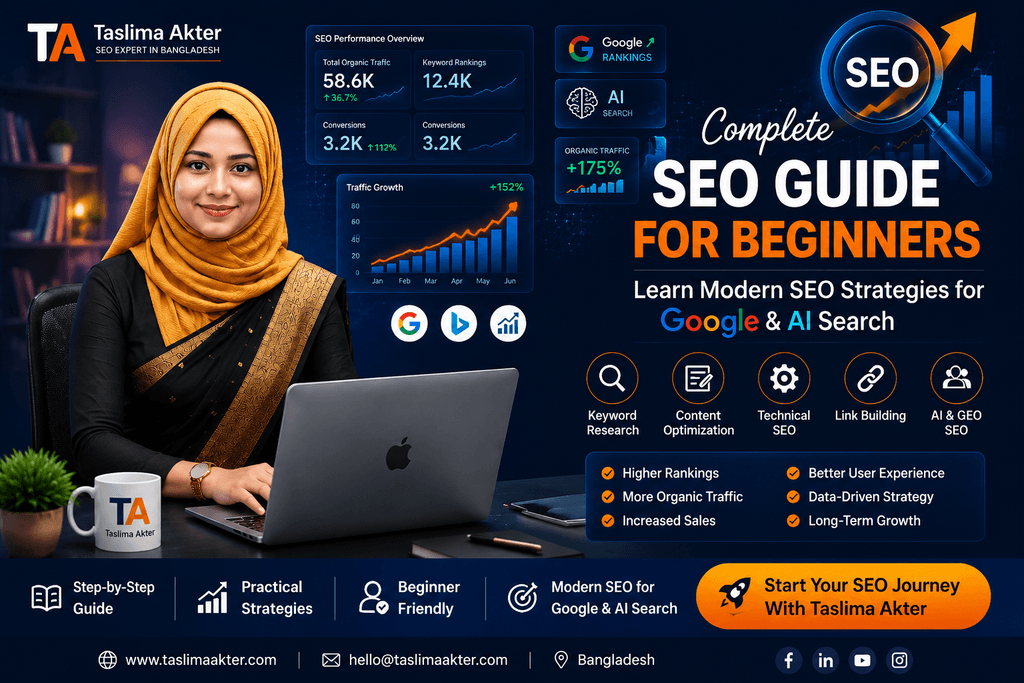
Complete SEO Guide for Beginners | Taslima Akter provides a complete understanding of how Search Engine Optimization (SEO) works and how beginners can use modern strategies to improve website visibility, attract organic traffic, and build long-term online growth.
SEO has become one of the most important digital marketing strategies because search engines continuously evolve. Today, successful SEO requires more than keyword placement. Instead, businesses need a combination of technical SEO, content optimization, user experience, topical authority, AI SEO, and GEO (Generative Engine Optimization).
As an experienced SEO Consultant in Bangladesh, Taslima Akter focuses on practical and data-driven SEO strategies that help businesses improve Google rankings, increase visibility, and prepare for the future of AI-powered search.
Introduction: Understanding the Power of SEO in Today’s Digital World
In the modern digital landscape, having a website is not enough. Businesses need to ensure that their audience can discover them when searching online. This is where SEO becomes essential.
Search Engine Optimization helps websites appear in relevant search results by improving content quality, website performance, authority, and user experience. Therefore, SEO creates a bridge between businesses and potential customers who are actively searching for solutions.
Why SEO Has Become Essential for Online Success
SEO is essential because search engines are one of the primary ways people discover information, products, and services. A strong SEO strategy allows businesses to build consistent organic visibility without depending only on paid advertising.
- Increase organic website traffic
- Reach targeted audiences
- Improve online credibility
- Generate quality leads
- Build long-term digital growth
How Search Engines Help Businesses Reach Their Target Audience
Search engines analyze billions of web pages to provide the most relevant answers to users. When businesses optimize their websites correctly, they can appear in front of people who are already interested in their products or services.
Moreover, SEO helps businesses understand customer behavior, search intent, and market demand. As a result, companies can create better experiences and more valuable content.
The Role of Modern SEO in Google Rankings and AI Search Visibility
Modern SEO is changing because Google and AI-powered platforms now focus on understanding meaning, expertise, and content relationships instead of only matching keywords.
Therefore, businesses need to optimize for both traditional search results and AI search experiences by creating helpful, trustworthy, and structured content.
What Is SEO? A Complete SEO Guide for Beginners
SEO (Search Engine Optimization) is the process of improving a website to increase its visibility on search engines like Google. The goal of SEO is to attract relevant visitors by making websites easier to understand, access, and trust.
Unlike paid advertising, SEO focuses on earning visibility naturally. Therefore, businesses can create sustainable traffic growth by improving website quality and relevance.
Understanding Search Engine Optimization and Its Purpose
The main purpose of SEO is to connect users with the most useful information. Search engines evaluate websites based on multiple factors, including content quality, technical performance, authority, and user experience.
- Improve website visibility
- Increase organic traffic
- Match user search intent
- Build website authority
- Support business growth
How SEO Works Behind Google Search Results
SEO works by helping search engines understand website content and determine which pages provide the best answers for users.
| SEO Process | Purpose |
|---|---|
| Crawling | Discover website pages |
| Indexing | Store and understand information |
| Ranking | Select the best search results |
The Three Core Pillars of SEO
| SEO Pillar | Main Focus |
|---|---|
| On-Page SEO | Content optimization and user experience |
| Technical SEO | Website performance and accessibility |
| Off-Page SEO | Authority and trust building |
On-Page SEO: Optimizing Content for Better Rankings
On-page SEO focuses on improving elements within a website, including titles, headings, content, internal links, images, and keyword usage.
Technical SEO: Improving Website Performance and Accessibility
Technical SEO improves website structure so search engines can crawl, index, and understand content efficiently.
Off-Page SEO: Building Authority and Trust
Off-page SEO focuses on activities outside the website, such as backlinks, brand mentions, and digital reputation building.
How Search Engines Work: The Foundation Every Beginner Should Know
Understanding search engine processes helps beginners create better SEO strategies. Search engines use automated systems to discover, organize, and rank website information.
Crawling: How Google Discovers Website Content
Crawling is the process where search engine bots discover new pages and updated content across websites.
Indexing: How Search Engines Understand Web Pages
Indexing allows search engines to store and organize website information so it can appear in relevant searches.
Ranking: How Google Selects the Best Search Results
Ranking determines which pages appear first based on relevance, quality, authority, and user experience.
How AI Search Is Changing the Future of Search Engines
AI-powered search is transforming how users find information. Therefore, SEO strategies now need to focus on clear answers, expert content, semantic relationships, and strong entity signals.
Keyword Research: The First Step to Successful SEO Strategy
Keyword research is one of the most important steps in SEO because it helps businesses understand what their audience is searching for. By identifying the right keywords, websites can create content that matches user needs and improves search visibility.
A successful keyword strategy does not focus only on search volume. Instead, it considers relevance, competition, search intent, and business goals. Therefore, effective keyword research creates a strong foundation for long-term SEO growth.
- Discover what users are searching for
- Understand customer problems and needs
- Find valuable ranking opportunities
- Create targeted SEO content
- Improve organic visibility
Understanding Search Intent Behind Keywords
Search intent explains the reason behind a user’s search query. Understanding intent allows businesses to create content that provides the exact information users need.
| Search Intent Type | User Goal | Example |
|---|---|---|
| Informational | Learn something | What is SEO? |
| Commercial | Compare solutions | Best SEO consultant in Bangladesh |
| Transactional | Take action or buy | Hire SEO expert |
| Navigational | Find a specific brand | Taslima Akter SEO |
Moreover, search engines increasingly focus on understanding user intent rather than simply matching keywords. Therefore, businesses should always create content based on what users actually want to achieve.
How to Find High-Value SEO Keywords
High-value keywords are terms that attract relevant visitors and support business objectives. Effective keyword research combines data analysis with a clear understanding of the target audience.
- Analyze customer questions
- Research competitor keywords
- Identify industry-related topics
- Study search trends
- Evaluate keyword competition
Short-Tail vs Long-Tail Keywords: Which One Should Beginners Use?
Keywords can generally be divided into short-tail and long-tail categories. Understanding the difference helps beginners create more effective SEO strategies.
| Keyword Type | Characteristics | Example |
|---|---|---|
| Short-Tail Keywords | Broad terms with high competition | SEO services |
| Long-Tail Keywords | Specific terms with clearer intent | SEO consultant for small business in Bangladesh |
For beginners, long-tail keywords are often easier to target because they usually have lower competition and attract users with stronger intent.
Keyword Mapping for Better Content Organization
Keyword mapping connects specific keywords with relevant website pages. It helps prevent keyword cannibalization and ensures every page has a clear SEO purpose.
| Page Type | Keyword Target |
|---|---|
| Homepage | Brand and main service keywords |
| Service Page | Commercial keywords |
| Blog Content | Informational keywords |
| Product Page | Transactional keywords |
As a result, keyword mapping creates a structured website where every page supports a specific search intent.
On-Page SEO Strategies Every Beginner Should Master
On-Page SEO focuses on optimizing elements within a website to improve rankings, usability, and search engine understanding. It helps search engines recognize page topics while creating a better experience for visitors.
Creating SEO-Friendly Titles and Meta Descriptions
SEO titles and meta descriptions influence how users see a page in search results. Therefore, they should clearly communicate value while naturally including important keywords.
- Write unique page titles
- Include target keywords naturally
- Create attractive descriptions
- Match search intent
- Avoid keyword stuffing
Optimizing Headings, URLs, and Content Structure
A proper content structure helps users and search engines understand information easily. Therefore, websites should use clear headings and organized content sections.
- Use one clear H1 heading
- Organize topics with H2 sections
- Use H3 and H4 for supporting details
- Create readable URLs
- Maintain logical content flow
Using Internal Linking to Improve Website Authority
Internal linking connects related pages and helps search engines understand content relationships. Furthermore, it distributes authority across important pages.
- Link related content naturally
- Support important pages
- Improve user navigation
- Strengthen topical authority
Optimizing Images for Better Search Visibility
Image optimization improves page speed and helps search engines understand visual information. Therefore, every image should be optimized properly.
- Use descriptive image names
- Add accurate ALT text
- Compress image files
- Choose suitable formats
- Maintain quality
Improving Content Quality Through E-E-A-T Principles
E-E-A-T (Experience, Expertise, Authoritativeness, and Trustworthiness) helps websites demonstrate credibility. Search engines prefer content created by knowledgeable sources who provide accurate and useful information.
- Show real experience
- Demonstrate expertise
- Build author credibility
- Provide trustworthy information
- Update content regularly
Technical SEO Basics: Strengthening Your Website Foundation
Technical SEO improves the technical structure of a website so search engines can crawl, index, and rank pages effectively. A strong technical foundation supports all other SEO activities.
Improving Website Speed and Core Web Vitals
Website speed affects user experience and search performance. Therefore, improving Core Web Vitals helps websites provide faster and smoother experiences.
- Optimize images
- Improve loading speed
- Reduce unnecessary code
- Improve server performance
Making Websites Mobile-Friendly and User-Focused
Mobile optimization is essential because many users access websites through smartphones. A responsive website improves usability and supports better search performance.
Creating XML Sitemap and Robots.txt Files
XML sitemaps help search engines discover important pages, while robots.txt controls crawler access. Proper configuration supports better indexing.
Fixing Technical SEO Issues That Affect Rankings
- Broken links
- Crawl errors
- Duplicate content
- Indexing problems
- Redirect issues
Understanding Website Security and HTTPS Importance
HTTPS improves website security and builds user trust. Secure websites provide better experiences and support stronger SEO foundations.
Content SEO: Creating Valuable Content That Ranks Higher
Content SEO focuses on creating, optimizing, and improving website content to increase search visibility and provide value to users. Modern search engines prioritize helpful, accurate, and well-structured content that satisfies user needs.
Therefore, successful SEO content should not only include keywords but also answer questions, solve problems, demonstrate expertise, and create a better user experience.
Building Content Around User Needs and Search Intent
Creating successful SEO content begins with understanding what users are searching for and why they need that information. Search intent helps businesses create content that matches different stages of the customer journey.
- Identify user questions
- Understand audience problems
- Create helpful solutions
- Match content with search intent
- Provide accurate information
Creating Topic Clusters and Topical Authority
Topic clusters organize website content around a main subject. This strategy helps search engines understand that a website has deep knowledge about a specific topic.
| Content Structure | Purpose |
|---|---|
| Pillar Page | Covers a broad topic in detail |
| Cluster Content | Explains supporting subtopics |
| Internal Links | Connects related information |
| FAQ Content | Answers specific user questions |
Writing Helpful Content for Google and AI Search
Google and AI-powered search systems increasingly focus on understanding content quality, expertise, and relevance. Therefore, businesses should create content that provides direct answers and meaningful insights.
- Use clear explanations
- Add expert insights
- Include practical examples
- Structure information properly
- Keep content updated
Updating Old Content to Maintain Search Performance
Content optimization does not end after publishing. Regular updates help maintain accuracy, improve rankings, and keep information useful for users.
- Update outdated information
- Add new insights
- Improve readability
- Refresh keywords
- Fix broken links
Topic Clusters and Topical Authority: Building Long-Term SEO Strength
Topical authority SEO focuses on proving expertise around a specific subject by creating comprehensive and connected content. Instead of ranking one page, businesses build a complete information ecosystem.
How Topic Clusters Improve Search Visibility
Topic clusters create stronger connections between related pages. As a result, search engines can better understand website expertise and content relationships.
- Create one main pillar page
- Develop supporting articles
- Connect pages through internal links
- Cover different user questions
- Build subject expertise
Using Semantic SEO to Strengthen Topic Relationships
Semantic SEO helps search engines understand the meaning behind content. Instead of focusing only on exact keywords, businesses should include related concepts, entities, and supporting information.
Building Entity-Based SEO Signals
Entity SEO helps search engines understand relationships between people, businesses, services, and topics. Strong entity signals improve brand recognition and search understanding.
Off-Page SEO: Building Website Authority and Trust
Off-page SEO focuses on activities outside the website that improve authority, reputation, and trust. These strategies help search engines understand whether a website is a reliable source.
Understanding Backlinks and Their Importance
Backlinks are links from other websites that point to your website. High-quality backlinks from relevant sources can improve authority and ranking opportunities.
- Earn links naturally
- Create valuable resources
- Build industry relationships
- Focus on quality over quantity
Creating High-Quality Link Building Strategies
Effective link building focuses on earning valuable mentions rather than creating artificial links. Therefore, businesses should invest in useful content, partnerships, and digital PR.
Digital PR and Brand Mentions for SEO Growth
Digital PR improves online visibility by earning media mentions, expert references, and trusted brand recognition. Moreover, strong brand signals support both Google rankings and AI search visibility.
- Create industry resources
- Share expert opinions
- Build brand reputation
- Earn trusted mentions
Avoiding Harmful SEO Practices and Spam Links
Low-quality backlinks and spam techniques can damage website trust. Therefore, businesses should follow ethical SEO practices and focus on sustainable authority building.
Local SEO Guide for Beginners
Local SEO helps businesses improve visibility for location-based searches. It allows companies to connect with nearby customers who are actively searching for specific services.
Optimizing Google Business Profile for Local Visibility
A complete and accurate Google Business Profile improves local search opportunities. Businesses should maintain updated information and encourage genuine customer reviews.
- Complete business details
- Add accurate categories
- Upload quality photos
- Collect customer reviews
- Share regular updates
Improving Local Search Rankings Through Reviews and Citations
Reviews and citations help search engines verify business credibility. Consistent business information across platforms improves local trust.
Local SEO Strategies for Small Businesses
- Create location-based content
- Optimize local keywords
- Build local backlinks
- Engage with customers
- Maintain accurate listings
SEO Tools Beginners Should Use for Better Results
SEO tools help beginners analyze websites, research keywords, monitor performance, and discover opportunities for improvement. However, tools are most effective when combined with proper SEO knowledge and strategic decision-making.
By using the right tools, businesses can understand search behavior, identify technical issues, and create data-driven SEO strategies that support long-term growth.
| SEO Tool Category | Main Purpose |
|---|---|
| Google Search Console | Monitor rankings, indexing, and search performance |
| Google Analytics | Understand user behavior and website traffic |
| Keyword Research Tools | Find valuable search terms and content opportunities |
| SEO Audit Tools | Identify technical and optimization issues |
| AI SEO Tools | Support content research and optimization |
Google Search Console for Website Performance Tracking
Google Search Console is one of the most important SEO tools for beginners. It provides insights about search visibility, keyword performance, indexing status, and technical problems.
- Track website impressions and clicks
- Identify ranking keywords
- Find indexing problems
- Submit sitemaps
- Monitor search performance
Google Analytics for Understanding User Behavior
Google Analytics helps businesses understand how visitors interact with their websites. It provides valuable information about traffic sources, engagement, and conversions.
- Analyze visitor behavior
- Track organic traffic growth
- Measure conversions
- Understand audience interests
- Improve marketing decisions
Keyword Research and SEO Analysis Tools
Keyword research tools help businesses discover search opportunities and understand competitors. Therefore, they play an important role in creating targeted SEO strategies.
- Find relevant keywords
- Analyze keyword difficulty
- Discover content gaps
- Research competitors
- Identify search trends
AI-Powered SEO Tools for Modern Optimization
AI-powered SEO tools are becoming increasingly useful for content research, keyword analysis, and workflow improvement. Nevertheless, human expertise remains essential for strategy, creativity, and quality control.
- Support content planning
- Analyze search trends
- Improve optimization workflows
- Assist with content ideas
- Save research time
SEO Metrics: How to Measure Your SEO Success
Measuring SEO performance is essential because it helps businesses understand whether their strategies are producing meaningful results. Instead of focusing only on rankings, successful SEO measurement considers traffic, engagement, and business growth.
Tracking Organic Traffic Growth
Organic traffic shows how many visitors discover a website through unpaid search results. Increasing organic traffic indicates that SEO efforts are improving website visibility.
- Monitor traffic trends
- Identify high-performing pages
- Analyze traffic sources
- Discover growth opportunities
Monitoring Keyword Rankings and Visibility
Keyword rankings help businesses understand how their pages perform for important search queries. However, rankings should always be evaluated together with traffic quality and conversions.
Understanding Click-Through Rate and User Engagement
User engagement shows whether visitors find website content valuable. Therefore, businesses should monitor important engagement signals.
- Click-through rate (CTR)
- Engagement rate
- Time spent on pages
- Returning visitors
- Content interactions
Measuring Conversion and Business Growth
The ultimate goal of SEO is to support business growth. Therefore, businesses should measure how organic search contributes to leads, sales, inquiries, and customer relationships.
Modern SEO Strategies for Google & AI Search
The future of SEO is evolving with artificial intelligence, machine learning, and generative search experiences. Therefore, businesses must prepare strategies that work across traditional search engines and AI-powered platforms.
Optimizing Content for AI Overviews and Generative Search
Generative Engine Optimization (GEO) focuses on creating content that AI systems can understand, summarize, and reference. Clear answers, structured information, and expert-driven content improve AI search visibility.
- Create direct answers to user questions
- Use clear headings and structure
- Provide trustworthy information
- Include expert insights
- Improve content readability
Using Semantic SEO and Entity Optimization
Semantic SEO helps search engines understand the meaning and context behind content. Instead of focusing only on exact keywords, businesses should build connections between related concepts, entities, and topics.
- Use related keywords naturally
- Cover topics comprehensively
- Build entity relationships
- Create connected content clusters
Creating Helpful, Expert-Led Content
AI search systems and modern search engines prioritize reliable information. Therefore, businesses should combine AI technology with human expertise to create content that demonstrates experience and trust.
- Share professional experience
- Provide practical examples
- Support claims with reliable information
- Maintain content accuracy
Preparing Websites for the Future of Search Technology
Future-ready SEO requires businesses to focus on technical excellence, content quality, authority, and user satisfaction. As search technology changes, websites that provide genuine value will continue to perform strongly.
- Build topical authority
- Improve technical SEO
- Create helpful content
- Optimize for AI search
- Strengthen brand trust
Common SEO Mistakes Beginners Should Avoid
Learning SEO requires continuous improvement, testing, and adaptation. However, many beginners make common mistakes that reduce their chances of achieving better search visibility. Understanding these mistakes helps businesses create stronger SEO foundations and avoid wasted effort.
Focusing Only on Keywords Instead of Users
One common SEO mistake is focusing only on keyword placement instead of understanding user needs. Modern search engines evaluate whether content provides valuable answers and a helpful experience.
- Create content for real users
- Understand search intent first
- Use keywords naturally
- Focus on solving problems
Publishing Low-Quality or Duplicate Content
Search engines prefer original, useful, and trustworthy content. Therefore, publishing copied or shallow content can negatively affect website authority and visibility.
- Create original insights
- Add expert experience
- Provide practical solutions
- Improve content depth
Ignoring Technical SEO Problems
Even high-quality content may struggle if Technical SEO problems exist. Website speed, indexing issues, mobile performance, and security should always be monitored.
- Fix broken links
- Improve website speed
- Check indexing problems
- Optimize mobile experience
Using Outdated SEO Techniques
SEO constantly changes with algorithm updates and AI-powered search development. Therefore, businesses should avoid outdated tactics and focus on modern strategies such as semantic SEO, topical authority, and GEO.
Forgetting Content Updates and Optimization
Publishing content once and never updating it can reduce performance over time. Regular optimization keeps information accurate, competitive, and valuable.
- Refresh outdated information
- Add new insights
- Improve readability
- Update internal links
How Taslima Akter Helps Businesses Learn and Implement SEO
Taslima Akter helps businesses understand and implement modern SEO strategies by combining practical experience, technical knowledge, and data-driven approaches. Her SEO process focuses on improving visibility, building authority, and creating sustainable digital growth.
Experience-Based SEO Strategy Development
Every business has different goals, audiences, and challenges. Therefore, SEO strategies should be customized based on industry, competition, website condition, and customer behavior.
- Website SEO analysis
- Keyword research
- Competitor analysis
- Content strategy planning
- Technical SEO improvement
Creating Data-Driven SEO Growth Plans
Data-driven SEO helps businesses make smarter decisions. By analyzing website performance, search trends, and competitors, businesses can identify opportunities and improve results.
- Analyze website performance
- Identify ranking opportunities
- Improve content strategy
- Track SEO progress
Combining Technical SEO, Content Strategy, and AI SEO
Modern SEO requires multiple approaches working together. Taslima Akter combines technical optimization, content strategy, semantic SEO, and AI-focused optimization to create future-ready SEO solutions.
- Technical SEO: Improves website performance and accessibility
- Content SEO: Creates valuable and optimized content
- Semantic SEO: Builds stronger topic relationships
- AI SEO: Prepares websites for future search
- GEO: Improves visibility in generative search
Helping Businesses Build Long-Term Search Visibility
The goal of SEO is not only achieving temporary rankings. Instead, businesses need sustainable visibility that continues to generate value over time through strong content, authority, and technical performance.
Beginner SEO Roadmap: Step-by-Step Plan for Getting Started
Beginners can learn SEO successfully by following a structured roadmap. Instead of trying every technique at once, focus on building strong foundations and improving step by step.
Step 1: Analyze Your Website and Competitors
- Check website performance
- Analyze competitors
- Identify SEO gaps
- Understand market opportunities
Step 2: Research Keywords and Search Intent
Find keywords that match your audience’s needs. Focus on relevance and search intent instead of targeting keywords only because they have high search volume.
Step 3: Create Optimized and Helpful Content
Create content that answers questions, provides solutions, and demonstrates expertise. Use proper structure, internal links, and semantic keywords.
Step 4: Improve Technical SEO Performance
- Improve website speed
- Fix technical errors
- Optimize mobile performance
- Improve security
Step 5: Measure Results and Continuously Improve
SEO requires continuous monitoring. Track rankings, traffic, engagement, and conversions to understand performance and make improvements.
Frequently Asked Questions About Complete SEO Guide for Beginners
1. What Is SEO and Why Is It Important for Beginners?
SEO (Search Engine Optimization) is the process of improving a website’s visibility in search engine results. It helps beginners understand how to attract organic traffic, reach the right audience, and build a stronger online presence without depending only on paid advertising.
2. How Long Does SEO Take to Show Results?
SEO results depend on several factors, including website condition, competition level, content quality, technical improvements, and consistency. Generally, SEO requires continuous effort because sustainable rankings are built over time through quality optimization.
3. Can Beginners Learn SEO Without Coding Knowledge?
Yes, beginners can learn many SEO concepts without coding knowledge. However, understanding basic technical SEO concepts such as website structure, speed optimization, indexing, and performance improvements can help create better SEO strategies.
4. What Are the Most Important SEO Ranking Factors?
Important SEO ranking factors include helpful content, technical website performance, user experience, backlinks, website authority, relevance, and trust signals. Modern SEO also focuses on expertise, topical authority, and semantic understanding.
5. Is SEO Still Effective After AI Search Growth?
Yes, SEO remains highly effective even with the growth of AI search. However, SEO strategies are evolving. Businesses now need to optimize content for Google search, AI-powered platforms, and generative search experiences by creating accurate and valuable information.
6. What Is the Difference Between SEO and Digital Marketing?
SEO is a part of digital marketing that focuses on improving organic search visibility. Digital marketing includes multiple channels such as SEO, paid advertising, social media marketing, email marketing, and content marketing.
7. How Can Beginners Start Learning SEO?
Beginners should start by learning SEO fundamentals, keyword research, search intent, on-page optimization, technical SEO, content strategy, and analytics. Practicing SEO on a real website is one of the best ways to develop practical skills.
8. What SEO Tools Should Beginners Use First?
Beginners can start with tools such as Google Search Console, Google Analytics, keyword research tools, and SEO audit tools. These tools help analyze website performance, identify issues, and discover optimization opportunities.
9. How Does Technical SEO Improve Website Rankings?
Technical SEO improves website accessibility, crawling, indexing, speed, mobile performance, and security. A technically optimized website helps search engines understand content more effectively and provides a better user experience.
10. Why Should Businesses Work With an SEO Consultant?
An SEO consultant helps businesses develop effective strategies, identify growth opportunities, fix technical issues, optimize content, and adapt to search engine changes. With expert guidance, businesses can build sustainable visibility and achieve long-term digital growth.
Conclusion: Build Your SEO Knowledge and Grow With Modern Search Strategies
Complete SEO Guide for Beginners | Taslima Akter shows that SEO is no longer limited to keywords and rankings. Modern SEO combines technical optimization, high-quality content, user experience, topical authority, semantic SEO, and AI search optimization to create long-term digital success.
As search technology continues to evolve, businesses need strategies that focus on helping users, building trust, and providing valuable information. Therefore, learning SEO fundamentals creates a strong foundation for achieving sustainable visibility in Google search and AI-powered platforms.
Why Learning SEO Creates Long-Term Digital Growth Opportunities
SEO is one of the most valuable digital skills because it helps businesses attract audiences naturally. Unlike temporary advertising campaigns, SEO creates continuous opportunities by improving website authority, visibility, and organic traffic.
- Build consistent organic traffic
- Increase brand visibility
- Create stronger customer relationships
- Improve online credibility
- Support sustainable business growth
Moreover, businesses that invest in SEO today can prepare themselves for future search changes. As a result, SEO knowledge becomes a long-term competitive advantage in the digital marketplace.
Preparing Your Website for Google, AI Search, and Future Trends
The future of search is moving toward artificial intelligence, conversational search, and personalized experiences. Therefore, websites must become more helpful, structured, and trustworthy to remain competitive.
- Create expert-driven content
- Improve website technical performance
- Build topical authority
- Optimize for semantic search
- Prepare for AI-powered search experiences
Future-ready SEO requires businesses to focus on quality rather than shortcuts. Websites that provide accurate information, excellent user experiences, and genuine expertise will have stronger opportunities in evolving search environments.
Start Your SEO Journey With Expert Guidance From Taslima Akter
Starting SEO can feel overwhelming because it involves multiple areas, including keyword research, content strategy, technical optimization, and performance tracking. With proper guidance, businesses can create a clear SEO roadmap and avoid common mistakes.
Taslima Akter helps businesses understand modern SEO strategies by combining practical experience, technical expertise, and data-driven approaches. Her focus is to create SEO solutions that improve visibility, strengthen authority, and support long-term growth.
- Complete SEO analysis
- Strategic keyword research
- Content optimization planning
- Technical SEO improvements
- AI and GEO-focused SEO strategies
Build Your Future With Modern SEO Strategies
SEO success comes from continuous learning, strategic implementation, and adapting to search engine changes. Whether you are a beginner, business owner, or digital marketer, understanding modern SEO can help you create stronger online opportunities.
By applying the strategies discussed in this guide, you can improve website visibility, create valuable content, and prepare your online presence for Google and AI search technologies.
Ready to Improve Your Website Visibility?
Take the next step toward building a stronger digital presence with professional SEO guidance. Connect with Taslima Akter to develop a customized SEO strategy designed for sustainable growth.