Introduction: Your Website May Have Problems You Cannot See
What is an SEO Audit? Imagine opening your website analytics dashboard and discovering that organic traffic has been declining for three months. Your pages still load, products remain available, and the design looks professional. Nevertheless, fewer customers are finding your business through Google. Where should you look first?
The problem may be hidden beneath the visible website. For example, important pages might be excluded from indexing, internal links could lead to broken URLs, or the content may no longer satisfy what customers are searching for. Meanwhile, your competitors may have improved their websites and created more useful resources. Without proper investigation, identifying the real cause becomes difficult.
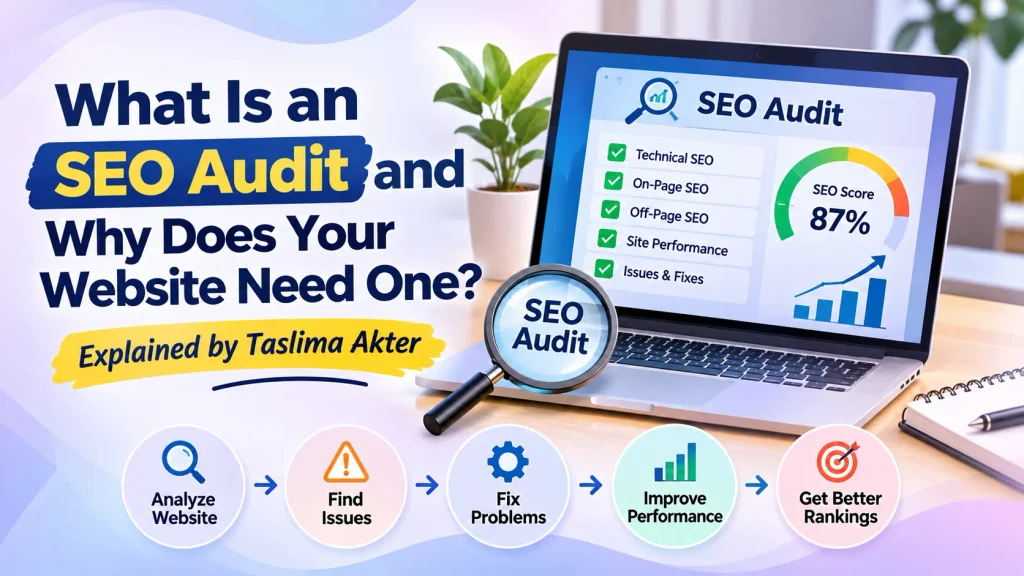
This is where an SEO website audit becomes valuable. Rather than making random changes, an audit examines how your website performs technically, how well its content answers search queries, and whether search engines can discover its important pages. Consequently, business owners receive a clearer picture of what needs attention.
However, an audit is not a promise of first-page rankings. It is a structured evaluation that helps prioritize improvements based on evidence. Furthermore, it can reveal opportunities to strengthen user experience, website architecture, and organic search visibility.
In this guide, Taslima Akter, Chairman & Co-Founder at Floriva IT, explains the purpose of SEO auditing, the checks involved, and how website owners in Bangladesh and beyond can use audit findings to make better decisions.
Illustrative process flow; outcomes depend on implementation and website conditions.
What Is an SEO Audit? Meaning, Purpose, and How It Works
An SEO audit is a systematic examination of a website’s ability to support organic search discovery, relevance, and usability. In simple terms, it helps answer three important questions: Can search engines access the website? Can they understand its important pages? And do those pages provide useful answers to the intended audience?
Unlike a basic website design review, an audit considers both technical conditions and content-related factors. For instance, an attractive landing page may still contain an incorrect canonical tag that points search engines toward another URL. Similarly, a valuable article might receive little visibility because its topic does not match the searcher’s intent.
The Difference Between an SEO Audit and SEO Optimization
Although the terms are related, they describe different activities. An audit identifies issues and opportunities, whereas SEO optimization involves making improvements. Therefore, the audit is best understood as the diagnosis, while implementation is the treatment plan.
For example, an audit may discover that several product pages contain identical titles. The optimization stage would involve reviewing search intent and writing more useful, distinctive titles where necessary. Afterwards, performance monitoring helps determine whether the changes produced meaningful improvements.
What Should a Professional SEO Audit Deliver?
A useful report should do more than display hundreds of automated warnings. Instead, it should explain each important finding, demonstrate supporting evidence, estimate business relevance, and recommend practical next steps. Additionally, the report should distinguish urgent errors from low-impact suggestions.
Typically, an audit includes a summary of technical issues, content opportunities, indexing concerns, internal linking weaknesses, and performance observations. Furthermore, each recommendation should identify the responsible person or team whenever implementation requires a developer, writer, designer, or marketing specialist.
Ultimately, a quality audit gives decision-makers a clearer way to allocate resources. Instead of changing everything at once, businesses can focus on problems that obstruct important pages or create unnecessary friction for visitors.
What Does a Complete SEO Audit Include?
A complete website SEO audit evaluates several connected areas rather than judging the website through one score. While each business has different priorities, the following checks commonly provide the foundation for a useful assessment.
Technical SEO and Indexing Audit
First, technical analysis examines crawlability, indexing status, XML sitemaps, robots.txt directives, redirects, canonical tags, and relevant server responses. For example, an accidental noindex directive may prevent an important page from appearing in Google Search. However, not every excluded URL represents a problem; duplicate or intentionally private pages may be excluded appropriately.
On-Page SEO and Content Quality Audit
Next, an on-page SEO audit evaluates titles, headings, descriptions, internal links, topical relevance, and how successfully the content answers user questions. Furthermore, it can reveal outdated information, overlapping pages, or important search intents that have not been addressed. Therefore, the goal is useful content improvement rather than inserting keywords repeatedly.
Website Speed, Mobile Experience, and Core Web Vitals
Page experience deserves attention because visitors expect websites to load efficiently and respond reliably. In particular, Core Web Vitals examine loading performance, responsiveness, and visual stability. However, a perfect performance score does not guarantee higher rankings, and real-user experience should remain the priority.
Internal Linking, Structured Data, and Off-Page Review
Internal linking helps visitors discover relevant pages and gives search engines context about relationships between content. Meanwhile, structured data can clarify supported page information when implemented correctly. An off-page review may also examine suspicious backlinks, brand mentions, and relevant authority signals. Nevertheless, backlink quantity alone should not determine quality.
The diagram summarizes audit categories, not a fixed ranking-factor formula.
Finally, local businesses may need an additional assessment of their business profile, service-area pages, and consistent public business details. Consequently, a local service provider in Dhaka may require a different audit scope from an international e-commerce company.
Why Does Your Website Need an SEO Audit?
A website can appear completely functional while still struggling to reach relevant searchers. Therefore, one important benefit of an SEO audit is understanding the difference between how a website looks and how it actually performs in organic search.
Identify Problems Before They Affect More Pages
Technical issues may spread when templates, plugins, or website settings affect entire page groups. For example, a mistaken canonical configuration could influence numerous product pages. By detecting the problem early, a business can investigate its cause before applying further changes.
Improve Relevant Organic Visibility and User Experience
An audit can expose missing commercial information, confusing navigation, outdated content, and important pages buried deep within the website. Furthermore, it can reveal whether mobile visitors struggle to use forms or locate essential information. Consequently, improvements may support both search accessibility and customer experience.
Make Better Decisions About SEO Investment
Without an audit, businesses sometimes spend their budgets publishing unnecessary articles while urgent indexing problems remain unresolved. In contrast, an evidence-based assessment helps distinguish essential work from optional enhancements. Therefore, it becomes easier to plan developer time, content production, and ongoing monitoring.
Consider a hypothetical online store that receives impressions for product categories but very few clicks. An audit could investigate search intent, title relevance, page quality, and competing results. However, it should not immediately assume that meta descriptions are the only cause. Instead, multiple possible explanations must be examined.
Similarly, a local service website may attract visitors who never submit enquiries. In that situation, reviewing landing-page clarity and conversion tracking could be just as important as reviewing keyword positions. Ultimately, the value of an audit lies in identifying actionable problems rather than producing a dramatic-looking score.
How to Conduct an SEO Audit Step by Step
Conducting a step-by-step SEO audit requires a clear process. Although automated tools can collect valuable information, interpretation remains essential. Therefore, the following workflow combines technical investigation with business priorities rather than depending on a single audit score.
Step 1: Establish Website Goals and Search Performance
Begin by identifying the website’s important services, products, and target customers. Next, review organic clicks, impressions, conversions, and major landing pages. For instance, a service website should distinguish high-value enquiries from unrelated informational traffic. This baseline will help you interpret later changes.
Step 2: Check Crawling, Indexing, and Technical Accessibility
Use Google Search Console and appropriate crawling tools to inspect indexability, page responses, redirects, and canonical signals. Additionally, review whether important URLs are discoverable through internal links and XML sitemaps. However, remember that submitting a sitemap does not guarantee indexing.
Step 3: Review Content, Keywords, and Search Intent
Evaluate whether the main pages address the questions visitors actually ask. Meanwhile, identify duplicate search intents, outdated articles, thin commercial descriptions, and internal linking gaps. Instead of creating separate pages for every keyword variation, consider consolidating content where the user intent is substantially the same.
Step 4: Test Page Experience and Mobile Usability
Check important templates on mobile devices and examine loading, responsiveness, layout stability, and navigation. Furthermore, inspect images, scripts, and third-party elements that may affect user experience. Prioritize actual visitor problems over chasing a perfect laboratory score.
Step 5: Prioritize Fixes and Monitor Outcomes
Finally, prepare an actionable report identifying the problem, supporting evidence, proposed solution, business priority, and implementation owner. Afterwards, monitor relevant metrics to determine whether changes were successful. Because search performance fluctuates for many reasons, avoid attributing every increase or decline to one modification.
Benchmark
Crawl
Review
Improve
Measure
Which SEO Audit Tools Should You Use, and When Should You Hire an Expert?
Several tools can help website owners perform a basic SEO audit. However, each tool answers different questions. For example, Google Search Console provides information about how Google discovers and displays your pages, whereas a website crawler can reveal structural issues across a larger collection of URLs.
| Audit Tool | Main Use |
|---|---|
| Google Search Console | Search performance, indexing, URL inspection |
| Google Analytics | Visitor behavior and configured conversions |
| PageSpeed Insights | Performance diagnostics and relevant user-experience data |
| Website Crawling Tools | Redirects, links, headings, responses, and structural analysis |
| Structured Data Testing Tools | Checking supported markup and implementation errors |
For a small website, these tools may be enough to identify straightforward problems, such as broken internal links or an accidentally blocked page. Additionally, a website owner can review titles, headings, content accuracy, and mobile presentation without purchasing an expensive software subscription.
Nevertheless, more complex situations benefit from specialist investigation. A major website migration, JavaScript rendering problem, sudden traffic decline, or widespread indexing issue may require technical SEO experience and development support. Therefore, seek professional assistance when diagnosis or implementation exceeds the team’s capabilities.
When hiring an SEO audit specialist, request an example of the final report and ask how findings are prioritized. Furthermore, confirm whether the quoted service includes implementation or only recommendations. The best audit arrangement is not necessarily the most expensive; instead, it is the one that delivers practical answers to meaningful business problems.
Frequently Asked Questions About SEO Audits
Below are ten practical answers to common questions about website SEO audits, their benefits, limitations, and implementation.
1. What Is an SEO Audit in Simple Terms?
An SEO audit is a structured review of a website’s search accessibility, content relevance, and technical condition. In other words, it identifies problems and opportunities that may affect organic visibility. Afterwards, the findings can guide a practical improvement plan.
2. Why Is an SEO Audit Important for a Website?
An audit helps uncover hidden technical issues, content weaknesses, and navigation problems. Furthermore, it enables businesses to prioritize improvements instead of making random changes. Consequently, website owners can allocate time and resources more effectively.
3. How Often Should You Conduct an SEO Audit?
There is no universal audit schedule. However, a detailed review after major redesigns, migrations, unexplained performance declines, or significant content changes can be valuable. In addition, periodic checks help detect emerging issues before they affect many pages.
4. Can I Perform an SEO Audit Myself?
Yes, website owners can carry out basic checks using Search Console, analytics, and accessible crawling or performance tools. Nevertheless, interpreting complex indexing and rendering issues may require specialist knowledge. Therefore, start with manageable checks and seek help when necessary.
5. How Long Does an SEO Audit Take?
The required time depends on website size, available access, technical complexity, and the depth of analysis. For instance, a small brochure website may need less investigation than an extensive e-commerce catalogue. Consequently, agree on the audit scope before estimating effort.
6. Does an SEO Audit Improve Google Rankings Immediately?
No, an audit alone does not change rankings. Instead, it identifies recommendations that must be implemented and evaluated. Furthermore, search engines need time to process some changes, and positive ranking outcomes are never guaranteed.
7. What Is the Difference Between Technical SEO and a Full SEO Audit?
A technical SEO audit focuses primarily on crawling, indexing, site architecture, and technical accessibility. In contrast, a full audit may also include content, user intent, internal links, local search considerations, and performance measurement.
8. Is an SEO Audit Necessary for a New Website?
A pre-launch or post-launch review can be valuable for a new website. For example, checking important page accessibility, canonical tags, navigation, and analytics setup may reveal early mistakes. However, the appropriate depth depends on the project.
9. How Much Does a Professional SEO Audit Cost?
Pricing varies with the number of URLs, website complexity, reporting requirements, and the services included. Therefore, compare written deliverables and clarify whether technical implementation is separate from the audit fee. A generic fixed price cannot describe every website’s needs.
10. How Can Taslima Akter Help With SEO Audit Planning?
Taslima Akter works in technical SEO, keyword research, on-page optimization, and content strategy. Businesses can use these areas of expertise to discuss website challenges and possible audit priorities. Nevertheless, a project-specific assessment is necessary before defining the appropriate work.
Conclusion: Turn SEO Audit Findings Into Meaningful Website Improvements
Understanding what an SEO audit is helps website owners move from guessing about traffic problems to investigating them systematically. Although an audit cannot guarantee rankings, it can uncover important technical obstacles, content weaknesses, and opportunities to improve the experience of visitors.
However, discovering problems is only the beginning. The real value comes from deciding which findings matter most, implementing suitable changes, and evaluating outcomes. Therefore, businesses should view auditing as part of an ongoing improvement process rather than a one-time certificate of website quality.
For businesses in Bangladesh, this process can be especially useful when competing in crowded local and national search markets. Moreover, an evidence-based review helps prevent unnecessary spending on repetitive content, irrelevant keywords, or low-priority technical tasks.
Taslima Akter, Chairman & Co-Founder at Floriva IT, brings a professional focus on technical SEO, keyword research, and content optimization. Consequently, businesses seeking clearer SEO priorities can begin by documenting their website objectives, reviewing available performance data, and identifying issues that require specialist assessment.
Ultimately, a successful SEO audit process should produce understandable findings, realistic recommendations, and a practical improvement roadmap. Instead of pursuing a perfect audit score, prioritize the changes that make your website more accessible, useful, and relevant to the people you want to reach.