SEO vs Google Ads is an important comparison for small businesses looking to attract customers through Google. While search engine optimization focuses on improving organic search visibility, Google Ads helps businesses reach potential customers through paid advertising. However, both approaches involve different costs, timelines, and advantages. Therefore, choosing the right strategy requires understanding your business goals, available budget, and market competition.
For example, a new business may prefer Google Ads to generate enquiries quickly. In contrast, an established company might invest in SEO to develop sustainable organic visibility. Moreover, businesses can combine these approaches when immediate opportunities and long-term growth are equally important.
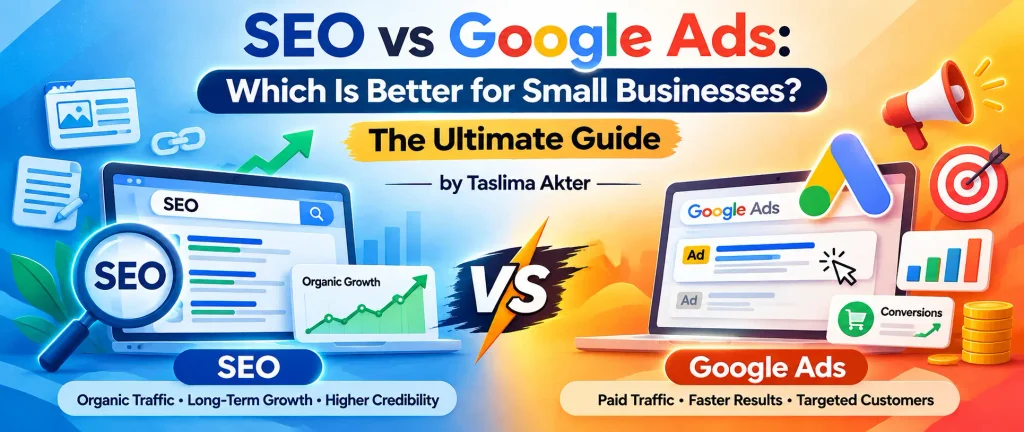
Two approaches to search visibility: organic optimization and paid advertising.
As illustrated above, SEO aims to improve organic discoverability through website optimization, whereas Google Ads provides paid exposure to relevant audiences. Nevertheless, neither strategy guarantees sales without effective targeting, useful landing pages, and accurate conversion tracking.
In this guide, Taslima Akter examines the differences between organic search and paid advertising, including costs, results timelines, return on investment, and long-term opportunities. Furthermore, the comparison helps small businesses choose an effective marketing approach based on realistic expectations rather than promotional promises.
What Is the Difference Between SEO and Google Ads?
SEO and Google Ads both help businesses appear on Google, yet they work in very different ways. SEO focuses on improving a website so that it becomes more relevant, more accessible, and more valuable in organic search results. Therefore, SEO usually involves technical improvements, keyword mapping, internal linking, content updates, and authority building. Although organic clicks do not require payment per visit, achieving strong rankings often takes time and consistent effort.
Google Ads, by contrast, is a paid advertising system where businesses bid to show ads in search results and other placements. As soon as a campaign is approved and active, it can begin generating impressions and clicks. However, traffic usually stops when the campaign budget ends. Consequently, the main difference is simple: SEO aims to build organic visibility over time, whereas Google Ads buys visibility through paid placements. For small businesses, understanding this distinction is important because it shapes budgeting, expectations, and marketing strategy.
| Comparison Factor | SEO | Google Ads |
|---|---|---|
| Traffic Type | Organic | Paid |
| Speed | Slower, gradual | Faster, immediate |
| Cost Model | Work, tools, content | Ad spend + management |
| Duration | Can continue over time | Stops when ads stop |
| Main Strength | Long-term visibility | Fast lead generation |
SEO vs Google Ads Cost: Which Is More Affordable for Small Businesses?
Cost is often the first concern for small businesses, and rightly so. SEO does not charge for each organic click; however, it still requires investment in strategy, website improvements, content creation, and ongoing monitoring. Therefore, SEO may appear slower at first, yet it can create long-term value if the work is consistent and the website targets the right search intent.
Google Ads usually follows a pay-per-click structure. As a result, businesses pay when users click their ads. In some industries, this can become expensive very quickly, especially when competition is high. Nevertheless, Google Ads can still be affordable if campaigns are well targeted and landing pages convert efficiently. In practical terms, SEO often requires more patience, whereas Google Ads usually demands more immediate cash flow. Consequently, the better option depends on whether your business can wait for organic growth or needs immediate enquiries to justify its spend.
Illustrative comparison only, not actual market pricing.
SEO vs Google Ads Results: Which Delivers Traffic, Leads, and Sales Faster?
When speed matters, Google Ads usually wins. After the campaign goes live, businesses can start receiving impressions and clicks very quickly. Therefore, businesses that need urgent leads, event bookings, or promotional traffic often prefer Google Ads at the beginning. Moreover, paid campaigns let you test offers, landing pages, and keywords without waiting months for organic visibility.
SEO, by comparison, tends to generate slower but more durable results. Initially, improvements may appear in impressions and rankings before stronger click growth happens. Nevertheless, once valuable pages start ranking well, they can keep attracting potential customers without requiring payment for every click. Consequently, if your business needs quick traction, Google Ads may be more suitable; however, if you want durable visibility, SEO can become more valuable over time. In many cases, the smartest answer is not speed alone but whether that speed also leads to profitable conversions.
Illustrative trend only. Actual results depend on strategy, competition, and website quality.
SEO vs Google Ads ROI: Which Provides Better Long-Term Value?
Return on investment matters more than raw traffic. A business may receive many clicks through Google Ads, yet still struggle if the cost per lead is too high. Likewise, a website may gain organic traffic from SEO, but that traffic may not be profitable if it fails to attract the right audience. Therefore, ROI should be measured through enquiries, booked calls, sales, customer quality, and lifetime value rather than clicks alone.
SEO often becomes more cost-efficient in the long term because successful pages can continue generating traffic without per-click charges. On the other hand, Google Ads offers quicker control and clearer short-term testing. As a result, paid campaigns can be excellent for validating offers, while SEO can support long-term acquisition efficiency. Consequently, small businesses should not ask only which one is cheaper; instead, they should ask which one creates stronger returns for their business goals over time.
SEO work / Ad spend
Organic / Paid clicks
Leads / Sales
Profit / LTV
Which Is Better for Small Businesses: SEO, Google Ads, or Both?
The best choice depends on the business situation. For example, a new company launching a service may need Google Ads first because it wants enquiries quickly. Meanwhile, an established business with a functioning website may benefit more from SEO because it wants durable visibility and lower customer acquisition costs over time. Therefore, the question is not simply which one is “better” in general; instead, it is which one is better for your current needs, budget, and sales cycle.
In many cases, combining both channels is the smartest option. Google Ads can generate immediate traffic while SEO builds long-term credibility and organic reach. Consequently, the short-term pressure on paid advertising can reduce once organic visibility improves. Small businesses, however, should avoid splitting their budget blindly. Instead, they should decide according to customer intent, urgency, and conversion potential. A service business in Dhaka may use Google Ads for urgent leads and SEO for long-term authority, whereas a niche e-commerce store may rely on SEO content while testing high-intent paid keywords.
| Business Goal | Better Starting Point | Main Reason | What to Measure |
|---|---|---|---|
| Urgent leads | Google Ads | Fast visibility | CPL, enquiries |
| Long-term growth | SEO | Organic value | Traffic, leads, rankings |
| New product testing | Google Ads | Quick validation | CTR, conversions |
| Brand trust building | SEO | Useful content and visibility | Organic reach, engagement |
| Balanced growth | Both | Short + long-term results | ROI, CPA, LTV |
When Should Small Businesses Use SEO and Google Ads Together?
Using both strategies together can create a stronger marketing system. Initially, Google Ads can drive targeted visitors quickly, which is helpful when launching a product, testing a new service page, or promoting a seasonal offer. At the same time, SEO can support long-term traffic growth by building strong landing pages, useful informational content, and better internal linking. Therefore, the two channels can complement each other rather than compete.
For example, a business can use Google Ads data to identify high-converting search terms, and then use those insights to strengthen SEO content. Similarly, SEO can help improve landing-page relevance, which may also support better paid performance. As a result, small businesses gain both immediate reach and a stronger organic foundation. Nevertheless, this combined strategy works best when tracking is clear and responsibilities are well planned. Otherwise, the business may spend money in both places without fully understanding what is actually driving results.
Common SEO and Google Ads Mistakes Small Businesses Should Avoid
Many small businesses waste money not because SEO or Google Ads is ineffective, but because execution is weak. In SEO, common mistakes include targeting the wrong keywords, publishing thin content, ignoring technical issues, and creating too many similar pages. As a result, the site may struggle to rank or attract the wrong traffic. In Google Ads, businesses often make the mistake of using broad targeting, weak ad copy, poor landing pages, or missing conversion tracking.
Another major mistake is misunderstanding the relationship between the two channels. Some business owners assume that paying for Google Ads will improve organic rankings. However, ads and organic rankings operate separately. Furthermore, businesses sometimes judge performance too early. SEO needs time, while Google Ads needs optimization. Consequently, success in either channel depends on strategy, measurement, and consistent improvements rather than quick assumptions or unrealistic promises.
- SEO mistake: Targeting keywords without understanding search intent.
- SEO mistake: Ignoring technical SEO issues and page quality.
- Google Ads mistake: Using a wide budget with weak targeting.
- Google Ads mistake: Sending paid traffic to poor landing pages.
- Shared mistake: Not tracking leads, calls, and conversions clearly.
- Shared mistake: Expecting instant profitable results without testing.
Expert Insights by Taslima Akter: Choosing the Right Strategy
Taslima Akter, Chairman & Co-Founder at Floriva IT, works in technical SEO, keyword research, on-page optimization, and content strategy. From a practical perspective, small businesses should begin by understanding their commercial priorities. If the business needs immediate enquiries, Google Ads may deserve faster attention. However, if the goal is sustainable visibility and a stronger organic presence, SEO should become a core investment.
Moreover, Taslima Akter recommends matching the strategy to the current stage of the business. A new business may use Google Ads for quick data and SEO for gradual asset building. Meanwhile, an established business can often improve results by combining technical SEO, conversion-focused content, and selective paid campaigns. Therefore, a business-specific evaluation is more effective than asking whether one channel is universally superior. Ultimately, the right answer comes from goals, resources, timing, and measurable results.
Frequently Asked Questions About SEO vs Google Ads
Below are practical answers to common questions small businesses ask when comparing SEO vs Google Ads.
1. Is SEO better than Google Ads for small businesses?
It depends on the goal. SEO is often better for long-term organic growth, whereas Google Ads is usually better for fast traffic and immediate lead generation.
2. Which is cheaper: SEO or Google Ads?
SEO does not charge per click, but it still requires investment in content and optimization. Google Ads can become expensive faster, especially in competitive industries. Therefore, the cheaper option depends on efficiency and results.
3. Does Google Ads help improve SEO rankings?
No. Google Ads and organic SEO rankings are separate systems. However, Google Ads can still provide useful keyword and conversion data that may support SEO strategy decisions.
4. How long does SEO take compared with Google Ads?
Google Ads can generate traffic quickly once active, whereas SEO may take several weeks or months to show stronger results. Consequently, timing is a key decision factor.
5. Which generates more leads: SEO or Google Ads?
Either one can generate more leads depending on search intent, targeting, and landing-page quality. Google Ads may produce faster leads, while SEO may provide stronger long-term lead flow.
6. Is SEO more profitable than Google Ads in the long run?
Often, yes. If SEO pages rank well and attract relevant visitors, the long-term cost per acquisition may improve. Nevertheless, profitability still depends on conversions and commercial relevance.
7. Can small businesses use SEO and Google Ads together?
Yes. In fact, combining both can work very well. Google Ads can support immediate traffic, while SEO builds long-term visibility and content strength.
8. Should a new business start with SEO or Google Ads?
A new business often starts with Google Ads if it needs immediate enquiries. However, it should begin foundational SEO early as well, so future growth does not depend entirely on paid traffic.
9. What happens to website traffic when Google Ads stops?
Paid traffic usually drops when ads stop running. Therefore, businesses relying only on paid campaigns may lose visibility quickly unless they also build organic channels.
10. How can Taslima Akter help small businesses improve their SEO strategy?
Taslima Akter can support businesses through technical SEO, keyword research, content strategy, and on-page optimization guidance. As a result, businesses can better evaluate how SEO should fit into their wider marketing plan.
Conclusion: SEO vs Google Ads – Which Should Small Businesses Choose?
SEO vs Google Ads is not a one-size-fits-all decision. Google Ads is often better for immediate visibility, faster lead generation, and short-term campaign control. By contrast, SEO is usually better for sustainable organic growth, long-term trust, and lower click dependency over time. Therefore, the better choice depends on budget, urgency, competition, and business maturity.
For many small businesses, the strongest path is a balanced one. Initially, Google Ads can drive fast traffic and valuable conversion data. Meanwhile, SEO can build durable assets that continue supporting growth later. Ultimately, the smartest strategy is not the one that sounds more popular; rather, it is the one that aligns with your goals and produces measurable business outcomes.