
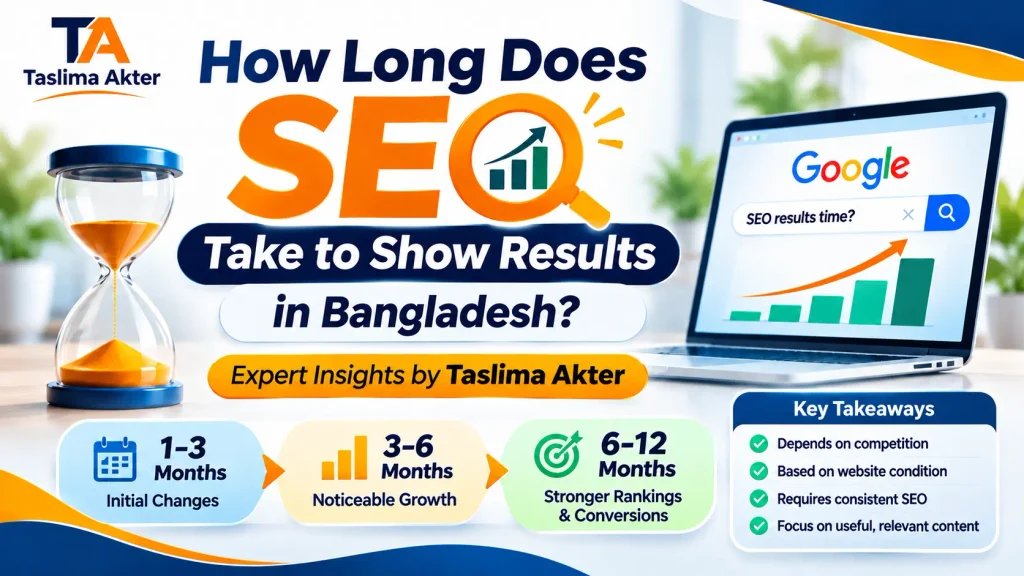
How long does SEO take to show results? For businesses in Bangladesh, early improvements may appear within weeks, while meaningful organic traffic growth often takes several months or longer. However, no guaranteed timeline exists because websites differ in competition, technical condition, content quality, and search history.
Imagine launching an online business in Dhaka and investing in professional SEO services. Initially, your website receives very few Google impressions. Nevertheless, as technical errors are corrected and useful content develops, your pages may gradually appear for more relevant searches.
Understanding the SEO results timeline is therefore essential for setting realistic business expectations. Moreover, increased visibility does not automatically guarantee enquiries, purchases, or revenue. These outcomes also require relevant visitors and a website that serves customers effectively.
In this guide, Taslima Akter, Chairman & Co-Founder at Floriva IT, examines the factors influencing SEO performance. Additionally, the article explains practical optimization methods and shows how businesses can measure sustainable growth in Google Search.
Understanding the SEO Timeline: What Happens in the First 12 Months?
SEO progress usually develops through several stages rather than appearing immediately after optimization. Initially, businesses need a proper website audit, keyword research, and technical improvements. Once these activities are completed, Google needs time to discover and process relevant changes.
Meanwhile, search impressions may improve before meaningful organic clicks or conversions develop. Consequently, tracking multiple performance indicators gives a more complete picture of progress than checking keyword positions alone.
The accompanying line chart illustrates how different SEO indicators could develop over a hypothetical 12-month period. Importantly, these numbers are educational examples rather than actual research findings or guaranteed performance forecasts.
Hypothetical normalized indices — not real website results
Each series uses a 0–100 illustrative index, not raw counts. Actual trends may rise, fall or remain flat.
A practical 12-month SEO plan helps organize work without promising particular rankings by a specific date. Instead, businesses should assess completed tasks, technical health, search visibility, and commercial outcomes throughout the campaign.
| SEO Period | Typical Activities | What to Measure |
|---|---|---|
| Months 1–2 | Audit, keyword mapping, technical corrections | Indexing status, audit completion, baseline performance |
| Months 3–4 | Page optimization, content improvements, internal linking | Search impressions, relevant queries, completed changes |
| Months 5–6 | Content refinement and performance evaluation | Organic clicks, engagement, qualified enquiries |
| Months 7–9 | Additional content and technical improvements | Topic coverage, landing-page trends, conversions |
| Months 10–12 | Strategy review and long-term planning | Business outcomes and remaining opportunities |
Technical fixes do not always require months to complete. Nevertheless, search engines may need additional time to crawl and process changes. Furthermore, competitive content often requires sustained improvements before meaningful visibility develops.
Key Factors That Determine How Quickly SEO Results Appear
Hypothetical planning percentages, not ranking weights
Planning
The time required for SEO ranking improvements depends on website history, competition, technical accessibility, and content relevance. As a result, two businesses investing similar resources may experience very different outcomes.
Consider a website with important pages blocked from indexing. Such a problem needs immediate technical attention. By comparison, a technically healthy site targeting difficult commercial keywords may require stronger content and sustained optimization.
Additionally, SEO activities do not contribute equally to every project. The pie chart demonstrates a possible allocation of work rather than Google’s ranking formula. Accordingly, actual priorities should reflect confirmed issues and business requirements.
Beyond technical considerations, businesses must evaluate how competitive their chosen keywords are. For instance, a local service keyword with limited competition may present different opportunities from a national finance or technology search. Nevertheless, search volume alone cannot determine keyword difficulty.
- Website history: Existing indexed pages and search performance provide a useful starting point.
- Keyword competition: Competitive searches require stronger relevance and meaningful differentiation.
- Technical SEO: Crawl accessibility, indexing, server responses, and canonical settings influence discovery.
- Content quality: Accurate, original information helps satisfy the audience’s search intent.
- Internal linking: Clear connections make important pages easier to discover and navigate.
- Brand credibility: Genuine references, reliable company information, and transparent authorship support trust.
- Implementation consistency: Delayed approvals, unfinished development, and incomplete changes may slow progress.
Consequently, a proper SEO website audit provides more useful guidance than predicting rankings from domain age or article quantity alone. By identifying important problems early, businesses can also allocate their resources more effectively.
How Long Does SEO Take for New vs Established Websites?
New websites typically begin with limited content, search history, and organic visibility. Therefore, the initial SEO work often focuses on crawl accessibility, indexing, website structure, essential service pages, and keyword research.
Established websites, meanwhile, may already have indexed content and useful Search Console data. Even so, outdated pages, broken redirects, overlapping content, and technical problems can reduce their effectiveness.
Website age alone cannot predict how quickly Google SEO results will appear. Instead, compare existing page quality, confirmed problems, search demand, and the resources available for improvement.
| Factor | New | Established |
|---|---|---|
| History | Limited | Available |
| Content | Build pages | Refine pages |
| Indexing | Establish | Review |
| Search Data | Often sparse | Often available |
| Main Focus | Foundation | Optimization |
Website condition matters more than age alone.
For a new website, making important pages discoverable and indexable can be a valuable early achievement. Afterwards, the business can develop relevant content around customer questions and commercial needs. Clear navigation and accurate company information also make the website easier to understand.
An established website should instead take advantage of its available performance data. For example, pages receiving relevant impressions but limited clicks may offer optimization opportunities. Similarly, underperforming categories might need more useful information rather than entirely new URLs.
- New websites: Build essential pages, review indexing, establish navigation, and target realistic search intent.
- Established websites: Analyze existing rankings, improve helpful content, and resolve confirmed technical problems.
- Redesigned websites: Verify redirects, canonical URLs, internal links, and indexing settings after migration.
- Websites losing traffic: Compare affected pages, search queries, technical changes, and fluctuations in demand.
How Google Rankings, Organic Traffic, and Conversions Improve Over Time
Search impressions and relevant query exposure.
Visitors arriving through unpaid search results.
Relevant enquiries, purchases or other desired actions.
This is a measurement framework, not a guaranteed conversion funnel.
SEO success should not be measured through rankings alone. Initially, a website may appear for more relevant queries. Some searchers may then click its results and explore the content. Eventually, qualified visitors might complete meaningful business actions.
However, increased impressions do not automatically produce more clicks. Likewise, additional visitors do not guarantee enquiries or sales. Accordingly, organic SEO performance should be evaluated using several connected metrics.
Relevant visitors are especially important because traffic volume alone reveals little about customer intent. For instance, an informational article may attract researchers, whereas a commercial service page may receive fewer visits but generate more qualified enquiries.
| SEO Metric | What It Measures | Business Meaning |
|---|---|---|
| Search Impressions | Appearances in eligible search results | Search visibility trends |
| Organic Clicks | Clicks from unpaid search listings | Website discovery and interest |
| Click-Through Rate | Clicks relative to impressions | Search result engagement |
| Keyword Positions | Observed positions for particular queries | Keyword-specific visibility |
| Organic Conversions | Desired actions attributed to organic visitors | Potential business value |
| Organic Revenue | Revenue attributed to organic search where measurable | Commercial contribution |
Google Search Console and website analytics may report different measurements because they serve different purposes. Therefore, use consistent reporting methods and consider attribution limits, seasonal changes, and tracking configurations when evaluating progress.
For businesses in Bangladesh, a useful monthly report should identify which pages attract relevant visitors. In addition, it should explain whether important queries are improving and whether customer enquiries support the original objectives.
Proven SEO Strategies That Can Help Improve Results More Efficiently
A well-organized SEO strategy can reduce unnecessary work and address important website problems. Nevertheless, no legitimate optimization method can guarantee immediate first-page rankings.
Start by identifying technical errors affecting essential pages. Afterwards, analyze keyword intent and improve content with existing commercial or informational value. Relevant internal links should also be strengthened so visitors can explore related topics more easily.
Prioritizing tasks according to verified evidence is therefore essential. For example, resolving an accidental indexing restriction may deserve attention before publishing additional articles with overlapping search intent.
Fix an accidental noindex directive
Repair major website architecture issues
Refine minor descriptive details
Create unnecessary overlapping pages
Example classifications only. Real effort and impact vary.
Effective SEO content optimization should focus on search intent rather than repetitive keyword placement. If several phrases represent the same search need, one comprehensive page may serve visitors better than multiple overlapping articles.
- Conduct a technical SEO audit: Check crawl accessibility, indexing, server errors, redirects, and canonical URLs.
- Research search intent: Identify whether customers need information, service comparisons, or purchasing guidance.
- Improve existing content: Update useful pages, remove unnecessary repetition, and answer overlooked questions.
- Develop topical authority: Cover relevant subjects through connected pillar and supporting content without cannibalization.
- Strengthen internal linking: Connect appropriate pages using clear, descriptive anchor text.
- Demonstrate E-E-A-T: Include genuine experience, accurate information, relevant expertise, and transparent authorship.
- Earn legitimate references: Develop valuable resources that relevant websites may naturally cite.
- Monitor SEO performance: Review Search Console, website analytics, and conversion reports regularly.
As a result, sustainable improvements are better pursued through consistent technical quality and genuinely helpful information rather than shortcuts promising instant ranking success.
SEO Results in Bangladesh: Local, National, and International Competition
Dhaka and other genuine business service areas
Customers across Bangladesh
Overseas customers and business buyers
Competition depends on the query and market, not geography alone.
Businesses in Bangladesh require different SEO approaches according to their customers. For instance, a Dhaka-based service provider may target location-specific searches, whereas a nationwide retailer focuses on broader product and category keywords.
Garment exporters and software companies serving overseas buyers face additional challenges. In particular, international competition, customer expectations, and market-specific information requirements may influence their strategies.
Accordingly, SEO results in Bangladesh cannot be predicted through one universal timeline. Both the target market and commercial search intent affect the work required.
For local SEO, accurate Google Business Profile information, genuine service areas, and relevant pages help customers understand where a company operates. However, local keywords are not necessarily easy to rank for. Competition can remain intense even within a small geographic area.
National SEO, by comparison, often requires stronger website architecture and comprehensive commercial content. For example, an electronics retailer may need distinct category pages, accurate product details, and useful answers to buyers’ questions.
International SEO introduces further considerations. As a result, businesses targeting overseas markets should research local terminology, buyer requirements, language preferences, and suitable website structures before expanding content.
| SEO Market | Primary Audience | Important Priorities |
|---|---|---|
| Local | Customers in specific cities or service areas | Accurate business information, local relevance, service details |
| National | Customers throughout Bangladesh | Category optimization, content quality, nationwide relevance |
| International | Customers in target foreign markets | Localization, buyer intent, market-specific content |
Expert Insights by Taslima Akter: Building a Realistic SEO Growth Strategy
.
Taslima Akter, Chairman & Co-Founder at Floriva IT, works in technical SEO, keyword research, on-page optimization, and content strategy.
For businesses asking how long SEO takes to show results, the starting point should be their current website condition. Begin by clarifying the target audience and business objectives. Afterwards, review technical accessibility, existing organic performance, and content relevance.
Optimization activities should then be prioritized according to verified problems. Therefore, a realistic strategy focuses on achievable deliverables and measurable progress rather than guaranteeing a particular Google position.
Identify problems
Understand intent
Improve key pages
Review outcomes
Chairman & Co-Founder at Floriva IT
Businesses should connect SEO activities with meaningful customer outcomes. For instance, increased traffic may look encouraging, but qualified enquiries and conversions provide clearer insight into commercial value when reliable tracking is available.
- Business discovery: Identify target customers, key products or services, and measurable objectives.
- SEO website audit: Review crawling, indexing, internal linking, and content-related problems.
- Keyword mapping: Connect distinct search intents with suitable pages.
- Content improvement: Optimize valuable resources and address meaningful information gaps.
- Technical implementation: Resolve verified issues according to business importance.
- Performance monitoring: Evaluate search impressions, organic clicks, leads, and completed improvements.
- Continuous refinement: Adjust priorities as new evidence and customer needs emerge.
A professional SEO consultation should also clarify the tasks included, technical responsibilities, and reporting methods. Furthermore, transparent communication helps businesses evaluate whether the proposed strategy matches their resources and website requirements.
Ultimately, an effective SEO strategy is not simply about achieving faster rankings. Rather, it should make the website more useful, accessible, and relevant to target customers over time.
Frequently Asked Questions About SEO Results and Google Rankings
The following answers address common questions about SEO results timelines, organic search growth, Google rankings, and realistic business expectations in Bangladesh.
1. How Long Does SEO Take to Show Results on Google?
Early measurable improvements may appear within weeks, whereas meaningful organic traffic growth can require several months or longer. However, no guaranteed timeline exists. Competition, technical condition, content usefulness, and implementation quality all influence the outcome.
2. Can SEO Show Results Within 30 Days?
Yes, certain improvements may become measurable within 30 days, especially when a website has fixable technical issues or existing search visibility. Nevertheless, substantial traffic growth, higher rankings, and conversions cannot be guaranteed during that period.
3. How Long Does SEO Take for a New Website in Bangladesh?
New websites may require several months or longer to develop consistent organic visibility. Initially, businesses should establish technical accessibility, useful pages, proper indexing, and relevant keyword targeting. Additionally, competitive conditions will influence subsequent progress.
4. Why Does SEO Take 3 to 6 Months or Longer?
SEO requires research, implementation, content development, crawling, indexing, and continued evaluation. Moreover, competitive queries may demand stronger relevance and more comprehensive information. As a result, meaningful improvements do not follow a fixed timetable.
5. How Long Does Local SEO Take to Show Results?
Local SEO progress depends on competition, geographic relevance, business information, and website quality. Although some changes may become visible relatively quickly, competitive local searches can require ongoing optimization before consistent improvements emerge.
6. Does Website Age Affect SEO Ranking Speed?
Website history influences the starting conditions of an SEO campaign. Established websites, for example, may already have useful content and performance data. However, domain age alone does not guarantee rankings, especially when technical or content problems remain unresolved.
7. How Can I Tell if My SEO Strategy Is Working?
Google Search Console provides useful information about impressions, clicks, and search queries. In addition, website analytics can help track engagement, qualified enquiries, and conversions. Compare consistent reporting periods while considering seasonal patterns and tracking limitations.
8. Can Technical SEO Improvements Deliver Faster Results?
Technical corrections can sometimes produce earlier measurable improvements, particularly when they resolve serious crawling or indexing restrictions. However, eligibility for indexing does not guarantee high rankings. Therefore, combine technical accessibility with useful, relevant content.
9. How Long Does It Take to Reach Google’s First Page?
No SEO provider can guarantee a first-page ranking date. Search results depend on relevance, competition, search context, and other factors. Consequently, businesses should prioritize qualified visibility and measurable commercial outcomes rather than guaranteed positions.
10. How Can Taslima Akter Help Businesses Improve SEO Performance?
Taslima Akter works in technical SEO, keyword research, on-page optimization, and content strategy. Through a discussion of website goals, search performance, and technical challenges, businesses can evaluate suitable improvements. Nevertheless, actual results depend on competition, website conditions, and implementation.
Conclusion: How to Achieve Sustainable SEO Results in Bangladesh
Understanding how long SEO takes to show results helps businesses establish realistic expectations. However, no universal timeline applies because websites differ in technical health, competition, content quality, and existing performance.
A successful strategy begins with identifying the website’s most important problems. Afterwards, businesses should improve technical accessibility, search intent alignment, and content usefulness. Meanwhile, organic traffic and conversions should be monitored alongside keyword positions.
Ultimately, SEO requires ongoing research, implementation, measurement, and refinement. Therefore, sustainable progress depends on consistently useful improvements supported by reliable performance evidence.
For businesses in Bangladesh, SEO planning should reflect the actual customer market, whether local, national, or international. Moreover, specialists such as Taslima Akter can be considered when evaluating technical, content, and keyword optimization requirements.
Most importantly, SEO results should be judged through meaningful progress rather than unrealistic guarantees. With a clear strategy, relevant improvements, and consistent measurement, businesses can better understand how organic search contributes to their goals.