
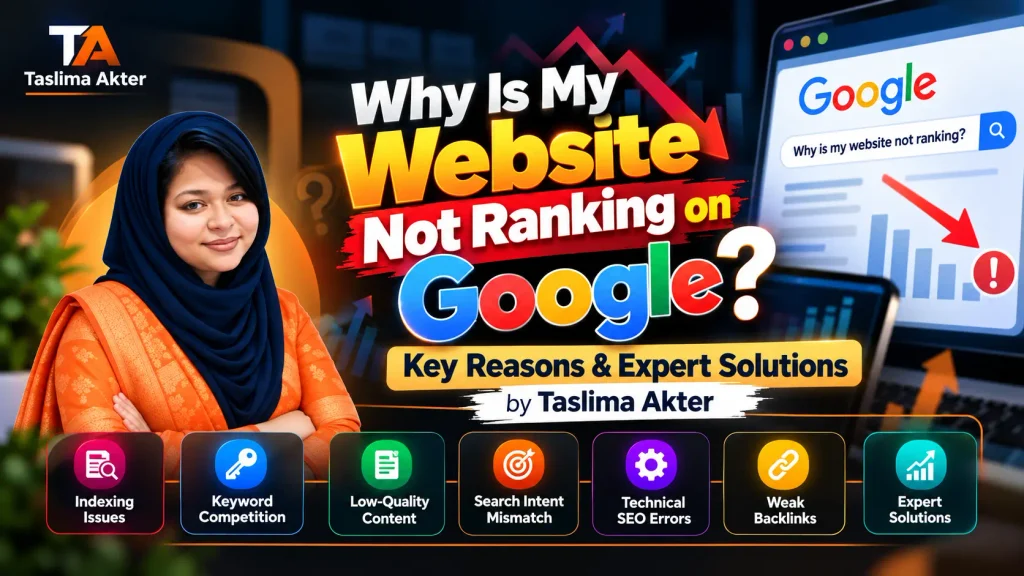
Why is my website not ranking on Google? It is a frustrating question, especially when you have invested time in website design, published articles, and optimized important pages. You may even see competitors appearing above your business while your website receives very little organic traffic.
However, poor Google visibility does not always mean your website needs more content or backlinks. Sometimes, the real issue is a blocked page, incorrect indexing settings, weak search intent alignment, or content that fails to answer visitors’ questions. In other cases, your pages may already be indexed but cannot compete effectively for the keywords you are targeting.
Therefore, successful Google ranking troubleshooting starts with identifying the actual problem rather than applying random SEO techniques. Moreover, understanding how Google discovers, indexes, and evaluates pages can save time and unnecessary expenses.
In this guide, SEO specialist Taslima Akter explains the common causes of website ranking problems, practical diagnostic methods, and improvements that can support long-term search visibility.
Top Reasons Your Website Is Not Ranking on Google
A website can struggle in Google Search for several different reasons. First, Google may not have indexed the pages you want visitors to discover. Alternatively, your content may be indexed but too weak, irrelevant, or competitive to appear prominently for your target keywords.
Moreover, many websites publish similar articles without a clear keyword strategy. As a result, several URLs may compete for the same search intent while important commercial pages remain poorly optimized.
- Indexing problems: Important URLs are not included in Google’s index.
- Keyword competition: The website targets search queries dominated by more relevant or established pages.
- Weak content: Pages provide limited original information or fail to answer user questions.
- Search intent mismatch: The page format does not match what searchers expect.
- Technical errors: Crawling, rendering, or canonical problems interfere with discovery.
- Poor internal linking: Important pages are difficult to find from other website pages.
- Limited authority: The website lacks relevant references, credibility signals, or useful topical coverage.
Therefore, instead of assuming a single cause, compare your actual website evidence with each possible explanation. A detailed SEO website audit should identify which issues are confirmed and which still require investigation.
Common investigation categories
Technical SEO and Google Indexing Problems That Affect Rankings
Googlebot discovers and fetches accessible pages.
Google processes content and may store it in its index.
Relevant indexed pages may appear for matching queries.
Crawling and indexing do not guarantee rankings.
Technical SEO is one of the first areas to investigate when your website is not showing on Google. Before a page can compete in search results, Google generally needs to discover it, access suitable content, and decide whether to index it.
For example, a page with an unintended noindex directive may be excluded from Google’s index. Similarly, an incorrect canonical tag might indicate that another URL should be treated as the preferred version.
Additionally, broken internal links, server errors, inaccessible content, and incorrectly configured crawling controls can make website discovery more difficult.
- Check robots.txt: Confirm that essential content is accessible to Googlebot.
- Review noindex directives: Ensure important pages are eligible for indexing.
- Inspect canonical URLs: Identify unintended canonical selection or duplicate versions.
- Check HTTP status codes: Important pages should return an appropriate successful response.
- Review XML sitemaps: Include intended canonical, indexable URLs.
- Test internal links: Make sure important pages are reachable through crawlable links.
However, submitting an XML sitemap does not guarantee that Google will index every URL. Therefore, use Google Search Console URL Inspection and the Page Indexing report to investigate problems rather than repeatedly submitting the same pages.
Content Quality, Keyword Research, and Search Intent Mistakes
Even when Google successfully indexes a page, it may not rank prominently if the content does not satisfy search intent. For instance, someone searching for an SEO service provider generally wants information about services, experience, pricing considerations, and contact options—not only a general definition of SEO.
Furthermore, targeting numerous related keywords with nearly identical articles can create unnecessary overlap. Instead, each important page should have a clear purpose and address a distinct customer need.
- Match search intent: Identify whether users need information, comparisons, or a service.
- Improve content depth: Answer important questions with useful examples and explanations.
- Remove unnecessary repetition: Avoid keyword stuffing and generic paragraphs.
- Update outdated information: Review facts, screenshots, services, and recommendations.
- Strengthen topical coverage: Address relevant subtopics without creating duplicate pages.
- Improve internal linking: Connect related content through meaningful anchor text.
Moreover, websites should evaluate competing search results to understand what information users expect. However, the goal is not to imitate other pages. Rather, create original content that answers important questions more clearly and accurately.
Consequently, a strong SEO content strategy should prioritize relevance, helpfulness, and clear information architecture instead of publishing articles simply to increase content volume.
Example: Why is my website not ranking?
Example: Best SEO companies
Example: Hire SEO consultant
Match the page format with the searcher’s goal.
How Google Evaluates Website Quality, E-E-A-T, and Search Relevance
First-hand knowledge
Subject knowledge
Reputation and recognition
Accuracy and transparency
E-E-A-T is a quality framework, not a numerical ranking score.
Google uses automated systems to identify content that is relevant and useful for a search query. However, ranking involves many considerations rather than a single SEO score.
For example, a website offering detailed, accurate, and clearly organized information may provide greater value than a page filled with repetitive keywords. Furthermore, original examples, transparent business information, and genuine experience can help readers assess whether the content deserves their trust.
E-E-A-T stands for Experience, Expertise, Authoritativeness, and Trustworthiness. These concepts are useful when evaluating content quality. Nevertheless, E-E-A-T itself is not a separate numerical ranking factor.
- Demonstrate experience: Include genuine observations, examples, or project evidence.
- Show expertise: Explain complex topics correctly and clearly.
- Build credibility: Provide accurate author, business, and service information.
- Prioritize trust: Avoid misleading claims, fabricated reviews, and unsupported guarantees.
- Improve usability: Make pages easy to navigate and comfortable to read.
Additionally, technical page experience deserves attention. Google’s Core Web Vitals include loading performance, interaction responsiveness, and visual stability measurements. However, excellent speed scores alone do not guarantee prominent rankings.
Therefore, focus on creating a useful experience for real visitors while maintaining sound technical foundations.
How to Fix a Website That Is Not Ranking on Google: Step-by-Step Solutions
If your website is indexed but not ranking, begin with evidence rather than assumptions. First, open Google Search Console and identify which pages receive impressions, which have indexing problems, and which search queries already bring visitors.
Next, group the problems into technical, content, intent, and competition categories. This helps avoid wasting time on changes that do not address the actual issue.
- Inspect indexing: Use the URL Inspection tool on your important pages.
- Review technical accessibility: Check crawling, redirects, canonicals, server status, and rendering.
- Analyze search performance: Identify queries and pages with meaningful impressions but limited clicks.
- Improve search intent alignment: Ensure each page answers the type of question users are asking.
- Update existing content: Add missing explanations, genuine examples, and useful information.
- Strengthen internal links: Connect related pages using descriptive anchors.
- Investigate competition: Compare search result formats and the usefulness of competing content.
- Monitor outcomes: Track changes in organic clicks, conversions, and indexing status.
Moreover, prioritize high-impact fixes. For example, an important page accidentally marked noindex deserves attention before minor image metadata adjustments.
Finally, document the changes you make. Consequently, when search performance improves or declines, you can evaluate what happened rather than relying on guesswork.
Illustrative urgency scores, not actual audit results
Important Pages Blocked — 95/100
Incorrect Canonicals — 85/100
Search Intent Mismatch — 80/100
Thin Important Pages — 70/100
Weak Internal Linking — 60/100
Priorities must be reassessed using real website evidence and business impact.
How Long Does It Take to Improve Google Rankings?
Check Search Console, indexing, and critical technical issues.
Fix verified problems and improve important pages.
Monitor crawling, search visibility, and customer behavior.
Review outcomes and improve content or technical priorities.
The stages are sequential, but their duration varies by website.
Google rankings do not improve according to a fixed timetable. Although certain technical problems can be corrected quickly, Google still needs to process the changes. Moreover, competitive topics may require considerable ongoing effort before meaningful improvements become visible.
For example, correcting an accidental noindex directive may restore indexing eligibility. However, a technically accessible page may still struggle to rank if it lacks relevance or value compared with other results.
- Website age and history: Newer websites may have limited established search visibility.
- Keyword competition: Highly competitive queries can be difficult to improve.
- Technical condition: Serious crawling or indexing problems should be corrected first.
- Content usefulness: Strong original information can address important user needs.
- Implementation quality: Incomplete or incorrect changes may delay progress.
- Search demand: Seasonal and geographic differences influence reported traffic.
Therefore, set realistic milestones for completed work, indexing improvements, relevant impressions, and qualified enquiries. Furthermore, compare performance over suitable periods rather than expecting every keyword to move upward immediately.
Ultimately, long-term SEO improvement depends on continuous diagnosis and useful website changes, not on guaranteed ranking deadlines.
Expert SEO Solutions by Taslima Akter to Improve Website Visibility
Taslima Akter, Chairman & Co-Founder at Floriva IT, works in search engine optimization, including technical SEO, on-page optimization, keyword research, and content strategy.
When a business asks, “Why is my website not ranking on Google?”, the most useful starting point is a website-specific investigation. Different websites can experience similar ranking symptoms for entirely different reasons.
For example, a WordPress website may have unintentionally blocked indexing. Meanwhile, an e-commerce store might struggle with duplicate product pages or weak category content. Consequently, each situation requires a different approach.
- Technical SEO review: Examine indexing eligibility, crawl accessibility, and important website errors.
- Keyword analysis: Identify relevant search queries and align them with appropriate pages.
- On-page optimization: Improve page titles, headings, relevant content, and internal linking.
- Content gap analysis: Identify useful information missing from important pages.
- Performance monitoring: Use search data to evaluate progress and refine priorities.
Additionally, businesses should consider how website improvements support customer enquiries and commercial goals. Higher visibility has limited value when the visitors attracted are not relevant to the products or services offered.
Therefore, a consultation with Taslima Akter can begin with your website address, key business objectives, target location, and existing search visibility challenges. The resulting recommendations should be evaluated according to evidence, scope, and measurable deliverables.
Practical troubleshooting workflow
Identify actual problems
Understand keyword intent
Improve priority pages
Evaluate search outcomes
Chairman & Co-Founder at Floriva IT
Frequently Asked Questions About Websites Not Ranking on Google
Below are answers to common questions about Google indexing issues, technical SEO problems, content quality, and website ranking recovery.
1. Why Is My Website Not Ranking on Google Even After SEO?
Your website may still have unresolved indexing issues, content gaps, weak search intent alignment, or strong competition. Moreover, completing SEO tasks does not guarantee rankings. Therefore, evaluate actual search performance and whether your optimization addresses the right problems.
2. Why Is My Website Indexed but Not Ranking?
Indexing only means Google has included a page in its index. However, appearing prominently for a search query depends on relevance, usefulness, competition, and other ranking considerations. Consequently, an indexed page may receive few impressions or clicks.
3. How Do I Check If Google Has Indexed My Website?
Use the URL Inspection tool in Google Search Console to check an individual URL. Additionally, review the Page Indexing report for broader patterns. A Google site search can provide a quick indication, but it is not a complete or reliable index inventory.
4. Can Technical SEO Problems Prevent Google Rankings?
Yes. For example, unintended noindex tags, inaccessible pages, server errors, and incorrect canonical configurations can interfere with indexing or discovery. Therefore, technical SEO checks should be included in website ranking investigations.
5. Why Is My New Website Not Showing on Google?
A new website may not yet have been discovered, crawled, or indexed. First, verify the website in Search Console. Next, confirm that important URLs are accessible and have useful content. Furthermore, provide crawlable internal links and a suitable XML sitemap.
6. Does Low-Quality Content Affect Google Search Rankings?
Content that provides little original value or fails to satisfy search intent may struggle to compete. Consequently, businesses should prioritize accurate, complete, and helpful information instead of publishing repetitive articles merely to target keywords.
7. Can Backlinks Help My Website Rank Higher?
Relevant links from other websites can contribute to discovery and the signals search systems use. However, backlinks do not guarantee rankings. Moreover, manipulative link-building schemes can create risks. Therefore, focus on useful content and legitimate opportunities to earn references.
8. How Long Does Google Take to Rank a New Website?
Website Not Ranking on Google……….there is no guaranteed timeline to solve. Crawling, indexing, and ranking depend on several conditions, including website accessibility, search demand, competition, and content usefulness. Therefore, monitor indexing and relevant visibility trends while improving the website consistently.
9. Why Did My Website Suddenly Lose Google Rankings?
Sudden ranking losses may be related to technical changes, removed content, redirects, indexing problems, changes in competition, or search system updates. First, compare Search Console performance before and after the decline. Next, inspect affected pages and identify any website changes around the same period.
10. How Can Taslima Akter Help Fix Website Ranking Problems?
Taslima Akter works in technical SEO, on-page optimization, keyword analysis, and content strategy. Businesses can discuss their website challenges and request an evaluation of the most relevant optimization requirements. However, specific outcomes depend on the website and implementation.
Conclusion: Improve Google Rankings With a Practical SEO Strategy
Understanding why your website is not ranking on Google starts with separating indexing problems from ranking and relevance problems. Although the symptoms may look similar, their solutions can differ significantly.
First, review whether Google can access and index your important pages. Next, assess search intent, content quality, website structure, and competition. Moreover, use actual performance evidence to prioritize improvements instead of relying on generic SEO checklists.
For businesses seeking professional guidance, SEO specialist Taslima Akter can be considered for technical SEO, on-page optimization, keyword strategy, and content-focused website improvements.
Ultimately, better Google search visibility is supported by a combination of technical accessibility, helpful information, relevant keyword targeting, and consistent measurement. Therefore, identify the right problems, address them carefully, and monitor how your website performs over time.
To Learn more, Contact with Taslima Akter or Visit to: https://taslimaakter.com/