
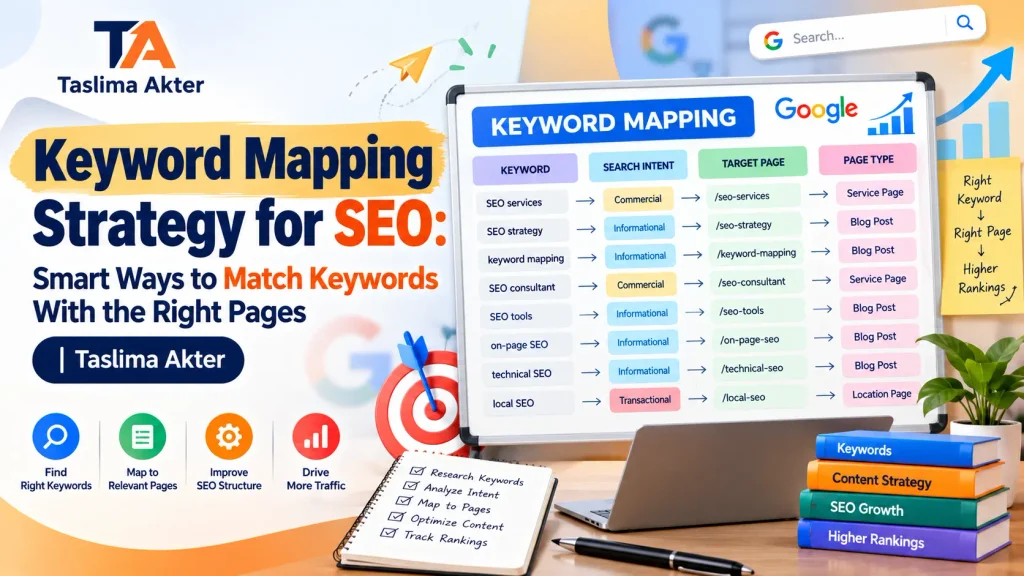
Keyword Mapping Strategy for SEO gives a website a clear way to connect search queries with the pages that should answer them. Instead of placing the same keywords across multiple URLs, a strategic keyword map assigns the right keyword, search intent, and page purpose to each important URL. As a result, your website becomes easier to organize, easier to optimize, and more useful for people searching on Google.
Imagine a website with dozens of valuable keywords but no clear plan for where those keywords belong. One service page targets several unrelated phrases, three blog posts compete for the same query, and an important commercial keyword has no dedicated landing page. Consequently, even good content can struggle to perform because the website sends unclear signals about which page should rank.
A strong SEO keyword mapping process solves this problem by connecting keyword research with website architecture. First, you identify what people are searching for. Next, you examine the intent behind those searches. Then, you compare the available URLs and decide whether each keyword should belong to an existing page, a new page, a stronger pillar page, or a consolidated resource.
Moreover, modern keyword mapping goes beyond traditional SEO. It can support semantic SEO, topical authority, internal linking, content planning, conversion optimization, and GEO for AI-driven search experiences. In this guide, Taslima Akter explains how to build a practical keyword-to-page framework that improves relevance while reducing unnecessary content overlap. Whether you are managing a small business website, personal brand, service website, or growing online platform, the right mapping strategy can turn scattered keyword data into a structured roadmap for sustainable search visibility.
What Is a Keyword Mapping Strategy for SEO?
A Keyword Mapping Strategy for SEO is the process of assigning relevant keywords and search intents to specific website pages. The objective is simple: make sure the right search query leads to the right page.
Keyword Mapping Explained in Simple Terms
Think of keyword mapping as a blueprint for your website. Instead of allowing every page to target whatever keywords happen to appear during writing, you create a deliberate relationship between keywords, URLs, search intent, and content types.
How Keywords Connect With Website URLs
For example, a business may have keywords for its main service, individual services, educational questions, comparisons, and local searches. Each group may require a different page because the searcher’s purpose is different.
Why Every Important Keyword Needs a Clear Page Owner
A clear page owner reduces confusion. Therefore, when a valuable keyword has a logical URL assigned to it, your optimization efforts become more focused and your internal linking becomes easier to manage.
Why Keyword-to-Page Mapping Matters for Modern SEO
Google does not simply match an exact keyword with an exact webpage. Search systems increasingly interpret meaning, context, entities, relationships, and user intent. Consequently, a well-structured keyword map should reflect the broader topic rather than relying on exact-match repetition.
How Mapping Improves Relevance and Website Structure
- Improves page relevance by connecting queries with appropriate content.
- Clarifies website architecture by assigning roles to URLs.
- Supports internal linking by identifying related pages.
- Reduces duplication by identifying overlapping topics.
- Improves content planning by revealing genuine gaps.
The Connection Between Search Intent and Page Purpose
The most important connection is between what someone wants and what a page provides. An informational search should generally lead to useful educational content, while a purchase-oriented search needs a page designed to support a transaction or commercial decision.
Keyword Mapping vs. Keyword Research
The two processes are connected but serve different purposes.
| SEO Process | Main Purpose | Typical Output |
|---|---|---|
| Keyword Research | Discover search opportunities | Keyword list |
| Search Intent Analysis | Understand what users want | Intent classification |
| Keyword Clustering | Group related searches | Topic clusters |
| Keyword Mapping | Assign searches to URLs | Keyword-to-page map |
| Content Planning | Decide what to create or improve | SEO content roadmap |
Why Finding Keywords Is Only the First Step
A list containing hundreds of keywords does not automatically create an SEO strategy. You still need to determine which terms belong together, which pages already satisfy the intent, and which opportunities genuinely deserve new content.
Turning Keyword Research Into an Actionable SEO Plan
Once keywords are mapped, the data becomes actionable. You can identify pages to optimize, URLs to consolidate, new content opportunities, internal-linking gaps, and priorities for future SEO work.
Why Keyword Mapping Is Essential for Higher Google Rankings
Ranking improvements usually come from multiple connected SEO decisions rather than one isolated action. A good keyword map gives those decisions direction because it shows which page should address which search opportunity.
Match Search Intent With the Right Landing Page
Search intent tells you why a person is searching. Therefore, understanding intent should come before assigning a keyword to a URL.
Informational Search Intent
Informational searches usually indicate that users want to learn, understand, solve a problem, or research a topic. Blog posts, guides, tutorials, checklists, and educational resources often fit this intent.
Choosing Blog Posts and Guides for Informational Queries
When users want an explanation rather than a direct purchase, an educational resource can satisfy their needs more effectively than a commercial landing page.
Commercial Search Intent
Commercial investigation searches often occur when users are comparing solutions or evaluating providers. These searches may require detailed service pages, comparison guides, buying guides, or category pages.
Using Service and Category Pages for Commercial Searches
Commercial pages should explain value, features, suitability, processes, and decision factors clearly enough to help visitors move toward the next step.
Transactional Search Intent
Transactional searches suggest that the user is closer to taking action. Product pages, booking pages, service pages, and conversion-focused landing pages can be appropriate destinations.
Mapping Purchase-Focused Keywords to Conversion Pages
When the searcher is ready to act, the destination should make that action clear. Consequently, transactional keywords should not normally be assigned to purely educational pages when a more relevant commercial URL exists.
Improve Topical Relevance Across Your Website
Keyword mapping also helps create relationships between broad topics and detailed subtopics. As a result, your website can demonstrate deeper topical relevance without publishing dozens of overlapping pages.
Build Strong Connections Between Related Keywords
- Group closely related queries.
- Separate keywords with genuinely different intent.
- Identify important entities and attributes.
- Connect supporting articles with pillar pages.
- Use semantic variations naturally within content.
Use Semantic Keywords to Strengthen Topic Coverage
Semantic terms provide context around the primary topic. Instead of repeating one phrase, use related concepts that naturally explain the subject in greater depth.
Create a Clear SEO Website Architecture
A keyword map can reveal how different pages should relate to each other. Therefore, it becomes a useful planning document for SEO website architecture.
Connect Pillar Pages With Supporting Content
A pillar page can own a broad commercial or informational topic, while supporting pages address distinct questions or subtopics. These pages can then be connected through contextual internal links.
Build Logical Keyword and URL Relationships
The result should be a website where important topics have clear owners and supporting content has a meaningful relationship with those owners.
How to Build a Keyword Mapping Strategy for SEO Step by Step
Building a keyword map does not have to be complicated. However, it should be systematic. The following process provides a practical framework for turning keyword research into a usable SEO plan.
Step 1: Collect and Organize Your Target Keywords
Start by gathering relevant keywords from your research. Include primary terms, long-tail searches, question-based queries, commercial phrases, and supporting semantic terms.
Group Keywords by Topic, Intent, and Business Value
- Collect relevant search terms.
- Remove irrelevant or duplicate queries.
- Group related keywords.
- Classify search intent.
- Evaluate business value.
- Prioritize important opportunities.
Separate Primary Keywords From Supporting Terms
A primary keyword represents the central topic of a page. Supporting terms add context and help cover related aspects without requiring separate URLs.
Step 2: Analyze the Search Intent Behind Each Keyword
Next, determine what type of result would genuinely satisfy the search. This step is essential because a keyword can look relevant while actually having a different intent from your proposed page.
Understand What the Searcher Actually Wants
- Is the user looking for information?
- Are they comparing options?
- Are they searching for a provider?
- Are they ready to purchase or contact someone?
- Are they searching for a specific brand or page?
Use SERP Results to Confirm Search Intent
Review the types of pages appearing for the keyword. If most results are guides, an educational article may be appropriate. If most results are service pages, the query may have stronger commercial intent.
Step 3: Review Your Existing Website Pages
Before creating anything new, audit the current URLs. You may already have a page capable of ranking for the target keyword.
Identify Existing Keyword Owners
- Review existing titles and headings.
- Analyze current organic visibility.
- Check page intent.
- Review content depth.
- Look for overlapping URLs.
- Identify strong pages that deserve optimization.
Find Pages That Already Have Ranking Potential
A page already receiving impressions for relevant searches may be a better optimization candidate than a brand-new URL. Consequently, keyword mapping should consider existing performance before recommending new content.
Step 4: Match Each Keyword to the Most Relevant URL
Now assign each important keyword or keyword cluster to the page that best satisfies its intent. If no suitable URL exists, mark the keyword as a potential content opportunity.
Choose the Right Page Type
| Search Need | Potential Page Type | Primary Objective |
|---|---|---|
| Learn | Blog / Guide | Answer questions |
| Compare | Comparison / Buying Guide | Support decisions |
| Hire | Service Page | Generate inquiries |
| Buy | Product Page | Support transactions |
| Explore a topic | Pillar Page | Build topical coverage |
| Find a location | Local Landing Page | Satisfy geographic intent |
Decide Whether to Optimize, Create, Merge, or Redirect
Not every keyword requires a new page. Depending on the evidence, the correct action may be to optimize an existing URL, create a new page, merge overlapping resources, or redirect a weak page toward a stronger destination.
Step 5: Identify Keyword Gaps and Missing Pages
After mapping existing URLs, examine the remaining keywords. These may reveal genuine gaps where users are searching for information that your website does not currently address.
Find Valuable Search Topics Without Existing Page Coverage
- Important commercial queries without a relevant landing page
- Frequently asked customer questions without answers
- Comparison searches not covered by existing content
- Problem-based queries related to your services
- Relevant local or industry-specific search needs
Turn Genuine Content Gaps Into New SEO Opportunities
A new page should be created only when it provides a distinct value proposition and satisfies a search reason that existing pages do not adequately address.
How to Match Keywords With the Right Pages
The central principle of keyword mapping is simple: match the searcher’s purpose with the page that can satisfy that purpose most effectively. This prevents the common mistake of forcing every valuable keyword into one page.
Map Primary Keywords to Core Commercial Pages
Core commercial pages should normally own the primary search themes that directly describe the business’s main products or services.
Service Pages and Product Pages
These pages should target queries that indicate a clear relationship with the offer. Supporting keywords can be included naturally when they share the same search intent.
Avoid Assigning Multiple Primary Keywords With Conflicting Intent
A page cannot effectively serve every possible search purpose. If one keyword expects a tutorial while another expects a service provider, separate resources may be more appropriate.
Map Informational Keywords to Supporting Content
Informational content can attract users earlier in the customer journey. Furthermore, it can introduce your expertise before the visitor is ready to make a commercial decision.
Blog Posts, Guides, Tutorials, and Educational Resources
- How-to guides
- Problem-solving articles
- Beginner explanations
- Industry guides
- Checklists
- Educational comparisons
Connect Informational Content Back to Relevant Commercial Pages
When an educational article naturally leads to a relevant service or product, a contextual internal link can help the visitor continue their journey without disrupting the informational purpose of the page.
Map Long-Tail Keywords Strategically
Long-tail keywords can reveal highly specific questions and use cases. However, not every long-tail variation deserves a separate URL.
When a Long-Tail Keyword Deserves Its Own Page
Create a separate page when the long-tail query represents a substantially different search need, audience, product, service, or decision.
When to Include a Long-Tail Query on an Existing Page
If the query is simply a more specific variation of the same intent, include it naturally within the existing page instead of creating another competing URL.
Keyword Mapping and Search Intent: The Connection SEO Professionals Should Understand
Search intent is one of the strongest decision-making factors in a keyword map. Two keywords can use different wording but require the same page, while two similar-looking keywords can require completely different resources.
Identify the Four Major Search Intent Categories
Informational Intent
The searcher wants knowledge, an explanation, instructions, or a solution. Educational content usually provides the strongest match.
Examples of Learning-Focused Search Queries
- What is keyword mapping?
- How does keyword mapping work?
- How do I create a keyword map?
- Why is keyword mapping important?
Commercial Investigation Intent
The searcher is researching options before making a decision. Detailed comparisons, reviews, service evaluations, and buying guides may satisfy this intent.
Examples of Comparison and Research Queries
- Best SEO strategy for small businesses
- SEO consultant vs SEO agency
- Best SEO tools for keyword mapping
- SEO strategy comparison
Transactional Intent
The searcher is ready to take an action such as buying, booking, hiring, or requesting information.
Examples of Action-Oriented Search Queries
- Hire an SEO expert
- SEO services
- SEO consultant
- SEO audit service
Navigational Intent
Navigational searches are usually intended to reach a particular brand, website, organization, or webpage.
How Branded Searches Should Be Mapped
Branded searches should normally be directed toward the most authoritative relevant brand or entity page rather than scattered across unrelated URLs.
Why SERP Analysis Should Guide Keyword Mapping
Search engine results pages provide valuable clues about what Google believes satisfies a particular query. Therefore, SERP analysis should be part of the mapping process.
Study Ranking Page Types Before Creating a URL
Look at the dominant page types, content formats, topic depth, and intent patterns among relevant results. This does not mean copying them. Instead, use the SERP to understand the expected search experience.
Use SERP Similarity to Detect Overlapping Intent
If two keyword variations return largely similar results, they may belong to the same page. If the results are substantially different, a separate page may be justified.
How Keyword Mapping Helps Prevent Keyword Cannibalization
One of the biggest benefits of a structured keyword map is better control over keyword cannibalization. When multiple pages target the same search intent, your website may create unnecessary competition between its own URLs.
What Is Keyword Cannibalization?
Keyword cannibalization occurs when multiple pages on the same website target similar or overlapping search intent. The problem is not simply that the same word appears on multiple pages; rather, the pages may compete because they serve substantially similar purposes.
How Multiple URLs Can Compete for Similar Searches
- Two blog posts answer the same question.
- Several service pages target the same commercial intent.
- Multiple location pages contain nearly identical information.
- A blog article and commercial page target the same query without distinct purposes.
Recognizing Overlapping Search Intent
Compare the purpose, audience, content format, and SERP results. If the pages satisfy the same searcher need, they may be better treated as one stronger resource.
Identify Cannibalization Before Publishing New Content
Before publishing a new article, search your existing site for related keywords and URLs. This simple step can prevent unnecessary content expansion.
Compare Existing URLs, Keywords, and Search Intent
- Check current page titles.
- Review existing focus keywords.
- Compare search intent.
- Analyze current rankings.
- Review content overlap.
- Check internal linking relationships.
Check Whether a New Article Has a Genuine Purpose
If the proposed article does not answer a genuinely different question, creating it may add unnecessary competition. Instead, strengthen the existing page.
How to Fix Existing Keyword Cannibalization
Consolidate Similar Pages
When two pages have overlapping intent but contain useful information, consolidation can create a more comprehensive resource. Unique and valuable sections can be preserved within the stronger URL.
When Merging Content Is Better Than Creating Another URL
Merging can be useful when several weaker pages address essentially the same topic. The decision should consider intent, content quality, backlinks, organic performance, and the overall role of each URL.
Use Canonicals, Redirects, or Internal Links Where Appropriate
Different technical solutions can serve different situations. Therefore, choose the appropriate approach according to the purpose and value of the pages rather than applying one solution automatically.
Choose the Solution Based on Search Intent and Page Value
The key question is always which URL should remain the strongest destination for the searcher. Once that is clear, the technical and content decision becomes easier.
Use Keyword Clustering to Build a Stronger Mapping Framework
Keyword clustering and keyword mapping work closely together. Clustering groups related searches, while mapping determines which page should own each group.
What Is Keyword Clustering?
Keyword clustering is the process of grouping closely related search terms according to topic, meaning, or search intent. This helps prevent the common mistake of creating a separate page for every minor keyword variation.
Group Closely Related Queries Into Topic Clusters
- Group synonyms with the same intent.
- Combine closely related long-tail variations.
- Separate different search purposes.
- Identify the main topic of each cluster.
Separate Keyword Variations From Distinct Search Intent
A keyword variation does not automatically represent a new content opportunity. The deciding factor should be whether the searcher needs a different resource.
Build Pillar and Cluster Relationships
A pillar page can represent a broad topic, while cluster pages explore distinct supporting intents. When mapped correctly, these pages create a coherent topical ecosystem.
Assign the Main Topic to a Pillar Page
The pillar should generally own the broad commercial or informational theme. Supporting pages should then address questions that deserve more focused coverage.
Connect Supporting Queries to Relevant Cluster Pages
Each supporting page should have a clear reason to exist and a logical relationship with the broader topic.
Avoid Creating Separate Pages for Simple Keyword Variations
Modern SEO should not treat every wording variation as a separate ranking opportunity. Instead, assess whether the variations share the same intent and SERP pattern.
Understand When Synonyms Belong on One Page
If users expect essentially the same answer, a single comprehensive page is often more useful than several thin pages.
Use SERP Overlap to Decide Page Ownership
SERP overlap can provide evidence about whether two queries should share a URL or receive separate resources. This makes keyword mapping more strategic and less dependent on assumptions.
Create an Effective Keyword Mapping Spreadsheet
A spreadsheet makes keyword mapping easier to manage, especially when a website contains many pages. The exact format can vary, but the goal is to capture enough information to make clear SEO decisions.
Essential Columns for an SEO Keyword Map
| Column | Purpose |
|---|---|
| Primary Keyword | Main search topic for the page |
| Secondary Keywords | Related terms supporting the topic |
| Search Intent | Reason behind the search |
| Current URL | Existing page assigned to the topic |
| Proposed URL | New destination when no suitable page exists |
| Page Type | Blog, service, product, category, guide, etc. |
| Priority | Importance of the opportunity |
| Action | Optimize, create, merge, redirect, or monitor |
Keyword, URL, Intent, Search Volume, and Priority
These fields provide a useful starting point. However, search volume should not be the only decision factor. Relevance, intent, competition, existing authority, and business value can be equally important.
Add Content Status and Optimization Notes
Tracking whether a page is planned, drafted, published, optimized, consolidated, or under review can turn the keyword map into an ongoing project-management resource.
Recommended Keyword Mapping Structure
Primary Keyword and Secondary Keyword Fields
- Primary keyword
- Secondary keyword group
- Search intent
- Topic cluster
- Target audience
- Business value
Track Existing URLs and Proposed URLs
Maintaining both current and proposed URLs helps prevent accidental duplication. It also provides a clear record of why a new page is being considered.
Example of a Practical Keyword Mapping Table
| Keyword | Intent | Page Type | Action |
|---|---|---|---|
| SEO services | Transactional | Service Page | Optimize existing page |
| how SEO works | Informational | Guide | Create or improve article |
| SEO strategy for small businesses | Informational | Blog Guide | Create supporting content |
| SEO consultant | Commercial | Consultant Page | Assign clear page owner |
| SEO audit checklist | Informational | Checklist | Create supporting resource |
How to Organize Keywords for Easy SEO Management
Keep the map simple enough to update regularly. A complicated spreadsheet that nobody maintains will eventually become outdated and less useful.
Use Mapping Data to Plan Future Content
Once the map is complete, it can become the foundation for your content calendar, internal-linking plan, optimization schedule, and SEO priorities.
How to Use Keyword Mapping for Content Planning
A completed keyword map can reveal what your website should publish next. More importantly, it can prevent content planning from becoming a repetitive exercise based only on keyword variations.
Turn Keyword Data Into a Content Calendar
Use keyword priorities to determine which content should be developed first. High-value commercial gaps may deserve earlier attention than low-priority informational topics.
Prioritize High-Value Search Opportunities
- Identify important commercial gaps.
- Improve existing pages with ranking potential.
- Create high-value supporting resources.
- Address important customer questions.
- Develop lower-priority educational content afterward.
Balance Commercial and Informational Content
A healthy content strategy supports different stages of the customer journey. Informational content can build awareness, while commercial pages can support consideration and action.
Build Content Around Different Search Reasons
Different search reasons can justify different pages. For example, someone asking how a service works may need an educational guide, while someone looking for that service needs a commercial page.
Problem, How-To, Comparison, Cost, and Decision Content
- Problem content: Helps users understand symptoms or challenges.
- How-to content: Explains processes and practical steps.
- Comparison content: Helps users evaluate alternatives.
- Cost-factor content: Explains what influences investment.
- Decision content: Helps users choose an appropriate solution.
Create a New Page Only When the Intent Is Genuinely Different
This principle protects the website from unnecessary URL growth. A new article should answer a search reason that the existing website does not already satisfy effectively.
Connect Every Supporting Article to Its Relevant Pillar
Internal links create pathways between related resources. Consequently, keyword mapping should be connected directly with internal-link planning.
Strengthen Internal Linking Through Context
- Link supporting articles to relevant pillar pages.
- Link commercial guides to appropriate service pages.
- Connect related educational resources.
- Use contextual anchor text.
- Review older content for new internal-link opportunities.
Use Descriptive Anchor Text Naturally
Anchor text should help users understand what they will find after clicking. Therefore, use descriptive language rather than repeatedly forcing an exact keyword.
Use Data Visualization to Understand Keyword Priorities
A keyword map can contain a large amount of information. A simple visual model can make priorities easier to understand. The example below is an illustrative framework rather than actual search-volume data.
Illustrative SEO Opportunity Distribution
Example distribution for planning purposes — not actual keyword volume.
Why Visualizing Keyword Data Can Improve Decision-Making
Tables provide detail, while charts provide quick comparison. Therefore, using both formats can make a large keyword dataset easier to interpret when planning content and optimization priorities.
Use Charts to Compare SEO Opportunities
- Compare keyword groups.
- Visualize content priorities.
- Identify commercial opportunities.
- Monitor changes over time.
- Present SEO recommendations clearly to stakeholders.
Keep Visual Data Connected to Real Search Evidence
Visualizations should support actual SEO data rather than replace it. When using real analytics, connect charts with search impressions, clicks, rankings, conversions, and keyword-level performance.
Optimize Existing Pages Using Keyword Mapping
Keyword mapping is not only useful for creating new content. It can also uncover opportunities within pages that already exist on your website.
Find Pages With Untapped Ranking Potential
Pages With Impressions but Low Click-Through Rates
A page receiving impressions but relatively few clicks may have opportunities in its title, description, search-intent alignment, or content positioning. Keyword mapping can show which queries are generating those impressions.
Pages Ranking on the Second Page of Google
Pages already appearing for relevant searches can sometimes provide useful optimization opportunities. Review their intent, content depth, internal links, topical coverage, and overall relevance before deciding whether a new page is necessary.
Improve Existing Content Instead of Creating Duplicate URLs
When a keyword belongs to an existing page, strengthening that page may be more logical than publishing another article. This keeps the website architecture cleaner and concentrates relevant signals on the appropriate URL.https://en.wikipedia.org/wiki/URL
Expand Missing Topics and Strengthen Search Intent
- Add missing information.
- Answer relevant questions.
- Improve heading structure.
- Add useful examples.
- Strengthen semantic coverage.
- Improve contextual internal links.
Update Titles, Headings, Content, and Internal Links
Optimization should remain natural. Update the page so that it better satisfies the searcher’s purpose rather than simply increasing the number of keyword mentions.
Consolidate Weak or Overlapping Pages
If the keyword map reveals multiple URLs targeting the same intent, review whether they should be consolidated. A single comprehensive page can often provide a clearer experience than several competing resources.
Identify Pages With Similar Intent
Compare their primary topics, audience, page types, rankings, backlinks, content depth, and SERP intent before deciding which URL should remain the main destination.
Preserve Valuable Content While Strengthening the Main URL
Consolidation should not mean losing useful information. Instead, preserve unique insights and integrate them into the strongest relevant resource.
Keyword Mapping for Technical SEO and Website Architecture
Keyword mapping can also influence the technical structure of a website. When page ownership is clear, URL organization, navigation, internal linking, and content hierarchy can become more logical.
Connect Keyword Strategy With URL Structure
URLs should reflect the website’s organization without becoming unnecessarily complicated. A clear structure can make pages easier to manage and understand.
Create Logical Categories and Website Folders
- Group closely related content.
- Keep commercial pages clearly organized.
- Use understandable URL structures.
- Avoid unnecessary URL variations.
- Keep important pages accessible.
Keep URLs Clear, Relevant, and User-Friendly
A URL should communicate enough information to make its destination understandable. However, avoid making URLs excessively long or forcing every keyword into the address.
Use Internal Linking to Reinforce Keyword Relationships
Internal links can reinforce relationships identified in the keyword map. They can show how supporting information connects with a broader topic or commercial page.
Link Supporting Pages to Topic Owners
- Link cluster content to pillar pages.
- Link related service resources together.
- Connect relevant product and category pages.
- Use natural contextual anchors.
- Review important pages for internal-link gaps.
Build Contextual Links Instead of Random Connections
An internal link should provide a reason to click. Consequently, context should guide internal linking rather than arbitrary link placement.
Identify Orphan Pages Through Keyword Mapping
Orphan pages can be difficult for visitors and search systems to discover through the website’s internal structure. Keyword mapping can help identify where these pages belong within the broader topic architecture.
Why Important Pages Should Not Remain Isolated
If a valuable page has no meaningful internal relationships, it may not receive the contextual support available elsewhere on the site.
Create Relevant Internal-Link Pathways
Use the keyword map to identify related pages that can naturally link toward the isolated resource. This creates stronger navigation and topic relationships.
Keyword Mapping for GEO, AI Search, and Answer Engines
Search is becoming increasingly conversational. Therefore, a modern Keyword Mapping Strategy for SEO should consider not only traditional Google queries but also question-based searches and AI-assisted discovery.
Adapt Keyword Mapping for Conversational Search
People may search using complete questions instead of short phrases. Your content architecture should therefore make room for natural-language questions and specific user scenarios.
Map Question-Based Searches to Direct Answers
- What is keyword mapping?
- How do I map keywords to URLs?
- How can keyword mapping prevent cannibalization?
- Should every keyword have a separate page?
- How often should a keyword map be updated?
Create Content That Clearly Resolves User Questions
Answer the main question clearly before expanding into detailed explanations. This structure can make content easier for both readers and information-retrieval systems to interpret.
Build Semantic Context Around Important Topics
Semantic SEO connects concepts rather than relying solely on exact phrases. A keyword map can therefore include related entities, attributes, questions, processes, and supporting concepts.
Connect Entities, Attributes, Concepts, and Relationships
- Define important entities clearly.
- Explain relationships between concepts.
- Cover important attributes.
- Answer related questions.
- Use natural terminology throughout the page.
Make Information Easier for AI Systems to Interpret
Clear structure, accurate terminology, direct answers, and logical relationships can make important information easier to understand across traditional and AI-driven search environments.
Optimize Pages for Answer-Focused Search Experiences
Use Definitions, Lists, Tables, and Clear Explanations
- Provide concise definitions.
- Answer common questions directly.
- Use descriptive headings.
- Present comparisons clearly.
- Use tables when they genuinely improve understanding.
- Explain complex concepts with relevant context.
Provide Concise Answers Before Detailed Supporting Information
A direct answer gives the reader immediate value. Detailed explanation can then provide context, examples, limitations, and practical recommendations.
Common Keyword Mapping Mistakes to Avoid
A keyword map becomes effective when it guides better decisions. However, several common mistakes can reduce its value.
Assigning Too Many Keywords to One Unrelated Page
Why Relevance Should Come Before Keyword Quantity
Adding dozens of unrelated keywords to one page does not create comprehensive SEO. Instead, it can weaken the page’s focus and make the content difficult to read.
Keep Page Purpose Clear
Every page should have a clear primary purpose. Supporting keywords should reinforce that purpose rather than pull the content in unrelated directions.
Creating a New Page for Every Keyword Variation
Why Synonyms Do Not Always Need Separate URLs
Search engines understand language and meaning. Therefore, synonyms and close variations can often be covered naturally within one comprehensive resource when intent is the same.
Check SERP Overlap Before Creating Content
Compare search results first. If the same pages appear for several variations, that is useful evidence that a single resource may satisfy the intent.
Ignoring Existing Ranking Pages
Why Existing URLs Should Be Audited First
Creating a new URL without reviewing existing pages can cause unnecessary overlap. Consequently, always check whether the website already has a relevant keyword owner.
Improve Strong Pages Before Expanding the Site
If an existing page already has authority, impressions, relevant rankings, or useful content, improving it may be more efficient than starting from zero.
Mapping Keywords Without Search Intent Analysis
Why Search Volume Alone Is Not Enough
High search volume can look attractive, but a keyword is valuable only when it is relevant to your business and can be addressed with the right page.
Match the Query With the Searcher’s Expected Content
Intent should determine the page type, content format, and conversion pathway. Therefore, evaluate the searcher before evaluating the keyword alone.
Failing to Update the Keyword Map
How Search Trends and Website Content Change
Websites evolve, new pages are published, search behavior changes, and some content becomes outdated. Therefore, the keyword map should be treated as a living SEO document.
Review Keyword Ownership Regularly
Review important keyword-to-page relationships periodically, especially after major content updates, site migrations, new service launches, or significant changes in search performance.
Advanced Keyword Mapping Techniques for Competitive SEO
Once the basic mapping framework is established, advanced analysis can make the strategy more precise. These techniques help connect keyword opportunities with business value, customer journeys, and competitive gaps.
Map Keywords by Business Value
Separate Traffic Opportunities From Conversion Opportunities
Some searches may attract awareness-stage visitors, while others may bring people who are ready to contact or purchase. Mapping should recognize this difference.
Prioritize Keywords That Support Business Goals
- Commercial relevance
- Customer demand
- Search intent
- Ranking opportunity
- Conversion potential
- Topical importance
Use Competitor and SERP Gap Analysis
Competitor analysis can help identify topics, intents, formats, and questions that your website does not cover adequately. However, the goal should be to identify useful opportunities rather than copy competitor pages.
Identify Topics Competitors Cover Better
- Missing subtopics
- Weak explanations
- Unanswered questions
- Missing comparison content
- Underdeveloped commercial pages
Find Search Intents Your Website Does Not Yet Satisfy
A competitor gap becomes meaningful when it represents a genuine user need that your business can address with better, more relevant content.
Map Keywords Across the Customer Journey
Search behavior changes as users move from awareness to consideration and decision-making. Therefore, keyword mapping can also become a customer-journey framework.
Awareness, Consideration, and Decision Stages
| Journey Stage | Typical Search Need | Useful Content |
|---|---|---|
| Awareness | Understand a problem | Educational guides |
| Consideration | Research possible solutions | Comparisons and detailed guides |
| Decision | Choose a provider or product | Service or product pages |
| Action | Complete the next step | Conversion-focused pages |
Connect Each Stage With the Right Content Format
Matching content format with journey stage creates a smoother path from discovery to action. It also helps prevent commercial pages from trying to answer every informational question.
Build a Content-to-Conversion Path
Move Searchers From Information to Action
When informational content naturally introduces a relevant commercial solution, internal linking can help visitors move to the next stage.
Connect Supporting Content With Relevant Service Pages
The connection should remain useful and contextual. A reader should understand why the linked page is relevant rather than encountering an unexpected promotional interruption.
How Taslima Akter Uses Keyword Mapping to Build Smarter SEO Strategies
Taslima Akter approaches keyword mapping as part of a broader SEO system. Instead of treating keywords as isolated phrases, the strategy connects search intent, existing URLs, content gaps, topical relationships, technical structure, internal links, and business objectives.
A Search-Intent-First Approach to Keyword Mapping
The first question is not simply “Which keyword should this page target?” Instead, the process begins with “What does the searcher actually need?” That change in perspective can significantly improve content planning.
Match Search Demand With the Most Appropriate Page
- Analyze the searcher’s goal.
- Review the SERP.
- Check existing URLs.
- Assign clear page ownership.
- Identify genuine content gaps.
- Build contextual internal links.
Focus on Relevance Instead of Keyword Stuffing
The purpose of mapping is not to increase keyword frequency. Instead, it is to ensure that each important search has a relevant, useful, and strategically positioned destination.
Data-Driven SEO Decisions
Keyword mapping becomes more powerful when combined with search performance data, website analytics, technical audits, SERP analysis, and content evaluation.
Combine Keyword Data, SERP Analysis, and Website Performance
- Review organic impressions.
- Analyze clicks and search queries.
- Check ranking trends.
- Review landing-page performance.
- Identify conversion opportunities.
- Monitor competing URLs within the site.
Prioritize Opportunities Based on Potential Impact
Not every keyword deserves the same level of investment. Prioritization should consider business value, search intent, competition, current performance, and the resources required to improve the page.
Build Sustainable Website Growth Through Better Page Ownership
Clear page ownership creates a cleaner content architecture. As a result, the website can expand its topical coverage without automatically creating duplicate or competing resources.
Strengthen Pillar Pages and Supporting Content
- Establish clear pillar topics.
- Assign supporting search intents.
- Connect pages contextually.
- Review keyword ownership regularly.
- Consolidate unnecessary overlap.
Reduce Cannibalization While Expanding Topical Coverage
The goal is not to publish the largest number of pages. Instead, it is to build the smallest set of strong resources needed to satisfy meaningful search intents comprehensively.
Keyword Mapping Strategy for SEO: A Practical Checklist
Use this checklist when creating or reviewing a keyword-to-page map. It can help keep the process organized and reduce avoidable content overlap.
Before Mapping Keywords
Audit the Existing Website
- List important existing URLs.
- Review current organic performance.
- Identify existing keyword owners.
- Check technical accessibility.
- Review current internal linking.
Identify Existing URLs and Their Current Roles
Understand what every important URL is supposed to accomplish before assigning new keywords or creating additional pages.
While Mapping Keywords
Match Keywords With Search Intent and Page Type
- Identify the primary keyword.
- Analyze search intent.
- Review the SERP.
- Find the existing URL.
- Check for cannibalization.
- Assign supporting keywords.
- Set an optimization priority.
Check for Existing Keyword Ownership
Always ask whether another page already satisfies the same intent. This single check can prevent a large amount of unnecessary content creation.
After Completing the Keyword Map
Optimize, Create, Merge, or Redirect Pages
- Optimize: Improve an existing relevant URL.
- Create: Build a new page for a genuine content gap.
- Merge: Consolidate overlapping resources.
- Redirect: Point an unsuitable URL toward the appropriate destination when justified.
- Monitor: Track pages that require further observation.
Monitor Rankings and Update the Map Continuously
Keyword mapping is not a one-time document. As your website grows and search behavior changes, revisit the map and adjust page ownership, content priorities, and internal relationships.
Frequently Asked Questions About Keyword Mapping Strategy for SEO
What Is Keyword Mapping in SEO?
Keyword mapping is the process of assigning keywords and search intent to specific website URLs. It helps determine which page should target each important search topic.
Why Is Keyword Mapping Important for SEO?
It helps improve page relevance, website organization, content planning, internal linking, and keyword ownership. Moreover, it can reduce unnecessary overlap between pages.
How Do I Map Keywords to Website Pages?
Start with keyword research, classify search intent, review existing URLs, analyze the SERP, group related terms, and then assign each important keyword cluster to the most relevant page.
How Does Keyword Mapping Prevent Cannibalization?
By giving important topics clear page owners, keyword mapping reduces the chance of creating several pages with substantially overlapping search intent.
Should Every Keyword Have a Separate Page?
No. Keywords that share the same intent can often be addressed on one comprehensive page. A separate URL is more appropriate when the searcher needs a genuinely different resource.
How Many Keywords Should One Page Target?
There is no fixed number. A page should target one clear primary topic while naturally covering relevant supporting terms that share the same search intent.
What Is the Difference Between Keyword Mapping and Keyword Clustering?
Keyword clustering groups related searches, while keyword mapping assigns those groups to specific pages. In practice, clustering usually comes before mapping.
How Often Should an SEO Keyword Map Be Updated?
Review it whenever the website adds major content, launches new services, changes its architecture, or experiences meaningful changes in search performance. Regular reviews can also help keep page ownership clear.
Can Keyword Mapping Improve Internal Linking?
Yes. A keyword map shows relationships between pillar pages, supporting content, services, products, and informational resources. These relationships can guide more relevant internal links.
How Does Keyword Mapping Support AI and GEO SEO?
It can help organize information around clear topics, entities, questions, and search intents. This creates a more understandable content architecture for both traditional search and AI-driven discovery.
Final Thoughts: Build a Smarter SEO Strategy With Keyword Mapping
A successful Keyword Mapping Strategy for SEO is not about placing as many keywords as possible across a website. Instead, it is about creating a logical connection between search demand, search intent, content, and URLs.
Match the Right Search With the Right Page
When every important keyword has a clear and relevant page owner, your website becomes easier to organize and optimize. Furthermore, the approach reduces unnecessary content overlap and creates stronger pathways between related resources.
Prioritize Intent, Relevance, and Business Value
- Understand what searchers want.
- Analyze the SERP before creating pages.
- Assign clear keyword ownership.
- Strengthen existing pages where possible.
- Create new URLs only for genuine search needs.
- Connect related content through internal links.
Turn Keyword Data Into a Clear Website Growth Strategy
A well-maintained keyword map can become the bridge between keyword research and real SEO execution. It can guide content planning, on-page optimization, internal linking, technical architecture, and long-term topical growth.
Keep Your Keyword Map Connected to Real SEO Performance
SEO does not remain static. Search behavior changes, websites evolve, competitors publish new resources, and existing pages gain or lose visibility. Therefore, your keyword map should evolve with your website.
Measure, Refine, Consolidate, and Expand
Use performance data to determine what deserves improvement. Then, refine strong pages, consolidate unnecessary overlap, expand genuine topic gaps, and update the mapping framework as your SEO strategy develops.
Create a Website Where Every Important Keyword Has a Purpose
Ultimately, effective SEO is about serving the right information to the right searcher through the right page. With a strategic keyword map, businesses can build a cleaner website structure, stronger topical relationships, better content decisions, and a more sustainable path toward organic search growth.
Build a smarter SEO foundation with strategic keyword-to-page mapping and turn scattered search data into a clear, organized path for sustainable digital growth with Taslima Akter.