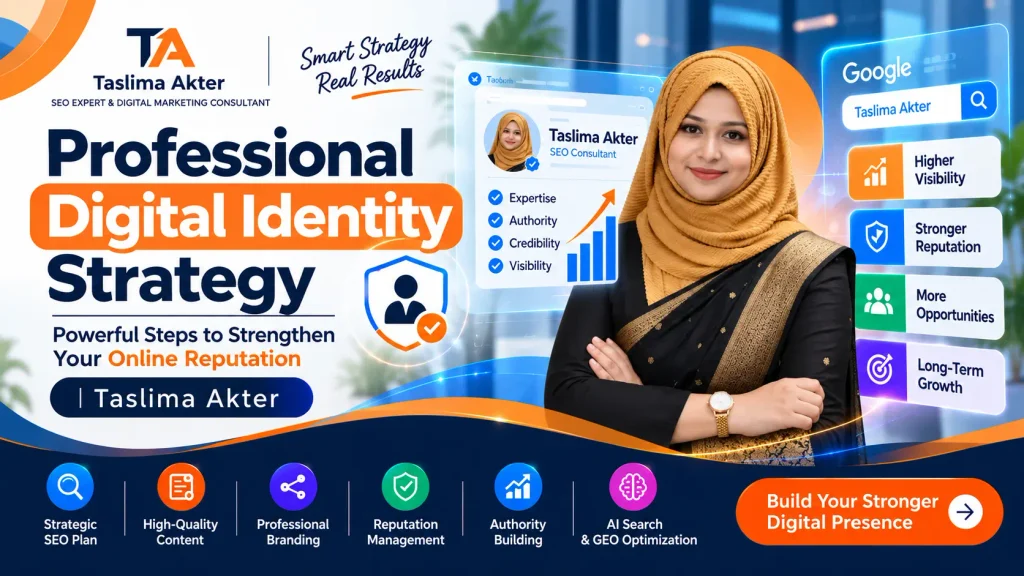
Professional Digital Identity Strategy is no longer simply about having a website, a LinkedIn profile, or a few social media accounts. Today, your professional identity exists across search engines, websites, social platforms, business directories, publications, online communities, and increasingly, AI-powered search experiences. When someone searches your name before contacting you, they may see your professional profile, articles, company information, interviews, social posts, reviews, images, and other digital references. Together, these elements create an impression of who you are and what you represent.
That is why a strong digital identity strategy needs to go beyond visibility. It should create consistency, demonstrate expertise, strengthen credibility, and make accurate professional information easy to discover. Instead of publishing disconnected content across different platforms, professionals can build a structured digital ecosystem where their website, content, profiles, reputation, and authority reinforce one another.
In addition, modern search is changing rapidly. Traditional search engines increasingly work alongside AI-powered discovery systems, conversational search, and generative answers. As a result, professionals need content that is not only optimized for keywords but also clear, contextual, trustworthy, and easy to understand. This is where SEO, semantic search, E-E-A-T, Digital PR, online reputation management, and Generative Engine Optimization become valuable parts of a complete strategy.
In this guide, Taslima Akter explains how professionals can build a stronger and more consistent digital identity through research-driven SEO, authoritative content, strategic positioning, professional profiles, reputation management, digital PR, and AI-search optimization. The goal is not to create artificial popularity. Instead, it is to build a credible online presence that accurately represents professional expertise and becomes more valuable over time.
Why a Professional Digital Identity Matters Today
Your digital identity often becomes part of your professional first impression. Before people speak with you, they may search your name and evaluate the information they find. Consequently, a well-managed digital presence can make professional information easier to understand and verify.
What Is a Professional Digital Identity?
A professional digital identity is the collection of online information, profiles, content, credentials, mentions, and digital assets associated with an individual in a professional context. It includes both assets you control and information published by others.
How Your Online Presence Shapes Professional Perception
People naturally look for signals that help them decide whether someone is relevant and trustworthy. Therefore, inconsistent biographies, incomplete profiles, outdated information, and weak search results can create unnecessary uncertainty.
Why Search Visibility Matters When People Research Your Name
When your professional information is easy to discover and consistent across important sources, visitors can understand your expertise more quickly and make better-informed decisions.
Why Professionals Need a Strong Digital Identity
A professional digital identity can support client acquisition, career development, networking, partnerships, thought leadership, and industry recognition. Moreover, it gives professionals a platform for communicating their expertise directly.
Connecting Expertise With Online Visibility
Your expertise becomes more valuable digitally when people can find useful evidence of it. Articles, case studies, professional profiles, portfolio pages, interviews, and educational resources can all contribute to that visibility.
Turning Professional Information Into a Trust-Building Asset
- Present accurate professional information.
- Demonstrate genuine experience.
- Publish useful and relevant content.
- Maintain consistent professional profiles.
- Build credible external recognition.
What This Professional Digital Identity Strategy Guide Covers
This guide brings several connected disciplines together so that your digital presence can work as one system rather than a collection of unrelated activities.
| Strategy Area | Primary Purpose |
|---|---|
| SEO | Improve search visibility and discoverability |
| Content | Demonstrate knowledge and expertise |
| Digital PR | Expand external recognition and authority |
| Reputation Management | Maintain a trustworthy digital footprint |
| Semantic SEO | Strengthen contextual understanding |
| GEO | Prepare content for AI-powered discovery |
Understanding the Core Elements of a Professional Digital Identity Strategy
A successful Professional Digital Identity Strategy combines several elements. Each one serves a different purpose; however, they become considerably stronger when they support the same professional positioning.
Professional Positioning
Positioning defines how you want people to understand your professional expertise. It answers questions such as what you do, whom you help, which subjects you specialize in, and what type of value you provide.
Defining What You Want to Be Known For
A focused professional identity is generally easier to communicate than a profile that attempts to represent too many unrelated skills.
Creating a Clear and Consistent Professional Message
Use a consistent core message across your website, professional profiles, author information, and relevant publications while adapting the wording naturally for each platform.
Online Visibility
Visibility makes your professional information discoverable. However, the objective is not to appear everywhere. Instead, focus on the search platforms, professional networks, and publications that matter to your audience.
Making Your Professional Information Easier to Discover
Search-friendly pages, useful content, optimized profiles, and relevant external references can make your professional information easier to find.
Connecting Your Name With Relevant Expertise
When your name repeatedly appears in appropriate contexts related to your expertise, visitors can more easily understand your professional specialization.
Digital Reputation
Your reputation includes what people encounter when they research you online. Therefore, reputation management should operate alongside SEO and content rather than as an isolated activity.
Managing How Your Professional Identity Appears Online
- Review branded search results.
- Update outdated professional profiles.
- Correct inaccurate information where possible.
- Maintain consistent professional descriptions.
- Develop stronger authoritative digital assets.
Strengthening Positive and Relevant Search Results
Create useful resources that accurately represent your expertise and professional experience. Over time, these resources can become important parts of your digital footprint.
Digital Authority
Authority develops when your expertise is supported by useful content, professional experience, credible references, and consistent contributions to your field.
Why Online Reputation Should Be Part of Your Digital Identity Strategy
Online reputation can influence professional decisions long before a direct conversation happens. As a result, reputation should be considered during every stage of digital identity development.
How People Evaluate Professionals Online
People may examine search results, websites, social profiles, articles, reviews, interviews, portfolios, and professional credentials. They rarely evaluate only one page.
Search Results, Profiles, Reviews, and Published Content
Each digital touchpoint can answer a different question. Your website may explain your expertise, while LinkedIn may demonstrate your professional history and an interview may provide external validation.
Understanding the First Impression Created by Your Digital Footprint
Review your digital presence as if you were discovering yourself for the first time. Ask whether the information is clear, current, relevant, and consistent.
Building Trust Before Direct Communication
Useful online information can reduce uncertainty. When visitors can understand your experience and expertise before contacting you, the initial conversation can begin with greater context.
Providing Accurate and Useful Professional Information
- Use accurate professional descriptions.
- Show relevant experience.
- Explain your specialization.
- Publish genuinely helpful resources.
- Keep important information updated.
Turning Online Credibility Into Professional Opportunities
A credible digital identity can support inquiries, referrals, partnerships, networking, speaking opportunities, and other professional interactions.
Managing Your Digital Reputation Proactively
Do not wait until a reputation problem appears. Instead, periodically review your digital footprint and strengthen the assets that accurately represent your professional identity.
Auditing Your Current Professional Digital Identity
Before building a new strategy, establish a baseline. A digital identity audit shows what already works, what needs improvement, and where important gaps exist.
Search Your Name and Professional Keywords
Search your full professional name along with important expertise, service, industry, and location-related queries where relevant.
Reviewing Google Search Results
Review the first several pages of relevant results and identify websites, profiles, articles, images, publications, and other references connected with your identity.
Identifying What Potential Clients or Employers See
Look at the results from an outsider’s perspective. Are your expertise, experience, services, and professional identity immediately understandable?
Review Your Existing Digital Profiles
Audit LinkedIn, professional websites, social media accounts, author profiles, business listings, portfolio pages, and other relevant platforms.
LinkedIn, Business Profiles, Social Media, and Author Pages
Compare the core information across these platforms and identify significant inconsistencies.
Checking Consistency Across Professional Platforms
| Audit Area | What to Check |
|---|---|
| Name | Professional spelling and consistency |
| Professional Title | Clear and accurate positioning |
| Biography | Relevant experience and expertise |
| Website | Current professional information |
| Social Profiles | Consistent branding and descriptions |
| External Mentions | Accuracy and relevance |
Identify Digital Identity Gaps
Once the audit is complete, prioritize the most important weaknesses. A missing professional website, unclear positioning, incomplete profiles, or lack of expertise-focused content may represent larger opportunities than minor metadata changes.
Building a Strong Professional Website and Online Presence
A personal website can serve as the central hub of your professional digital identity. Unlike third-party profiles, it gives you greater control over how your expertise, experience, services, and content are presented.
Create a Professional Homepage
Your homepage should communicate your professional identity quickly. Visitors should understand who you are, what you specialize in, and what they can find on the website.
Clearly Explain Who You Are and What You Do
Use a clear headline, concise introduction, relevant expertise, and straightforward navigation. Avoid vague statements that do not communicate professional value.
Communicating Your Expertise Within Seconds
A visitor should not have to search through several pages before understanding the purpose of your website.
Develop a Strong About Page
The About page provides space to explain your background, professional journey, expertise, qualifications, experience, and working approach.
Highlighting Experience, Skills, and Professional Background
Use specific information wherever appropriate. Concrete experience generally communicates credibility more effectively than broad statements about being an expert.
Using Authentic Information to Strengthen Trust
Explain your professional journey honestly and provide context that helps readers understand your experience.
Create Expertise and Service Pages
Separate expertise or service pages can target distinct search intentions while providing deeper information to visitors.
Connecting Professional Skills With Search Intent
Research what your audience wants to understand before deciding which pages deserve separate optimization.
Turning Expertise Into Searchable Digital Assets
- Service pages
- Expertise guides
- Case studies
- Portfolio pages
- Research resources
- Professional FAQs
Optimize Your Website for Search
Technical and on-page SEO help search engines access, interpret, and rank your content appropriately. Optimize important titles, headings, URLs, internal links, images, structured information, and metadata without forcing keywords.
SEO Strategies for Strengthening Your Digital Identity
SEO provides the search foundation for a Professional Digital Identity Strategy. The objective is to help search engines understand your professional identity while helping users discover useful information about your expertise.
Conduct Professional Keyword Research
Keyword research should consider how people search for your name, expertise, services, professional role, location, and industry topics.
Finding Name-Based and Expertise-Based Keywords
Build a keyword universe that includes branded searches as well as non-branded topics related to your actual expertise.
Connecting Keywords With Your Professional Goals
Prioritize terms that support meaningful objectives rather than selecting keywords based only on search volume.
Optimize Your Name for Search Visibility
Your name should appear naturally in relevant locations, including your homepage, About page, author information, professional profiles, and appropriate content.
Creating Relevant Pages Around Your Professional Identity
Create pages that provide genuine value rather than producing multiple thin pages simply because different keyword variations exist.
Establishing Clear Connections Between Your Name and Expertise
Consistently connect your professional identity with relevant areas of expertise through useful and contextually appropriate content.
Build Search-Friendly Content
Content should answer genuine questions and demonstrate knowledge. Use semantic variations such as professional digital presence, online identity, digital reputation, professional visibility, online authority, personal branding, and search visibility naturally where they fit the topic.
Answering Questions Your Target Audience Searches For
- How-to guides
- Industry explanations
- Problem-solving articles
- Comparison guides
- Case studies
- Expert opinions
- Frequently asked questions
Demonstrating Expertise Through Useful Information
Explain the reasoning behind recommendations and include examples where they improve understanding.
Avoid Keyword Cannibalization
Do not create separate pages for every minor variation of the same keyword when the search intent is identical. Instead, consolidate closely related topics into stronger resources and use semantic variations naturally.
Content Strategy for a Stronger Professional Digital Identity
Content gives professionals an opportunity to demonstrate what they know instead of simply claiming expertise. A strong content strategy therefore focuses on depth, usefulness, originality, and search intent.
Create Expertise-Driven Blog Content
Choose topics that connect your professional expertise with questions your audience genuinely wants answered.
Sharing Practical Knowledge and Professional Insights
Explain processes, challenges, decision-making factors, mistakes, and practical lessons instead of publishing generic summaries.
Demonstrating Experience Instead of Making Generic Claims
Where appropriate, use first-hand examples and project-based observations to make your content more useful and credible.
Publish Case Studies and Success Stories
Case studies can demonstrate how a strategy was applied in a real situation. They can also explain the problem, methodology, implementation, challenges, and measurable outcomes where data can legitimately be shared.
Explaining Strategy, Process, and Outcomes
A useful case study should explain what happened rather than simply presenting a positive result.
Using Evidence to Strengthen Professional Credibility
Evidence, where available and appropriate, provides greater context for professional claims and recommendations.
Develop Educational Resources
Guides, tutorials, checklists, frameworks, and explainers can turn professional knowledge into reusable digital assets.
Creating Guides, Tutorials, Checklists, and Explanations
- Beginner guides
- Advanced tutorials
- Practical checklists
- Strategy frameworks
- Industry explainers
Answering Complex Questions in Simple Language
Clear explanations make professional expertise more accessible while also improving the usefulness of your content.
Build Thought Leadership Content
Thought leadership requires more than publishing frequently. It involves contributing meaningful perspectives, analysis, observations, and knowledge to a professional conversation.
Sharing Original Opinions and Industry Analysis
When presenting opinions, explain the reasoning behind them and distinguish professional interpretation from established facts.
Personal Branding and Professional Digital Identity
Personal branding focuses on how you intentionally position and communicate yourself, while digital identity includes the broader collection of information associated with you online.
Define Your Unique Professional Position
Identify the combination of expertise, experience, audience, industry knowledge, and professional perspective that differentiates you.
Identifying Your Expertise and Differentiators
Consider your strongest professional capabilities and the specific problems you are qualified to address.
Communicating Your Value Without Overpromotion
Show value through useful information and evidence rather than relying on repeated promotional claims.
Create Consistent Brand Messaging
Your website, profiles, articles, and professional introductions should communicate a recognizable core identity.
Aligning Your Bio, Website, and Professional Profiles
Adapt the wording to each platform while preserving the core facts about your professional identity.
Maintaining the Same Core Professional Identity
Consistency helps people recognize that different digital profiles and publications represent the same professional individual.
Connect Your Personal Brand With Your Expertise
Use content and professional references to build meaningful connections between your name and your actual areas of knowledge.
Social Media Optimization for Professional Digital Identity
Social platforms can extend professional visibility when they are managed strategically. However, they should support your broader digital identity rather than become the only foundation of it.
Optimize Your LinkedIn Profile
LinkedIn can provide valuable professional context because it allows you to present experience, skills, achievements, interests, and industry knowledge in one place.
Creating a Search-Friendly Professional Headline
Use a clear professional headline that explains your role and specialization naturally rather than filling it with unrelated keywords.
Demonstrating Experience, Expertise, and Achievements
Use the profile to provide evidence of your professional background and areas of expertise.
Improve Professional Social Profiles
Review other relevant professional profiles and maintain accurate information across them.
Maintaining Accurate Names, Bios, and Descriptions
- Use a consistent professional name.
- Keep biographies current.
- Explain your expertise clearly.
- Link to authoritative professional assets where appropriate.
- Remove or update outdated information.
Creating Consistent Digital Brand Signals
Consistent information can make it easier for people and search systems to connect your professional profiles.
Use Social Content to Support Authority
Share useful professional insights rather than relying only on promotional updates. Furthermore, repurpose valuable website content into appropriate social formats to extend its reach.
Digital PR and Authority Building for Professionals
Digital PR can help professionals build visibility beyond their own websites and social accounts. It focuses on earning attention, mentions, references, and opportunities through relevant external platforms.
What Is Digital PR?
Digital PR connects professional expertise with publications, journalists, podcasts, interviews, online resources, and other relevant media opportunities.
Connecting Professionals With Relevant Publications
Look for publications where your expertise can genuinely contribute to the audience rather than pursuing exposure simply for the sake of visibility.
Using Publicity to Expand Digital Visibility
Relevant external exposure can introduce your expertise to new audiences and create additional professional references.
Build High-Quality Professional Mentions
- Expert interviews
- Industry articles
- Podcast appearances
- Expert commentary
- Professional publications
- Original research contributions
Interviews, Podcasts, Articles, and Expert Contributions
Choose opportunities that align naturally with your specialization and professional audience.
Prioritizing Relevant and Credible Platforms
A relevant mention from a credible source can be more valuable than a large number of unrelated references.
Use Digital PR to Strengthen Search Authority
External references can support your broader authority strategy when they are editorially relevant and genuinely earned.
Building Professional Authority Through Link Building
Link building can support professional authority when links are relevant, legitimate, and useful to visitors. Therefore, focus on earning meaningful references rather than collecting links indiscriminately.
Why Relevant Backlinks Matter
A contextual backlink can connect your professional website with a relevant industry, subject, publication, or professional community.
Understanding Links as Part of a Broader Authority Strategy
Backlinks are only one part of authority. Strong content, expertise, reputation, technical quality, and user value also matter.
Prioritizing Relevance Over Link Quantity
Prioritize websites and pages where a reference to your work makes logical sense.
Original Research, Data, Guides, and Expert Insights
- Original research
- Industry analysis
- Unique case studies
- Detailed professional guides
- Useful statistics and datasets
- Expert frameworks
Giving Other Websites a Reason to Reference Your Work
Create resources that solve a genuine information gap. When your content adds something useful, relevant websites have a stronger reason to reference it.
Avoid Low-Quality Link Building
Avoid irrelevant link schemes, excessive repetition, and tactics designed only to manipulate search rankings. Instead, build authority through useful content, professional relationships, and legitimate editorial opportunities.
Semantic SEO and Entity Optimization for Digital Identity
As Professional Digital Identity Strategy, Semantic SEO helps search systems understand subjects through context, concepts, entities, and relationships rather than relying only on exact keyword repetition.
Understanding Semantic SEO
Semantic optimization means covering a subject comprehensively and using related concepts naturally. Consequently, your content can communicate a clearer topical relationship between your name and expertise.
Moving Beyond Exact-Match Keywords
Use relevant terms such as digital identity, professional reputation, online authority, personal branding, professional visibility, digital presence, search visibility, and thought leadership when they genuinely fit the discussion.
Creating Context Around Your Professional Expertise
Explain your expertise through related topics, processes, problems, examples, services, and professional experiences.
Establishing Your Professional Entity
Your name functions as an important identity reference across your digital presence. Therefore, accurate and consistent information can help establish clearer connections between your identity and professional activities.
Connecting Your Name With Your Expertise
Use author information, biographies, professional profiles, relevant articles, and other appropriate sources to establish meaningful context.
Maintaining Consistent Entity Information Across the Web
Keep important professional facts accurate and reasonably consistent across major digital assets.
Strengthening Topic Relationships
Connect related content through strategic internal linking and clear information architecture. This helps visitors discover additional resources while also clarifying the relationship between topics.
E-E-A-T and Professional Credibility
E-E-A-T—Experience, Expertise, Authoritativeness, and Trust—provides a useful framework for thinking about professional credibility. It should be demonstrated through evidence and quality rather than treated as a checklist of claims.
Demonstrating Experience
Experience becomes visible when you share practical knowledge based on work you have genuinely performed or situations you have directly encountered.
Showing Real Projects and Professional Knowledge
Where confidentiality allows, discuss project processes, lessons, challenges, and decisions.
Turning Experience Into Evidence
Rather than simply saying you have experience, demonstrate how that experience influences your recommendations and methods.
Demonstrating Expertise
Expertise can be demonstrated through accurate educational content, detailed guides, professional analysis, case studies, and consistent contributions to a defined field.
Publishing Accurate and Useful Information
Prioritize accuracy and usefulness over publishing volume. Moreover, review important content regularly when the subject changes over time.
Building Knowledge Around a Defined Subject Area
Focused topical coverage makes your professional specialization easier to understand.
Strengthening Authoritativeness
External recognition can complement the expertise demonstrated on your own website. Relevant publications, professional organizations, interviews, and industry references can contribute to this broader picture.
Earning Relevant Mentions and Professional Recognition
Focus on recognition that genuinely reflects your expertise rather than attempting to manufacture authority.
Developing Authority Through Consistent Contributions
Authority usually develops gradually through repeated evidence of knowledge, useful work, and credible professional participation.
Improving Trust
Trust depends on accuracy, transparency, consistency, and responsible communication.
- Keep professional information current.
- Clearly distinguish facts from opinions.
- Avoid unsupported claims.
- Provide context for professional achievements.
- Make important information easy to verify.
AI Search and GEO for Professional Digital Identity
Search is becoming increasingly conversational and AI-assisted. Therefore, professionals should consider how their information can remain clear and useful when users discover answers through generative search systems as well as traditional search engines.
Understanding Generative Engine Optimization
Generative Engine Optimization, or GEO, focuses on improving the clarity, context, usefulness, and accessibility of information for AI-powered search and answer experiences.
How AI-Powered Search Is Changing Online Discovery
People may increasingly ask conversational questions instead of entering short keyword phrases. This makes clear explanations, direct answers, strong context, and trustworthy information more important.
Preparing Professional Content for AI Search
- Answer important questions directly.
- Use clear definitions.
- Provide relevant context.
- Demonstrate genuine expertise.
- Keep professional information consistent.
- Support important claims with credible evidence where appropriate.
Make Your Expertise Easy to Understand
AI systems and human readers both benefit from clear information. Explain your professional role, specialization, services, experience, and areas of knowledge without unnecessary ambiguity.
Using Clear Definitions and Context
Define specialized terms and explain how concepts relate to your professional work.
Helping Search Systems Connect Your Name With Your Expertise
Maintain consistent information across your website, author pages, professional profiles, publications, and relevant external references.
Create AI-Friendly Professional Content
Answering Important Questions Directly
Begin important sections with concise answers and then add supporting explanation. This structure improves readability for both users and systems that process information.
Combining Structured Information With Human Expertise
AI tools can assist with research, organization, and content workflows, but professional judgment, originality, fact-checking, and genuine experience remain essential.
Managing Online Reputation and Search Results
As Professional Digital Identity Strategy, Reputation management should be continuous because your digital footprint changes whenever new content, profiles, mentions, or professional information appears online.
Monitor Your Branded Search Results
Periodically search your name and important professional terms. Record meaningful changes and identify opportunities to improve the quality of your visible information.
Checking Your Name Regularly
Review search results, images, profiles, articles, and other relevant references.
Identifying Reputation Opportunities and Risks
Look for outdated profiles, incomplete professional information, inconsistent descriptions, and opportunities to create stronger authoritative resources.
Build Positive Search Assets
Develop useful assets that accurately represent your professional identity.
- Personal website
- Professional biography
- Expertise pages
- Case studies
- Educational content
- Professional profiles
- Relevant external publications
Creating Authoritative Websites and Professional Profiles
Focus on information that is accurate, useful, relevant, and genuinely representative of your professional experience.
Increasing Visibility for Relevant Information
The objective is to make accurate professional information easier to discover rather than attempting to manipulate search results.
Handle Outdated or Inaccurate Information
Where possible, update your own profiles and request corrections from platforms that control inaccurate information. In addition, strengthen current authoritative assets so visitors have access to better information.
Local SEO and Professional Digital Identity
For professionals targeting a specific market, local relevance can strengthen discoverability. This is especially useful when your services, professional network, or audience are connected to a particular city, country, or region.
Why Local Relevance Matters
Searchers often add location information when looking for services or professionals. Therefore, appropriate location context can help connect your expertise with relevant audiences.
Connecting Your Expertise With Local Search Demand
Research local questions, industry terminology, audience needs, and professional contexts that genuinely relate to your work.
Building Visibility Within Your Target Market
Use location information naturally where it improves relevance. Avoid inserting the same location phrase repeatedly into every page.
Optimize Location-Relevant Professional Information
Using Relevant Location and Service Context
Where appropriate, explain the markets you serve, professional communities you participate in, and location-specific expertise you possess.
Avoiding Unnecessary Location Keyword Repetition
Local SEO should improve relevance rather than make professional content difficult to read.
Build Local Professional Authority
Relevant local publications, professional organizations, events, industry communities, and credible references can strengthen recognition within a target market.
Measuring the Success of Your Professional Digital Identity Strategy
A digital identity strategy should be measured using several signals rather than one ranking position. Visibility matters, but meaningful professional outcomes matter as well.
| Metric | What It Helps You Understand |
|---|---|
| Branded Search Impressions | How often your name appears in search |
| Organic Clicks | Search-driven visits to your content |
| Website Engagement | How visitors interact with your resources |
| Brand Mentions | External recognition and references |
| Content Performance | Which topics attract relevant audiences |
| Leads and Inquiries | Professional opportunities generated |
Track Branded Search Visibility
Monitor how often your name and relevant professional terms appear in search. Changes in branded visibility can provide useful insight into recognition and discoverability.
Monitoring Searches for Your Name
Review impressions, clicks, ranking queries, and pages associated with your professional identity.
Understanding Changes in Professional Discoverability
Compare performance over meaningful time periods and consider multiple factors before drawing conclusions.
Measure Organic Search Performance
Analyze organic impressions, clicks, rankings, traffic, engagement, and conversions where appropriate.
Tracking Impressions, Clicks, Rankings, and Traffic
These metrics can reveal which pages and topics are gaining visibility and which require further optimization.
Identifying Which Content Performs Best
Use performance data to prioritize updates and future content instead of publishing randomly.
Monitor Engagement and Professional Opportunities
Traffic is useful, but the quality of the audience matters. Track meaningful inquiries, consultations, referrals, partnerships, speaking opportunities, and other relevant outcomes.
Leads, Inquiries, Partnerships, and Networking
Where possible, connect digital activity with measurable professional outcomes.
Connecting Visibility With Meaningful Outcomes
The best strategy is not necessarily the one that generates the most visitors. It is the one that attracts the right audience and supports meaningful professional objectives.
Evaluate Reputation and Authority Growth
Track relevant mentions, external references, media exposure, professional recognition, and improvements in the quality of your branded search results.
Common Professional Digital Identity Mistakes to Avoid
A strong digital identity can be weakened by inconsistent information, poor content decisions, and short-term SEO tactics. Therefore, avoid these common mistakes.
- Using inconsistent professional information: Keep important identity details accurate and aligned.
- Publishing generic content: Add genuine expertise, examples, and useful context.
- Targeting too many unrelated topics: Build authority around relevant professional subjects.
- Ignoring search intent: Match content with what users actually want.
- Neglecting technical SEO: Make important pages accessible and understandable.
- Relying only on social media: Build owned digital assets such as a professional website.
- Building irrelevant backlinks: Prioritize relevance and legitimate editorial references.
- Ignoring reputation management: Regularly review how your professional identity appears online.
- Making unsupported claims: Use evidence and transparent professional information.
- Measuring only rankings: Consider visibility, engagement, authority, and professional outcomes together.
Professional Digital Identity Strategy for Different Audiences
The exact strategy should change according to professional goals. A consultant, freelancer, entrepreneur, and executive may all need different digital assets and content priorities.
Strategy for Consultants
Consultants can focus on expertise pages, case studies, educational resources, industry analysis, and problem-solving content.
Demonstrating Specialized Knowledge
Build content around the problems your target clients actually face.
Turning Expertise Into Client-Focused Search Visibility
Connect educational content with relevant service and professional information without making every article promotional.
Strategy for Freelancers
Freelancers can use portfolio pages, project examples, service pages, testimonials where appropriate, and educational content to demonstrate capabilities.
Showcasing Skills, Portfolio, and Experience
Show practical evidence of your skills rather than relying only on a list of services.
Attracting Relevant Opportunities Through Search
Focus on search topics that match the services and projects you genuinely want to attract.
Strategy for Entrepreneurs
Entrepreneurs can connect founder visibility with business authority by sharing industry knowledge, leadership insights, and relevant professional experiences.
Connecting Founder Authority With Business Visibility
A founder’s professional identity can complement company-level branding when both communicate consistent and accurate information.
Building Trust Around the Person Behind the Business
Useful founder content can help audiences understand the knowledge and experience behind a company.
Strategy for Executives
Executives can develop professional authority through interviews, thought leadership, industry commentary, speaking opportunities, and carefully managed professional profiles.
Developing Thought Leadership and Industry Visibility
Focus on meaningful industry perspectives rather than excessive self-promotion.
Creating a Strong Executive Digital Footprint
Keep professional biographies, publications, interviews, and profiles accurate and aligned with current responsibilities.
Strategy for Industry Experts
Industry specialists can focus on deep educational content, original research, analysis, professional publications, and expert commentary.
Publishing Knowledge-Based Content
Build a library of resources around a clearly defined subject area.
Becoming More Discoverable Within a Specialized Field
Consistent topical coverage can make your professional specialization easier for audiences to recognize.
Step-by-Step Professional Digital Identity Strategy
A practical roadmap helps transform digital identity work from scattered activities into a structured process. The following sequence can provide a strong foundation.
| Step | Action |
|---|---|
| 1 | Define professional positioning |
| 2 | Identify core expertise |
| 3 | Audit the existing digital footprint |
| 4 | Research professional keywords |
| 5 | Analyze search intent and competitors |
| 6 | Optimize the personal website |
| 7 | Strengthen professional profiles |
| 8 | Create expertise-driven content |
| 9 | Build topical authority |
| 10 | Develop Digital PR opportunities |
| 11 | Optimize for AI search and GEO |
| 12 | Monitor reputation and performance |
| 13 | Refine and scale the strategy |
Step 1: Define Your Professional Positioning
Determine what you want your professional identity to represent and which audience you want to reach.
Step 2: Identify Your Core Expertise
Choose the subjects that genuinely reflect your experience, knowledge, and professional capabilities.
Step 3: Audit the Existing Digital Footprint
Search your name, review important profiles, examine existing content, and identify reputation or visibility gaps.
Step 4: Research Professional Keywords
Identify branded, expertise-based, service-based, question-based, and location-relevant searches.
Step 5: Analyze Search Intent and Competitors
Study what searchers expect and examine how authoritative professionals and websites address those needs.
Step 6: Optimize the Personal Website
Improve the homepage, About page, expertise pages, service pages, content structure, internal links, metadata, and technical foundations.
Step 7: Strengthen Professional Profiles
Update LinkedIn and other relevant profiles so they communicate consistent and accurate professional information.
Step 8: Create Expertise-Driven Content
Publish resources that answer genuine questions and demonstrate professional knowledge.
Step 9: Build Topical Authority
Connect pillar resources with supporting articles and cover important search intents without creating unnecessary duplicate pages.
Step 10: Strengthen Digital PR and External Recognition
Seek relevant interviews, publications, expert contributions, podcasts, and other legitimate opportunities to expand authority.
Step 11: Optimize for AI Search and GEO
Make important information clear, contextual, structured, useful, and supported by genuine expertise.
Step 12: Monitor Reputation and Search Visibility
Review branded searches, content performance, professional mentions, and important profile information regularly.
Step 13: Measure Results and Improve the Strategy
Use performance data to identify what should be updated, expanded, consolidated, or deprioritized.
How These Steps Work Together
Positioning guides keyword research, keyword research informs content, content demonstrates expertise, Digital PR expands external recognition, and measurement helps refine the next stage.
Turning Professional Expertise Into a Long-Term Digital Asset
When your professional knowledge is consistently documented, optimized, connected, and maintained, it can become a durable digital asset that supports your reputation and discoverability over time.
How Taslima Akter Can Help Strengthen Your Professional Digital Identity
Taslima Akter approaches professional digital identity through research, SEO, content strategy, semantic optimization, authority building, Digital PR, reputation management, and modern AI-search considerations. The objective is to connect professional expertise with genuine audience needs and measurable search opportunities.
Research-Driven Digital Identity Strategy
A strong strategy begins with understanding the professional, target audience, market, existing digital footprint, search landscape, and competitive environment.
Understanding Your Expertise, Audience, and Search Landscape
This research helps identify which topics, keywords, content formats, and digital assets deserve priority.
Building a Strategy Around Real Search Opportunities
Instead of creating content simply to increase publishing volume, the strategy focuses on valuable and relevant opportunities.
SEO and Content Strategy
SEO and content work together to make professional expertise more discoverable while providing useful information to the audience.
Connecting Search Visibility With Professional Authority
Content can target relevant search intent while simultaneously demonstrating knowledge and professional experience.
Creating Useful Content That Supports Long-Term Growth
The focus remains on useful, original, readable, and strategically connected resources.
Reputation and Digital Authority Building
A stronger professional presence requires more than rankings. It also requires accurate information, credible references, professional consistency, and a clear demonstration of expertise.
Strengthening Your Professional Presence Across Digital Channels
Important professional assets can be coordinated so that they communicate a consistent identity.
Creating Consistent and Credible Brand Signals
Consistency across websites, profiles, content, publications, and professional references can create a clearer digital footprint.
AI Search and GEO Strategy
As search evolves, professional content should remain understandable in both traditional and AI-assisted discovery environments.
Preparing Your Professional Content for Modern Search
Clear answers, useful context, consistent entity information, and evidence-based expertise can improve the overall quality of your digital presence.
Improving Context, Clarity, and Entity Recognition
The goal is to make your professional identity easier for both people and modern search systems to understand.
Frequently Asked Questions About Professional Digital Identity Strategy
1. What Is a Professional Digital Identity Strategy?
A Professional Digital Identity Strategy is a structured approach to improving how your professional identity is presented, discovered, understood, and evaluated online. It can combine SEO, content, professional profiles, reputation management, Digital PR, authority building, and AI-search optimization.
2. Why Is a Professional Digital Identity Important?
People often research professionals online before making decisions. A clear digital identity helps them understand your expertise, experience, professional role, and credibility more easily.
3. How Can I Improve My Professional Online Reputation?
Start by auditing your branded search results and professional profiles. Then update inaccurate information, create authoritative content, strengthen professional profiles, and build relevant external recognition.
4. How Can SEO Strengthen My Digital Identity?
SEO can make relevant professional information easier to discover through search. Keyword research, search-intent analysis, technical optimization, content, internal linking, and authority building can all contribute to stronger visibility.
5. How Long Does It Take to Build a Strong Digital Identity?
There is no universal timeframe. Progress depends on your existing digital footprint, competition, content quality, authority, consistency, search demand, and the depth of the strategy.
6. Can Social Media Improve Professional Visibility?
Yes. Professional social profiles can improve discoverability, networking, and content distribution. However, they should complement owned digital assets such as a professional website.
7. What Role Does Content Play in Digital Identity?
Content provides an opportunity to demonstrate knowledge and experience. Helpful articles, guides, case studies, research, and expert analysis can strengthen topical relevance and professional credibility.
8. How Does GEO Help Professional Digital Visibility?
GEO focuses on making professional information clear, contextual, useful, and easier for AI-powered search experiences to interpret. It complements traditional SEO rather than replacing it.
9. How Can I Build Professional Authority Online?
Build authority by demonstrating genuine expertise through useful content, relevant professional contributions, case studies, credible mentions, Digital PR, and consistent professional information.
10. How Can Taslima Akter Help With My Digital Identity Strategy?
Taslima Akter can develop a research-driven strategy covering SEO, keyword research, content, semantic SEO, topical authority, Digital PR, online reputation, professional visibility, and AI-search considerations according to the professional’s goals and audience.
Conclusion: Strengthen Your Online Reputation With a Strategic Digital Identity
A strong professional digital identity does not happen because of one profile, one article, or one SEO campaign. Instead, it develops through the consistent combination of positioning, search visibility, useful content, professional profiles, digital authority, reputation management, and external recognition.
The most effective Professional Digital Identity Strategy begins with clarity. First, define what you want to be known for. Then, understand your audience, research search demand, audit your existing digital footprint, and build the right digital assets around your expertise.
With a consistent approach, your digital footprint can become a long-term professional asset. It can help people discover your expertise, understand your experience, evaluate your credibility, and decide whether your professional services or knowledge are relevant to their needs.
For professionals who want to strengthen this process strategically, Taslima Akter focuses on connecting SEO, content, authority, reputation, and modern search optimization into a practical digital growth framework.
Final CTA: Build a Stronger Professional Digital Identity With Taslima Akter
Your expertise deserves a digital presence that communicates it clearly. If your current online identity does not fully reflect your professional experience, authority, and goals, now is the right time to build a more strategic foundation.
Taslima Akter can help you develop a customized strategy designed around your professional positioning, target audience, search opportunities, content needs, online reputation, and long-term visibility goals.
- Strengthen your professional search visibility.
- Build a clearer digital identity.
- Improve your online reputation.
- Develop expertise-driven content.
- Build topical and digital authority.
- Strengthen professional profiles.
- Explore relevant Digital PR opportunities.
- Prepare your content for AI-powered search and GEO.
Start building a stronger, more credible, and more discoverable professional digital presence with Taslima Akter.